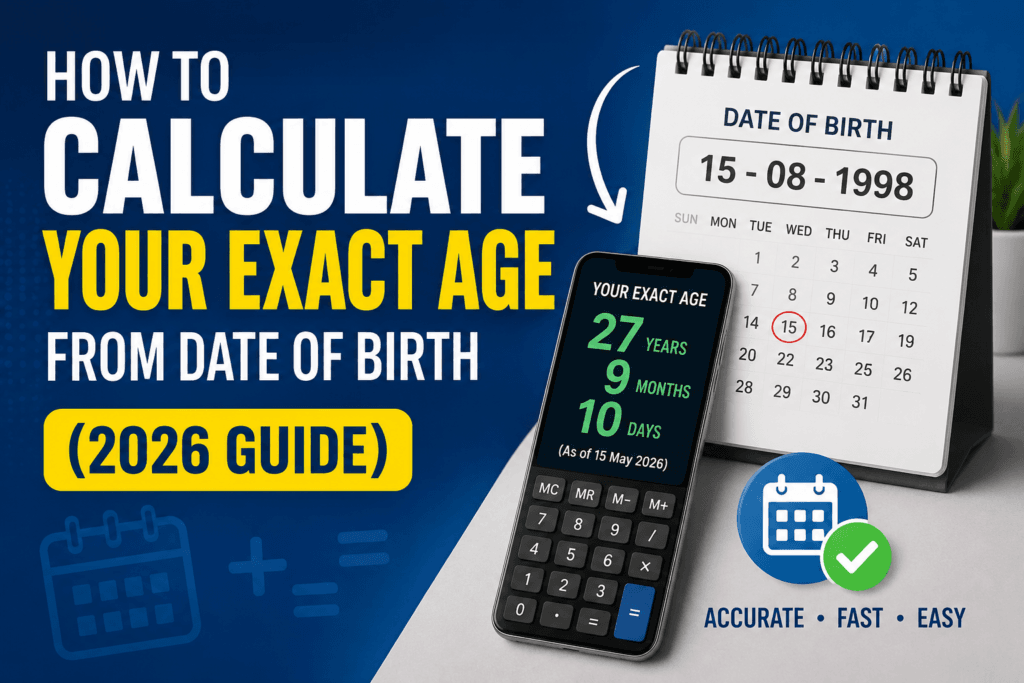
How to Calculate Your Exact Age from Date of Birth (2026 Guide)
A complete, step-by-step walkthrough for working out your precise age in years, months, and days — by hand or instantly with a free online calculator — including leap-year rules and the mistakes almost everyone makes.
To calculate your exact age, subtract your birth year from the current year. Then compare the current month and day to your birth month and day. If your birthday hasn’t happened yet this calendar year, subtract one more year and “borrow” the difference as extra months and days. The result is your exact age expressed as years, months, and days — for an instant, error-free result, use the free Toolriz Age Calculator.
Why Your Exact Age Matters More Than You Think
Most people only think about age in round numbers — “I’m 32” or “I just turned 40.” But a surprising number of everyday and official situations require your exact age, down to the month or even the day. A passport renewal form might ask for your age as of the application date. A school district might use a specific cutoff date to decide which grade your child enters. An insurance underwriter might price a policy differently depending on whether you are 39 years and 11 months old or a full 40.
Knowing how to calculate exact age correctly also helps you understand why a calculator gives the answer it does, instead of just trusting a black box. That matters when you’re filling out a legal document, double-checking a number on a government form, or simply settling a friendly debate about who is “technically” older between two people born in the same year.
This guide breaks the process down completely: the manual calendar method with full worked examples, the leap-year exceptions that trip people up, how to convert your age into weeks, days, or hours, and when it’s worth letting a tool do the heavy lifting for you.
Understanding the Basics: How Calendars Define “Age”
In the United States and almost everywhere else that uses the Gregorian calendar, age is measured in completed years since the date of birth. You don’t become “32” the moment you’re born in a given year — you become 32 the instant your birthday begins, 32 full years after your birth date. Up until that moment, you’re still 31.
This sounds obvious, but it’s the foundation of every calculation in this guide. There are three components to track:
- Years — the number of full birthday anniversaries you’ve completed.
- Months — the number of full calendar months since your most recent birthday.
- Days — the number of days since your most recent monthly anniversary of your birth date.
Because calendar months don’t all have the same number of days (28 to 31), and because every fourth year adds an extra day in February, age calculation isn’t a simple subtraction — it requires a small set of rules for “borrowing” across months and years, similar to borrowing in long subtraction. The next section walks through exactly how that works.
The Manual Method: Calculating Exact Age Step by Step
Here is the full method broken into five steps. It works for any two dates — your date of birth and any reference date, whether that’s today, a future date on a form, or a past date for historical records.
Years = CurrentYear − BirthYear
Months = CurrentMonth − BirthMonth
Days = CurrentDay − BirthDay
// Adjustment rules
IF Days < 0 → borrow days from the previous month, subtract 1 from Months
IF Months < 0 → borrow 12 months, subtract 1 from Years
Step 1 — Write down both dates clearly
Identify your date of birth and the reference date (usually today) in day, month, year form. Keep the three components separate so you can subtract each one individually.
Step 2 — Subtract the years
Subtract the birth year from the current year. This gives you a starting point, but it may be one year too high if your birthday hasn’t occurred yet this calendar year — that gets corrected in later steps.
Step 3 — Subtract the months
Subtract the birth month from the current month. If the result is negative — meaning your birth month hasn’t been reached yet this year — add 12 to fix it, and subtract one full year from the year total you calculated in Step 2.
Step 4 — Subtract the days
Subtract the birth day-of-month from the current day-of-month. If the result is negative, you’ll need to “borrow” days from the previous month relative to the current date, and subtract one from the month total.
Step 5 — Borrow correctly when a value goes negative
This is the step that causes the most confusion. When days go negative, take the number of days in the month immediately before the current month, add it to your negative day figure, and reduce the month count by one. When months go negative, add 12 and reduce the year count by one. The two worked examples below show this in full detail.
Tip
Always do the day-borrowing step using the month before the current date, not the birth month. This is the single most common source of manual calculation errors.
Worked Example 1: A Straightforward Case
Date of birth: March 15, 1990 | Reference date: June 24, 2026
| Component | Calculation | Result |
|---|---|---|
| Years | 2026 − 1990 | 36 |
| Months | 6 (June) − 3 (March) | 3 |
| Days | 24 − 15 | 9 |
Because both the current month (June) and current day (24) are later than the birth month and day (March 15), no borrowing is required at all — it’s a clean subtraction across all three components.
Worked Example 2: When Borrowing Is Required
Date of birth: August 30, 1995 | Reference date: June 24, 2026
| Component | Calculation | Result |
|---|---|---|
| Initial Days | 24 − 30 | −6 (borrow needed) |
| Borrowed Days | 24 + 31 (days in May) − 30 | 25 |
| Initial Months | (6 − 1 borrowed) − 8 | −3 (borrow needed) |
| Borrowed Months | 5 + 12 − 8 | 9 |
| Initial Years | 2026 − 1995 | 31 |
| Borrowed Years | 31 − 1 | 30 |
Here, the current day (24) is smaller than the birth day (30), so we borrow the number of days in the month before the current month — May, which has 31 days — and reduce the running month count by one before continuing. That knocks the month subtraction negative too, so we borrow 12 months and reduce the year count by one. The final, corrected result is 30 years, 9 months, and 25 days — not the “31 years” you’d get from a naive year-only subtraction.
Converting Your Age Into Other Units
Years, months, and days aren’t the only way to express age. Some forms, especially medical, immigration, or insurance paperwork, ask for age in months alone (common for infants) or in total days. Here’s how each unit is approximated, along with why exact totals require care.
Total months and total hours are simple multiplications once you know the years/months/days breakdown. Total days is the tricky one — it requires counting the exact number of days in every single month you’ve lived through, including any February 29 leap days along the way. Get this wrong by even one leap year and your total day count will be off by a full day or more.
Why manual day-counting is risky
Doing this by hand means tracking dozens of variable-length months across potentially several decades. A single missed leap year throws off every figure that follows. For an exact day, week, or hour count, it’s far safer to let a calculator do it — try the Toolriz Age Calculator for an instant, precise breakdown.
Common Mistakes People Make When Calculating Age
Subtracting only the years. “2026 minus 1995 equals 31” ignores whether the birthday has actually occurred yet this year. If it hasn’t, the true completed age is still 30, not 31.
Borrowing the wrong month’s day count. When days go negative, you must use the number of days in the month immediately before the current date — not the birth month, and not a flat assumption of 30 days.
Forgetting leap years entirely. Treating every February as 28 days will under- or over-count total days for anyone whose date range includes a February 29.
Mixing up date formats. The U.S. format (month/day/year) and the international format (day/month/year) are easy to confuse. 04/06/2026 means April 6 in the U.S. but June 4 almost everywhere else — a mix-up that silently produces a wrong age.
Assuming all months have 30 days. Several rounding shortcuts assume a flat 30-day month, which works for rough estimates but produces noticeably wrong totals over many years.
Leap Years and February 29 Birthdays: Special Rules
A leap year adds an extra day, February 29, roughly every four years, to keep the calendar aligned with Earth’s orbit. For most people, this only affects total day-count math — it doesn’t change your age in completed years, since your birthday still falls on a normal date every year.
For the relatively small number of people actually born on February 29 — sometimes called “leaplings” — things are slightly different. In any year that isn’t a leap year, February only has 28 days, so there’s technically no February 29 to celebrate. Most calendars, government systems, and software default to treating March 1 as the legal equivalent birthday in non-leap years, though a few jurisdictions and personal traditions use February 28 instead. Either convention still results in the person turning exactly one year older — the date used for the celebration doesn’t change the underlying math.
Rule of thumb for leap year ranges
When manually counting total days across a date range, count every leap year individually rather than using an average. A year is a leap year if it’s divisible by 4, except for century years, which must be divisible by 400 (so 2000 was a leap year, but 1900 was not).
Why Online Age Calculators Are More Reliable
The manual method above is reliable as long as every step, especially the borrowing logic and leap-year counting, is done correctly. In practice, that’s exactly where most hand calculations go wrong, particularly when someone needs a total day or week count spanning several decades.
An online calculator automates the entire process: it applies the year/month/day subtraction rules, accounts for every leap year in the range automatically, and can instantly convert the result into months, weeks, days, or hours without any risk of a borrowing mistake.
Skip the manual math
Enter your date of birth once and get your exact age in years, months, days, weeks, and hours — instantly and free.
Real-World Situations Where Exact Age Matters
Exact age calculation isn’t just an academic exercise. Here are common U.S. situations where the precise figure, not just a rounded number, genuinely matters:
| Situation | Why exact age matters |
|---|---|
| School enrollment | Many U.S. school districts use a specific age-by-date cutoff (such as a child’s age as of September 1) to determine grade placement. |
| Driver’s license eligibility | Minimum driving age varies by state and is checked against the exact birth date, not just the birth year. |
| Voting eligibility | U.S. citizens must reach the eligible voting age by election day, which depends on the exact date relative to the election. |
| Social Security retirement | The Social Security Administration calculates full retirement age based on birth year, and exact age affects benefit calculations at the time of filing. |
| Visa and immigration forms | Many forms require an applicant’s exact age as of the filing or interview date, calculated to the day. |
| Insurance underwriting | Premiums are frequently tiered by age band, and being a day into a new age bracket can change the calculated rate. |
| Age-restricted purchases | Retailers verifying eligibility for age-restricted products must confirm the buyer has reached the required age as of that exact day. |
Specific cutoff rules vary by state, agency, and institution — always confirm the exact requirement with the relevant authority for anything official.
Other Free Online Tools You Might Need
Age calculation is often just one step in a bigger task — converting dates, checking due dates, or working out time differences. Toolriz hosts a full library of free, no-signup calculators for exactly these situations.
Browse the full tool library
Date calculators, unit converters, financial tools, and more — all free, fast, and ad-light.
Frequently Asked Questions
How do you calculate age from a date of birth manually?
Subtract the birth year from the current year, then compare months and days. If the current month and day haven’t reached the birth month and day yet, subtract one year from the total and borrow the remainder as months and days, following the step-by-step method earlier in this guide.
What is the formula for calculating exact age?
Exact age equals (Current Year − Birth Year) years, (Current Month − Birth Month) months, and (Current Day − Birth Day) days, with borrowing applied whenever any value comes out negative, so the final figure is always positive and accurate.
How many days old am I today?
You’d need to count every day between your birth date and today, including all leap years in that span. Because leap years occur irregularly, this is hard to do precisely by hand — the Toolriz Age Calculator gives an exact total instantly.
Does the day you were born count as day one?
Your date of birth is the starting point (day zero), and you complete one full day of life at the end of that same calendar day. Your age in completed years only increases on each anniversary of that exact date.
How does a leap year affect age calculation?
A leap year adds one extra day, February 29, to the calendar. It affects total day-count math and the month-length figures used in manual borrowing, but it doesn’t change your age in completed years unless your own birthday falls on February 29.
What happens if I was born on February 29?
In years that aren’t leap years, February only has 28 days, so most calendars and official systems treat March 1 as the equivalent birthday, though some use February 28 instead. Either way, you still turn exactly one year older on that date.
How is age calculated for legal purposes in the United States?
U.S. legal age generally uses completed years from the date of birth, with the new age applying from the start of the birthday. Specific programs, such as school enrollment, driving eligibility, or retirement benefits, may apply their own defined cutoff dates rather than the exact birthday, so it’s worth checking the specific agency’s rule.
Can the method for calculating age differ by country?
The completed-years method described in this guide, based on the Gregorian calendar, is the standard in the United States and globally today. A few cultures have historical alternative age-counting traditions, but the Gregorian completed-years method is the universally recognized legal and administrative standard.
How accurate are online age calculators?
A properly built calculator is fully accurate because it automatically applies every calendar rule, including variable month lengths and leap years, eliminating the manual borrowing mistakes that commonly occur in hand calculations.
How do I calculate someone else’s age for a form, job application, or visa document?
Use their date of birth along with the specific reference date the form requires, often the submission date or an official cutoff, then apply the same year-month-day subtraction method described above. For official paperwork, using a calculator helps avoid rounding or borrowing errors.
Final Thoughts
Calculating your exact age comes down to one core idea: completed years since your birth date, adjusted with careful borrowing whenever the month or day comparison goes negative. Once you understand the borrowing logic, you can work out anyone’s exact age by hand with confidence — but for anything official, or for totals in days, weeks, or hours, an automated tool removes all risk of a small but consequential mistake.
Whenever you need a fast, dependable answer, the free Toolriz Age Calculator handles the entire calculation for you in seconds, and the broader Toolriz Online Tools library covers dozens of other everyday calculations.
References & Further Reading
- Gregorian calendar leap year rule: a year is a leap year if divisible by 4, except century years, which must be divisible by 400.
- U.S. Social Security Administration — full retirement age guidance, based on birth year.
- State-level departments of motor vehicles — minimum driving age requirements (vary by state).
- Toolriz Age Calculator — for instant, automated exact age results.
- Toolriz Online Tools — full library of free calculators.