
Soap Making · Ingredient Science
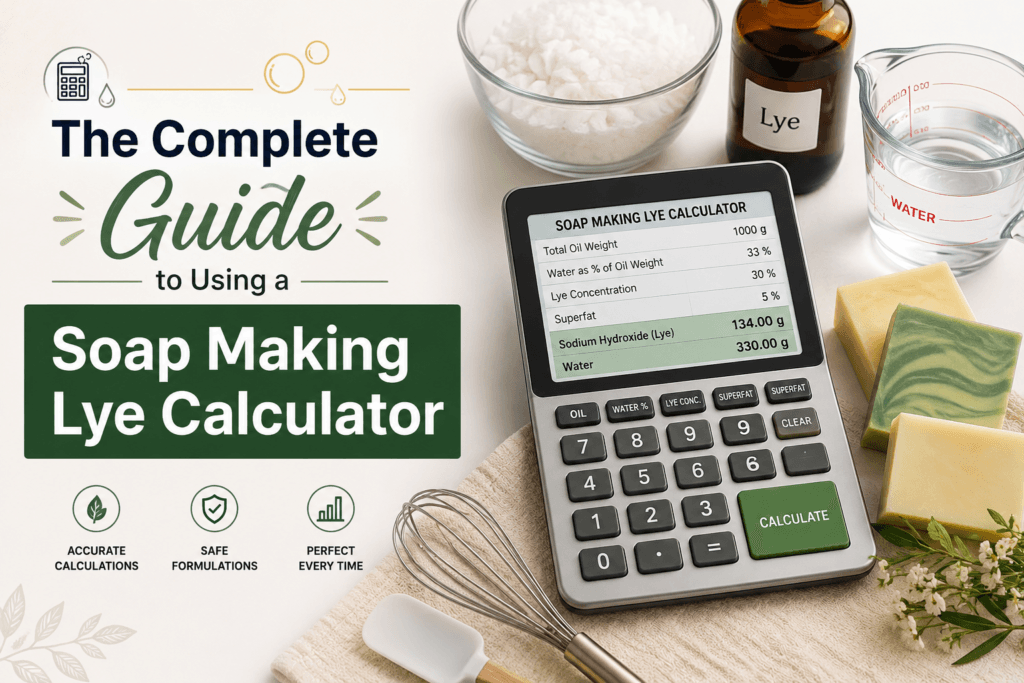
The Complete Guide to Using a Soap Making Lye Calculator
Every safe, mild, long-lasting bar of cold process soap starts with one number: the correct amount of lye. This guide breaks down the chemistry, the math, and the exact steps behind that number — so you never have to guess again.
Last updated July 2026Soap making looks like a craft, but underneath the swirls and scent, it is a precise chemical reaction. Fats and oils react with a strong alkali — lye — in a process called saponification, and that reaction only turns out right when the ratio of lye to oil falls inside a narrow, calculable range. Too little lye and your bars stay greasy and turn rancid early. Too much, and you’re left holding a caustic bar that can burn skin on contact. A soap making lye calculator exists to remove that guesswork entirely, and this guide walks through exactly how it works, why each input matters, and how to use one with confidence on your very first batch.
01 What a Lye Calculator Actually Does
A lye calculator is a formulation tool that converts the weights of the oils and fats in your recipe into the exact amount of lye and water needed to saponify them correctly. Instead of manually looking up saponification values for every oil, multiplying, adding a safety margin, and figuring out a workable water ratio, you enter your oil weights once and the calculator returns three numbers: the lye weight, the water weight, and the total batch weight.
Behind that simple output sits real chemistry. Every fat is made of triglycerides — three fatty acid chains attached to a glycerol backbone. When sodium hydroxide is dissolved in water and combined with those triglycerides, the alkali splits the fat molecule apart, releasing glycerin and binding the fatty acids into soap (a sodium salt of the fatty acid). This is saponification, and the amount of lye required is not a guess — it is a fixed chemical ratio unique to each type of fat.
You can try this exact calculation for your own recipe using the free soap making lye calculator, which applies the same SAP-value math described in this guide automatically.
Saponification value (SAP value): the number of milligrams of alkali required to saponify one gram of a specific fat, usually expressed as a decimal (for example, 0.137 for olive oil with NaOH). This single number is the entire basis of lye calculation.
02 Why You Can’t Just “Eyeball” Lye Amounts
New soap makers sometimes assume that soap recipes work like cooking recipes — a little more or less of an ingredient just changes the flavor. Lye math doesn’t forgive that kind of flexibility, for two connected reasons.
First, every oil saponifies at a different rate and requires a different amount of lye per gram. Coconut oil, for instance, has a much higher SAP value than a soft oil like sweet almond oil, meaning a gram of coconut oil needs noticeably more lye to fully convert into soap. A recipe that swaps oils without recalculating lye will either under-saponify (leaving free-floating caustic lye in the bar) or over-superfat it (leaving too much unreacted oil, which shortens shelf life and can turn a bar rancid, a process soap makers call “DOS,” or dreaded orange spots).
Second, the margin for error is genuinely small. A well-formulated bar typically runs a superfat of 3–8%. Miscalculating by even a few percentage points can push a recipe from “mild and moisturizing” to “harsh and drying,” or in the opposite direction, from “gentle” to “soft, oily, and prone to spoiling.” This is precisely the gap a lye calculator is built to close — it applies the correct SAP value for each oil in your exact recipe, every time, without the risk of manual arithmetic errors.
03 NaOH vs. KOH: Which Lye Do You Need?
Before any calculator can give you a usable number, it needs to know which alkali you’re formulating with, because the two most common types of lye behave differently and require different SAP values for the same oil.
Sodium hydroxide (NaOH)
Sodium hydroxide is the lye used for hard bar soap — the classic cold process or hot process bar. It produces a firm, solid soap because sodium salts of fatty acids pack tightly and hold their shape.
Potassium hydroxide (KOH)
Potassium hydroxide is used for liquid soap, soft soap, and shaving soap. Potassium salts of fatty acids are more soluble and stay soft or liquid rather than hardening into a bar. KOH recipes also typically use a different water ratio and are diluted after the cook, unlike a standard hard bar recipe.
Mixing these up is one of the most common beginner errors: running a bar-soap recipe through a calculator set to KOH (or vice versa) will produce a lye weight that’s wrong for the reaction you’re actually running. Always confirm which lye type is selected before trusting the output.
Advanced formulators sometimes combine a small percentage of KOH into a NaOH bar recipe to create a softer, more soluble lather — commonly seen in shaving soap. If you do this, your calculator needs to handle a dual-lye entry, since each alkali requires its own SAP value for the same oil.
04 SAP Values Explained (With a Working Chart)
The saponification value is the foundation of every lye calculation. It tells you, per gram of a specific oil, how many grams of lye are chemically required to convert that oil fully into soap with zero superfat. Multiply the oil’s weight by its SAP value, and you get the theoretical “0% superfat” lye amount for that single ingredient. Add up every oil in your recipe the same way, and you get the total lye needed before any superfat adjustment.
| Oil / Fat | SAP Value (NaOH) | SAP Value (KOH) | Typical Use % |
|---|---|---|---|
| Olive oil | 0.134 | 0.190 | 20–100% |
| Coconut oil | 0.183 | 0.257 | 15–30% |
| Palm oil | 0.141 | 0.199 | 15–30% |
| Shea butter | 0.128 | 0.180 | 5–20% |
| Castor oil | 0.128 | 0.180 | 3–10% |
| Sweet almond oil | 0.136 | 0.191 | 5–20% |
| Sunflower oil | 0.134 | 0.190 | 5–20% |
| Avocado oil | 0.133 | 0.188 | 5–15% |
| Cocoa butter | 0.137 | 0.194 | 5–15% |
| Rice bran oil | 0.128 | 0.181 | 5–20% |
These figures are the industry-standard averages soap formulators reference, though minor variation exists between batches of raw oil due to natural composition differences. This is exactly why a dedicated calculator is more reliable than memorizing numbers — it stores an up-to-date, cross-checked SAP database so you don’t need to track chart revisions yourself.
05 Superfat and Lye Discount, Demystified
“Superfat” (sometimes called “lye discount”) is the percentage of oil in a recipe that is intentionally left un-saponified. Rather than using the exact stoichiometric amount of lye to convert 100% of the oils into soap, soap makers deliberately hold back a small percentage of lye so a corresponding percentage of oil remains free in the finished bar. That leftover oil is what gives handmade soap its noticeably milder, moisturizing feel compared to most mass-produced commercial bars.
- 0% superfat — every bit of oil is converted into soap. Used almost exclusively for specialty applications like laundry soap, never for skin bars.
- 3–5% superfat — the standard range for everyday bar soap. Firm, long-lasting, and mild.
- 6–8% superfat — common for facial bars or sensitive-skin formulas, at some cost to bar hardness and shelf life.
- 10%+ superfat — used sparingly, usually in luxury or “conditioning” bars, but raises the risk of rancidity (DOS) over time.
Mathematically, superfat is applied after the base lye number is calculated: the calculator multiplies the total 0%-superfat lye figure by (1 − superfat percentage). A 5% superfat, for example, multiplies the base lye weight by 0.95, holding back exactly 5% of the lye that would otherwise be needed for full saponification.
Never treat superfat as a margin for measuring mistakes. It is a deliberate formulation choice, not insurance against inaccurate scales. If your measurements are off, the actual superfat in your finished bar will drift away from what you intended — sometimes into lye-heavy territory even with a “safe” superfat percentage entered.
06 Water Amount and the Water Discount Method
Water doesn’t participate in saponification the way lye and oil do — its job is to dissolve the lye into a workable solution and to control how quickly your batter thickens (“traces”) and how long it takes to fully cure. Calculators typically offer two ways to set water amount:
Percentage of oils
Water is calculated as a percentage of your total oil weight, commonly 33–38%. This is the most beginner-friendly method because it scales predictably with batch size.
Water-to-lye ratio
Water is calculated as a multiple of the lye weight itself (for example, a 2:1 or 2.5:1 water-to-lye ratio). This method is favored by more experienced formulators because it more directly controls how concentrated the lye solution is, which affects trace speed and bar hardness at unmolding.
Water discounting refers to intentionally reducing the water amount below the full default. A discounted-water recipe traces faster, unmolds sooner, and often produces a harder bar with less shrinkage — but it also raises the risk of the batter seizing or accelerating too quickly, especially with fragrance oils known to speed up trace. Beginners are generally better served starting with full water and discounting gradually as they gain experience reading their specific oils and fragrances.
Sample batter — 1,000g oil weight
07 Step-by-Step: Using a Lye Calculator
- List your oils by weight, not volume. Soap making is measured by weight (grams or ounces), never cups or milliliters, because density varies between oils and volume measurements introduce error the calculator can’t correct for.
- Enter each oil and its exact weight. Open the soap making lye calculator and input every oil in your recipe individually — the calculator pulls the correct SAP value for each one automatically.
- Select your lye type. Choose NaOH for bar soap or KOH for liquid/soft soap, since this changes every SAP value used behind the scenes.
- Set your superfat percentage. 5% is a dependable starting point for a first batch; adjust up or down based on the bar’s intended use.
- Choose your water method and amount. Start with the default percentage-of-oils setting until you’re comfortable reading trace behavior.
- Review the output before weighing anything. Confirm the lye weight, water weight, and total batch weight make sense relative to your mold size.
- Weigh lye and water separately, then combine lye into water — never water into lye. Adding water to lye can cause a violent, splattering reaction; always add lye slowly into water while stirring.
08 A Full Worked Example, Start to Finish
Suppose you want a 1,000g-oil batch using 500g olive oil, 300g coconut oil, and 200g shea butter, with a 5% superfat and NaOH lye. Here is how the underlying math plays out before any calculator rounding:
- Olive oil: 500g × 0.134 = 67.0g lye
- Coconut oil: 300g × 0.183 = 54.9g lye
- Shea butter: 200g × 0.128 = 25.6g lye
Add those together for the 0%-superfat total: 67.0 + 54.9 + 25.6 = 147.5g lye. Apply the 5% superfat discount by multiplying by 0.95: 147.5 × 0.95 = ~140.1g lye. That is the number a lye calculator would return for the lye field, and it’s the number you’d weigh out precisely on a gram-accurate scale — never rounded up “just to be safe,” since rounding up removes your intended superfat.
For water at 38% of oil weight: 1,000g × 0.38 = 380g water. Your total finished batter weight (before evaporation and additives like fragrance or colorant) comes to roughly 1,520g.
Running the numbers manually one time, then checking them against the lye calculator, is one of the fastest ways to build real confidence in the tool. Once you see that the calculator matches your own math, you can trust it fully for every batch afterward — including recipes with far more oils than a simple three-oil example.
09 Lye Safety: Non-Negotiable Rules
Lye is a strong alkali, and the dry crystals and the fully mixed lye-water solution are both capable of causing chemical burns. None of the following guidelines are optional, regardless of experience level.
- Always add lye to water, never water to lye — reversing the order can cause a dangerous, volcano-like reaction.
- Wear chemical-resistant gloves, safety goggles (not just glasses), and long sleeves every time you handle dry lye or lye solution.
- Mix lye in a well-ventilated space, or outdoors, and avoid breathing the fumes released as it dissolves — they can irritate airways.
- Use only heat-safe plastic, stainless steel, or glass containers for mixing lye — never aluminum, which reacts with lye and can release hydrogen gas.
- Keep dry lye and lye solution completely away from children, pets, and food-prep surfaces, and label containers clearly.
- Keep a bottle of vinegar nearby to neutralize minor splashes on surfaces, and know that skin contact requires immediate rinsing with large amounts of cool running water for at least 15 minutes.
If lye solution contacts skin, rinse immediately and continuously with cool water; if it contacts eyes, flush thoroughly and seek emergency medical care right away. These are the same core precautions any certified soap-making course or safety data sheet (SDS) for sodium hydroxide will emphasize, and they apply identically whether you calculated your recipe by hand or with a calculator.
10 Common Mistakes That Ruin a Batch
Using volume instead of weight
Measuring oils in cups instead of grams introduces enough density variation to meaningfully shift your actual superfat, sometimes by several percentage points.
Forgetting to reset the calculator between recipes
Leftover oil entries from a previous recipe are one of the most frequent sources of an inaccurate lye number — always start with a clean oil list for each new formulation.
Substituting oils without recalculating
Swapping one oil for another of similar “feel” (say, sunflower for sweet almond) still changes the SAP value driving the calculation. Any substitution requires re-running the numbers.
Confusing lye type
Running a bar-soap recipe through KOH SAP values, or a liquid-soap recipe through NaOH values, produces a lye weight that’s fundamentally wrong for the reaction taking place.
Rounding the lye weight upward “to be safe”
Rounding up reduces your intended superfat and can push a mild recipe toward a harsher, more lye-heavy bar — the opposite of the intended safety margin.
Calculate your next batch with confidence
Enter your oils, choose your lye type and superfat, and get an accurate lye and water weight in seconds.
Open the Lye Calculator →11 Frequently Asked Questions
How do I calculate how much lye I need for soap making?+
Multiply the weight of each oil by its saponification (SAP) value, add those figures together, then reduce the total by your chosen superfat percentage. A lye calculator automates this by storing accurate SAP values for each oil and applying the superfat math for you.
What is the difference between NaOH and KOH in soap making?+
Sodium hydroxide (NaOH) produces hard bar soap, while potassium hydroxide (KOH) produces soft or liquid soap. Each requires its own SAP value per oil, so selecting the correct lye type is essential before trusting a calculator’s output.
What superfat percentage should a beginner use?+
A 5% superfat is a reliable starting point for most bar soap, balancing mildness with bar hardness and shelf life. Facial bars often run 7–8%, while firmer, longer-lasting bars sometimes stay closer to 3%.
Why does my lye calculator give a different number than another calculator?+
Small differences usually come from slightly different SAP value databases or rounding, and are rarely a safety concern at a gram or two of variance. Pick one calculator and stay consistent with it for a given recipe rather than mixing numbers from multiple sources.
Is it safe to touch lye water while making soap?+
No — lye water is highly caustic and can burn skin within seconds of contact. Always wear chemical-resistant gloves, safety goggles, and long sleeves, and mix lye in a well-ventilated area away from children and pets.
Can I use a lye calculator for cold process, hot process, and liquid soap?+
Yes, provided the calculator lets you select the correct lye type. Cold process and hot process both use NaOH and calculate identically, while liquid soap uses KOH with a different SAP value and often a different water ratio.
Ready to formulate your own recipe? Head over to the soap making lye calculator to run your exact oils and superfat, or browse the rest of the full collection of free online tools for more calculators built for makers.