
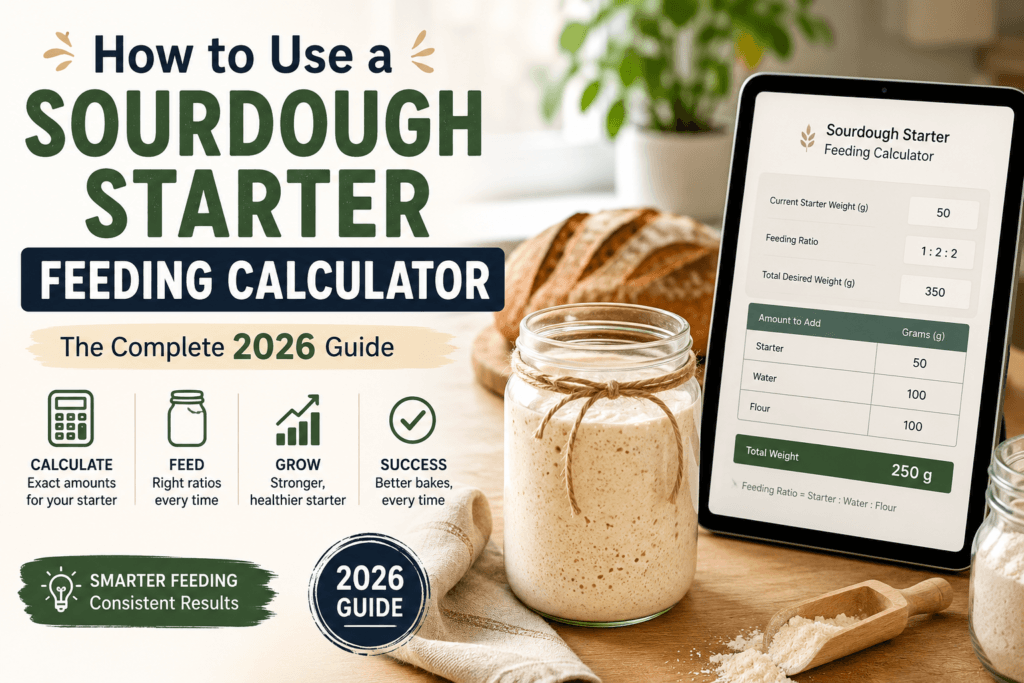
How to Use a Sourdough Starter Feeding Calculator: The Complete 2026 Guide
If you have ever stood in your kitchen at 9 p.m., staring at a jar of bubbling flour paste, wondering whether you should feed it 50 grams of flour or 100, you already know the real problem with sourdough. It’s not the baking. It’s the math.
Most people who quit sourdough don’t quit because their bread came out flat. They quit because they got tired of guessing. They fed their starter too much one day and starved it the next, and after a few weeks of inconsistent rises, it just felt easier to buy a loaf from the store. A sourdough starter feeding calculator exists to fix exactly that problem, and in this guide, I’m going to walk you through how to actually use one, why the numbers matter more than people think, and how to build a feeding routine around your real schedule instead of an Instagram baker’s schedule.
By the end, you’ll know how to use the free Sourdough Starter Feeding Calculator to get exact flour and water amounts in seconds, and you’ll understand the “why” behind the numbers well enough to adjust them on your own.

What Is a Sourdough Starter Feeding Calculator?
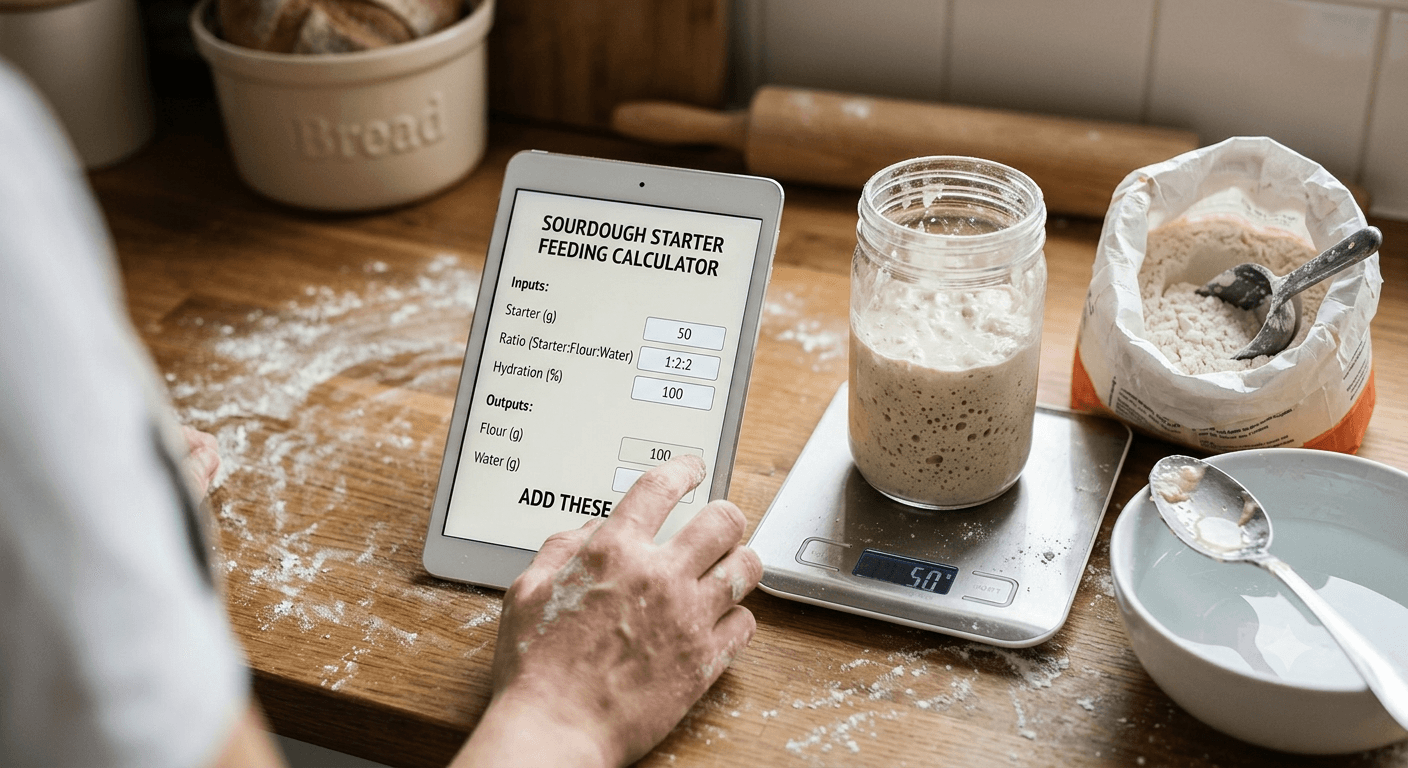
A sourdough starter feeding calculator is a small tool that takes three pieces of information — how much starter you’re keeping, what feeding ratio you want to use, and your starter’s hydration percentage — and instantly tells you exactly how many grams of flour and water to add. Instead of doing mental math with a kitchen scale in one hand and a sticky spoon in the other, you type in your numbers and get a clean answer.
In plain terms: you tell it “I have 50 grams of starter and I want a 1:2:2 ratio,” and it tells you “add 100 grams of flour and 100 grams of water.” That’s it. No spreadsheets, no napkin math, no second-guessing.
Why Guessing Your Feeding Ratio Almost Always Backfires
Here’s something most beginner guides skip over: sourdough starters are living cultures, and living cultures are unforgiving about inconsistency. When you eyeball your feedings — a scoop here, a splash there — you’re not just risking a slightly-off ratio. You’re changing the entire environment the yeast and bacteria are living in, every single time.
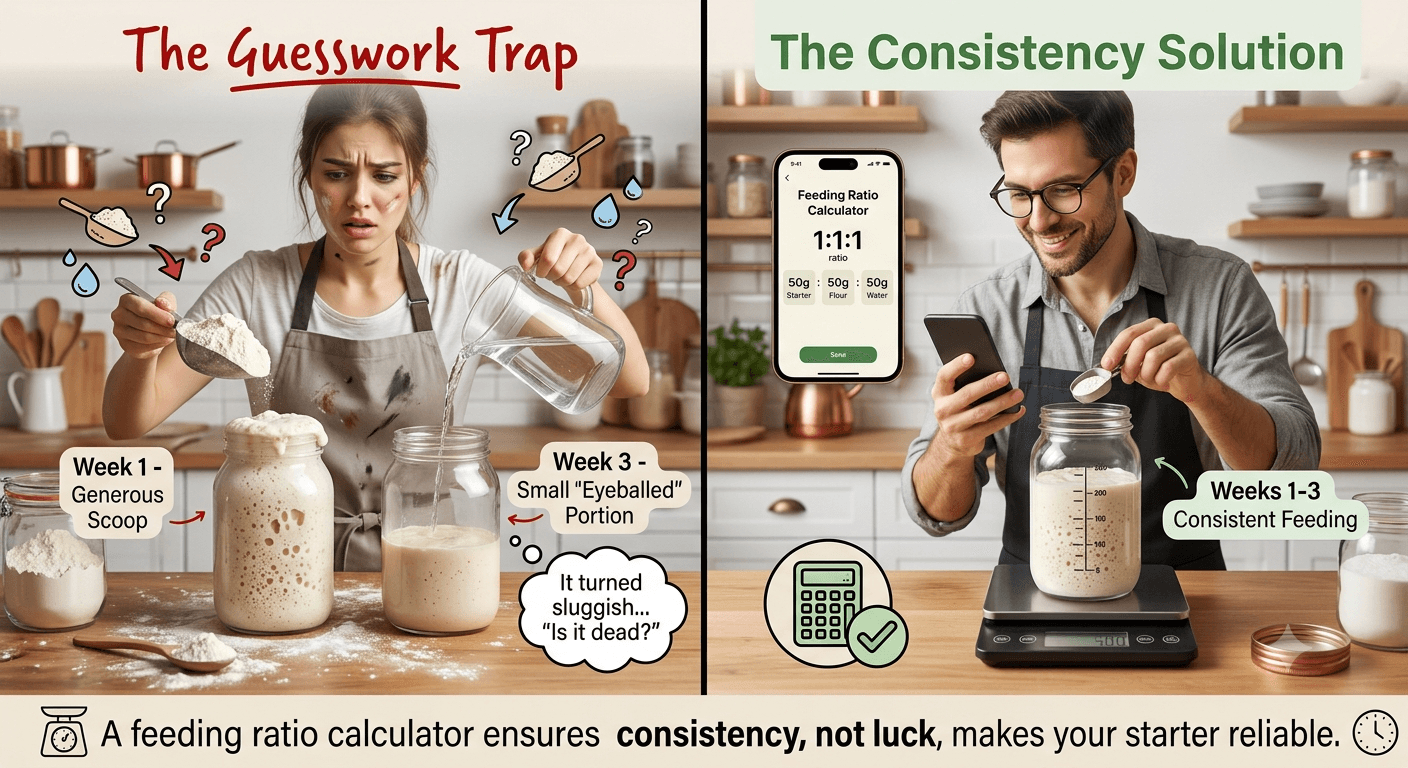
I’ve watched this play out the same way over and over with people who are new to home fermentation. Week one, the starter is fed generously and rises like a dream. Week two, they’re in a rush, so they eyeball a smaller feeding “just to save flour,” and the starter turns sluggish. By week three, they’ve convinced themselves their starter is dead, when really, it was just confused by inconsistent portions.
A feeding ratio calculator removes that variable completely. Once you lock in a ratio that works for your kitchen and your schedule, the calculator keeps you honest every time you feed, which means your starter experiences the same environment feeding after feeding. Consistency, not luck, is what makes a starter reliable.
How to Use a Sourdough Starter Feeding Calculator (Step-by-Step)
Using a feeding calculator takes less time than pulling a jar out of the fridge. Here’s the exact process:
Step 1: Weigh what’s left in your jar
Before you feed, put your starter jar on a kitchen scale and note the weight of just the starter (tare out the jar first). This is your starting number, and it’s the single most important input, because every other number in the calculator is built off of it.
Step 2: Decide on your feeding ratio
Ratios are usually written as starter : flour : water, like 1:1:1 or 1:2:2. A higher ratio means more food relative to starter, which means a slower, milder rise. A lower ratio means faster, more sour results. If you’re not sure which to pick, start with 1:1:1 for a daily counter starter, or 1:2:2 if you’re keeping it in the fridge and feeding less often.
Step 3: Enter your starter weight into the calculator
Open the Sourdough Starter Feeding Calculator and plug in the weight from Step 1, along with your chosen ratio.
Step 4: Let it calculate your flour and water
The calculator instantly returns the exact grams of flour and water you need. No rounding errors, no mental math, no “close enough” guessing.
Step 5: Adjust for hydration if your starter isn’t 100% hydration
Most recipes assume a 100% hydration starter (equal parts flour and water by weight). If you keep a stiffer starter, say 75% hydration, you’ll want to weight the water figure down slightly. A good calculator lets you fine-tune this rather than forcing one hydration level on everyone.
Step 6: Feed, mark the jar, and start your timer
Add the flour and water, mix thoroughly until there are no dry pockets, and mark the current level on the outside of the jar with a rubber band or piece of tape. This lets you visually track how much it rises, which is honestly more useful than staring at the clock.
Understanding Feeding Ratios: 1:1:1 vs 1:2:2 vs 1:5:5
The ratio you choose changes almost everything about how your starter behaves — how fast it rises, how sour your bread tastes, and how often you need to feed it. Here’s a breakdown of the most common ratios and when each one makes sense.
| Ratio | Best For | Typical Rise Time (Room Temp) | Flavor Result |
|---|---|---|---|
| 1:1:1 | Daily counter feeding, active baking weeks | 4–6 hours | Mild, quick, less sour |
| 1:2:2 | Fridge storage, feeding every 5–7 days | 6–8 hours | Balanced tang, steady rise |
| 1:5:5 | Long feeding gaps, weak or slow starters that need building up | 8–12 hours | Milder, more forgiving |
| 1:10:10 | Building a large batch for multiple loaves at once | 10–14 hours | Mild, needs longer to peak |
Notice a pattern here: the more food you give relative to starter, the longer and gentler the fermentation becomes. That’s why bakers who travel or bake once every week or two lean toward higher ratios like 1:5:5 — it stretches out how long the starter stays healthy between feedings without needing constant attention.
How Temperature and Season Change Your Feeding Math
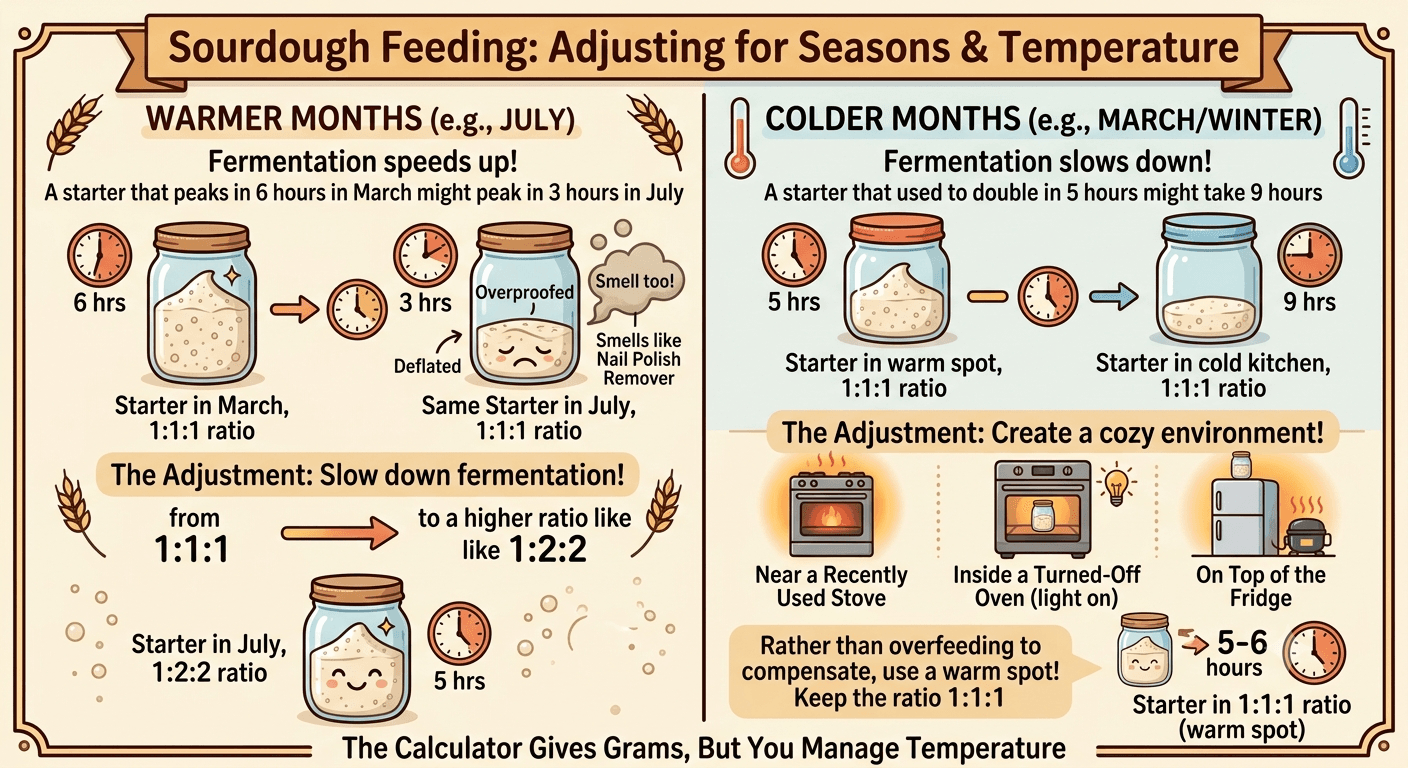
A feeding calculator gives you the correct grams, but it can’t taste your kitchen’s air temperature for you, so this part is on you. Wild yeast is temperature-sensitive in a way that’s easy to underestimate.
In warmer months, fermentation speeds up dramatically. A starter that peaks in six hours in March might peak in three hours in July, and if you’re not watching it, you can miss the window and end up with an overproofed, deflated starter that smells more like nail polish remover than bread dough. When temperatures climb, many bakers shift to a slightly higher ratio, like moving from 1:1:1 to 1:2:2, simply to slow things down to a manageable pace.
In colder months, the opposite happens. Fermentation drags, and a starter that used to double in five hours might take nine. Rather than overfeeding to compensate, most experienced bakers keep the ratio the same and instead find a slightly warmer spot for the jar — near a stove that’s been recently used, inside a turned-off oven with the light on, or on top of the fridge where the compressor generates gentle heat.

Common Mistakes People Make With Sourdough Feeding Calculators
- Measuring by volume instead of weight. A cup of flour can weigh anywhere from 120 to 150 grams depending on how it’s scooped. Calculators are built around weight, so measuring cups will throw off every ratio you try to hit.
- Forgetting to account for discard. If you don’t discard before feeding, your starter-to-food ratio quietly shifts every time, and the numbers the calculator gives you stop matching reality.
- Ignoring hydration percentage. Plugging numbers meant for a 100% hydration starter into a stiff, low-hydration starter routine will leave your dough far too wet or dry.
- Switching ratios too often. Jumping between 1:1:1 one day and 1:5:5 the next confuses the culture’s rhythm. Pick a ratio that fits your schedule and stick with it for at least a week before adjusting.
- Feeding based on the calendar, not the starter. A calculator tells you the amounts, not the timing. Watch the starter’s rise and fall, not just the clock, to know when it’s actually ready to be fed again.
How to Build a Feeding Schedule Around Your Lifestyle
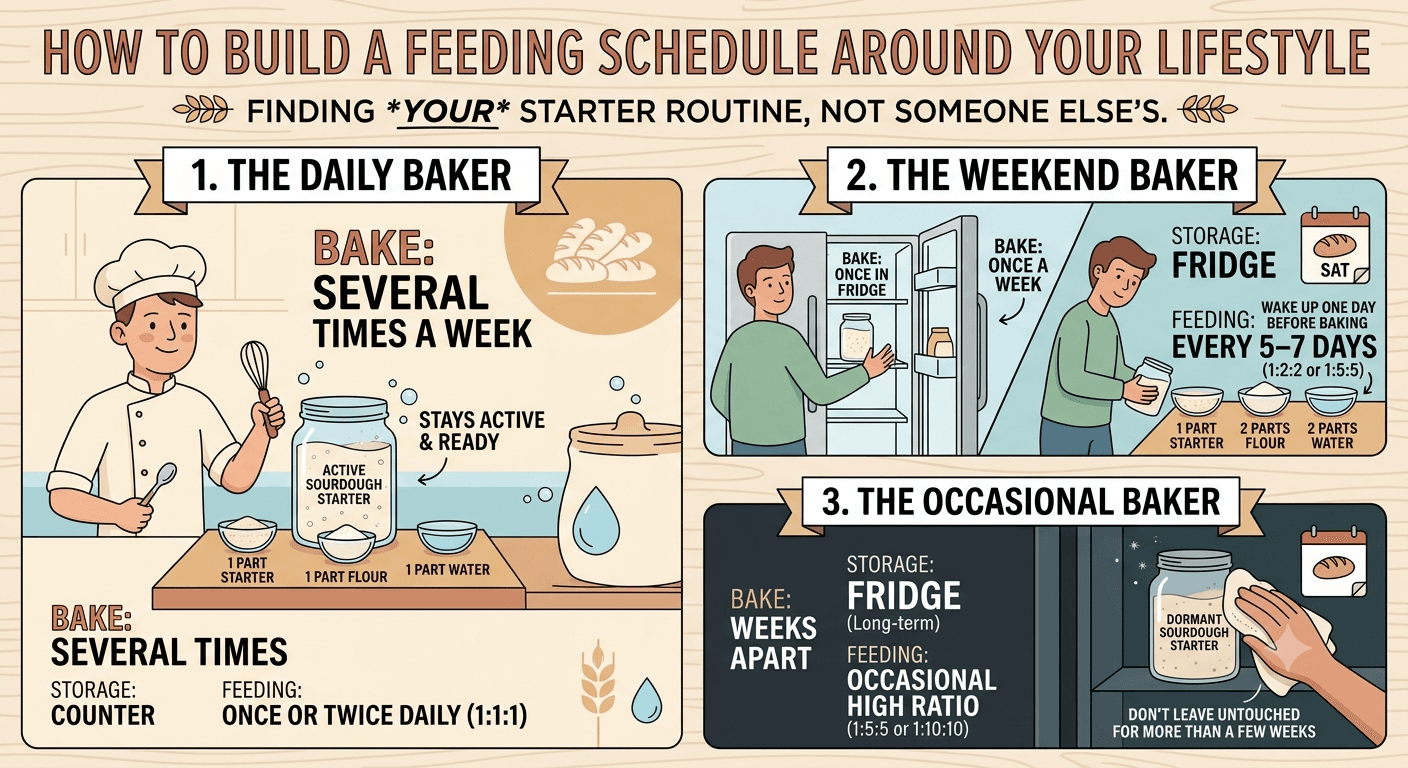
There’s no single “correct” feeding schedule, and honestly, most people who fail at maintaining a starter are trying to follow someone else’s routine instead of building one that fits their own life. Here are three realistic approaches:
The daily baker
If you bake several times a week, keep your starter on the counter and feed it once or twice daily with a 1:1:1 ratio. It stays active and ready with almost no lead time.
The weekend baker
If you only bake once a week, store your starter in the fridge and feed it once every 5–7 days using a 1:2:2 or 1:5:5 ratio. Pull it out and feed it at room temperature a day before you plan to bake so it wakes up and becomes active again.
The occasional baker
If weeks go by between bakes, a higher ratio like 1:5:5 or 1:10:10 stretched over fridge storage keeps the starter alive without demanding much attention. Just don’t leave it untouched for more than a few weeks without at least a check-in feeding.
Troubleshooting: What Your Starter Is Telling You
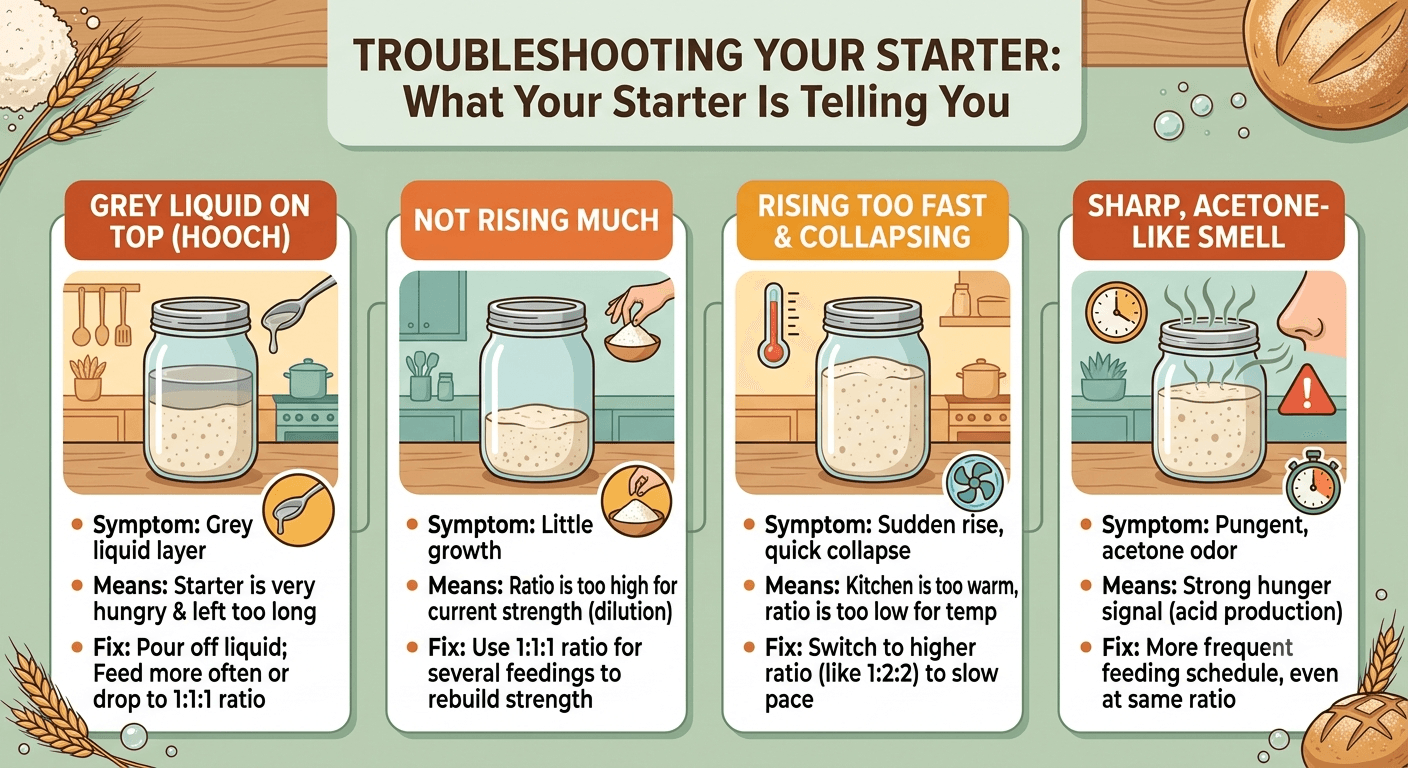
A feeding calculator solves the math problem, but it can’t diagnose a starter that’s behaving strangely. Here’s what a few common symptoms usually mean, and how adjusting your ratio can help.
Grey liquid sitting on top (hooch): Your starter is hungry and has been left too long since its last feeding. Pour off the liquid, and consider feeding slightly more often or dropping to a lower ratio like 1:1:1 for a few cycles.
Not rising much at all: This is often a sign the ratio is too high for the starter’s current strength, essentially diluting it faster than it can recover. Try dropping to 1:1:1 for several feedings in a row to rebuild strength before scaling back up.
Rising too fast and collapsing before you notice: This usually means your kitchen is warm and your ratio is too generous for the temperature. Move to a slightly higher ratio like 1:2:2 to slow the pace down to something more predictable.
Sharp, acetone-like smell: This is a hunger signal, similar to hooch. The starter has run out of food and started producing excess acid. A more frequent feeding schedule, even at the same ratio, usually resolves this within a few days.
Advanced Tips for Long-Term Starter Health
Once you’ve got the ratio math handled, a few small habits make a noticeable difference over the long run:
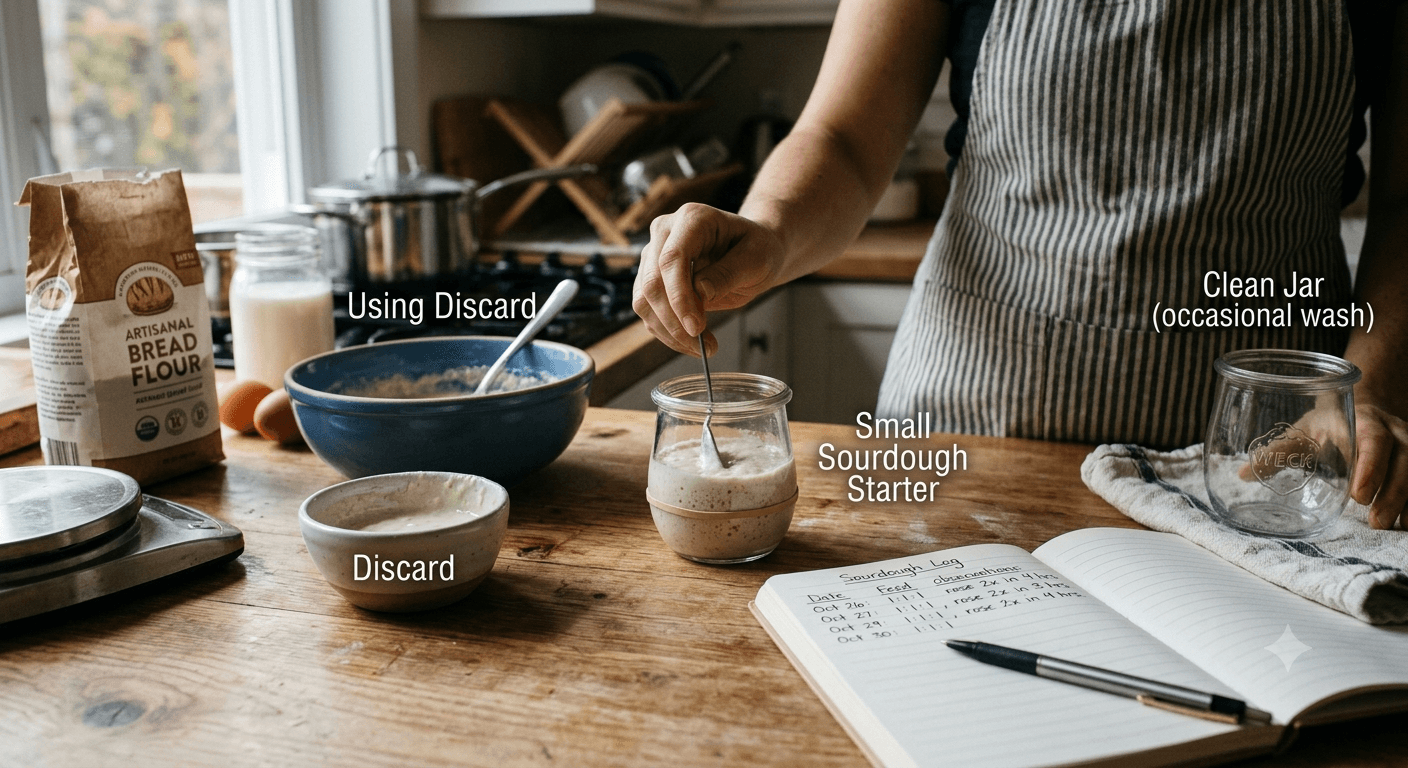
- Keep your starter small. There’s no reason to maintain 500 grams of starter if you only bake one loaf a week. A smaller starter means less discard, less waste, and less flour spent on maintenance feedings.
- Use discard instead of throwing it away. Pancakes, crackers, and pizza dough are all easy ways to put discard to use rather than tossing it down the drain.
- Clean your jar occasionally. Dried starter residue builds up on the inside walls of the jar over time and can introduce off-flavors. A quick wash every few weeks keeps things fresh.
- Track your feedings. A simple note of the date, ratio, and how the rise went helps you notice patterns over weeks, especially as seasons change.
Frequently Asked Questions
How much should I feed my sourdough starter?
It depends on your ratio and how much starter you’re keeping, which is exactly why a calculator is useful. As a general starting point, a 1:1:1 ratio (equal parts starter, flour, and water by weight) works well for daily feeding routines.
Can I use a calculator instead of the classic 1:1:1 ratio?
Yes. The 1:1:1 ratio is just one option among several. A calculator lets you plug in whatever ratio suits your schedule, whether that’s 1:2:2, 1:5:5, or something in between, and still get accurate flour and water amounts.
How often should I feed my sourdough starter?
Counter starters fed at a 1:1:1 ratio typically need feeding once or twice daily. Fridge starters fed at higher ratios like 1:2:2 or 1:5:5 can often go five to seven days between feedings.
Does a feeding calculator work for gluten-free or rye starters?
The ratio math works the same regardless of flour type, since it’s based on weight, not flour variety. Rye and gluten-free starters may ferment at different speeds, but the flour and water amounts a calculator gives you will still be accurate.
Why does my starter need different amounts of water each time?
If your starter’s hydration percentage stays consistent, the water amount shouldn’t change unless your starter weight changes. If you notice inconsistent results, double-check that you’re weighing your starter before feeding rather than estimating it.
Is it bad to change my feeding ratio frequently?
Frequent switching can make a starter’s behavior harder to predict, since it’s constantly adjusting to a new food-to-starter balance. It’s generally better to settle on one ratio and give it at least a week before deciding whether to adjust.
Final Thoughts
Sourdough doesn’t need to be complicated, and honestly, most of the frustration people run into has nothing to do with baking skill. It comes down to inconsistent feeding math that quietly throws the whole process off balance. A sourdough starter feeding calculator takes that variable off your plate entirely, so you can focus on the part that actually matters: baking bread you’re proud of.
If you haven’t tried it yet, the free Sourdough Starter Feeding Calculator takes about ten seconds to use and removes the guesswork for good. And if you’re the kind of person who likes having the right tool for every job, it’s worth browsing the full collection of free online tools as well — there’s likely another one in there that saves you time on something else you’ve been eyeballing for too long.