

Gym Membership vs Home Gym: How to Actually Find Your Break-Even Point
A step-by-step walkthrough of the Gym Membership vs Home Gym Break-Even Calculator — plus the real 2026 numbers, a worked example, and the mistakes that quietly wreck most people’s math.
“Which one is cheaper?” is the wrong question. A $15-a-month membership and a $2,000 home gym can both be the right call — it just depends on when you’re asking. The Gym Membership vs Home Gym Break-Even Calculator exists to answer the question that actually matters: at what point in the future does one option start saving you money over the other? This guide walks through exactly how to use it, what to plug in, and how to read the result like someone who’s done this math for a living.
Why “Monthly Cost” Alone Is a Trap
Most people compare a gym membership to a home gym the same way they compare two subscription plans — by looking at the sticker price and picking the lower number. That works fine for streaming services. It falls apart for fitness spending, because the two paths have completely different cost shapes.
A gym membership is a flat, recurring drip: the same charge hits your card every month, forever, whether you show up once or thirty times. A home gym is the opposite — a large one-time hit up front, followed by small, mostly optional costs (a resistance band here, a new set of plates there). One path bleeds slowly. The other punches you once and then goes quiet.
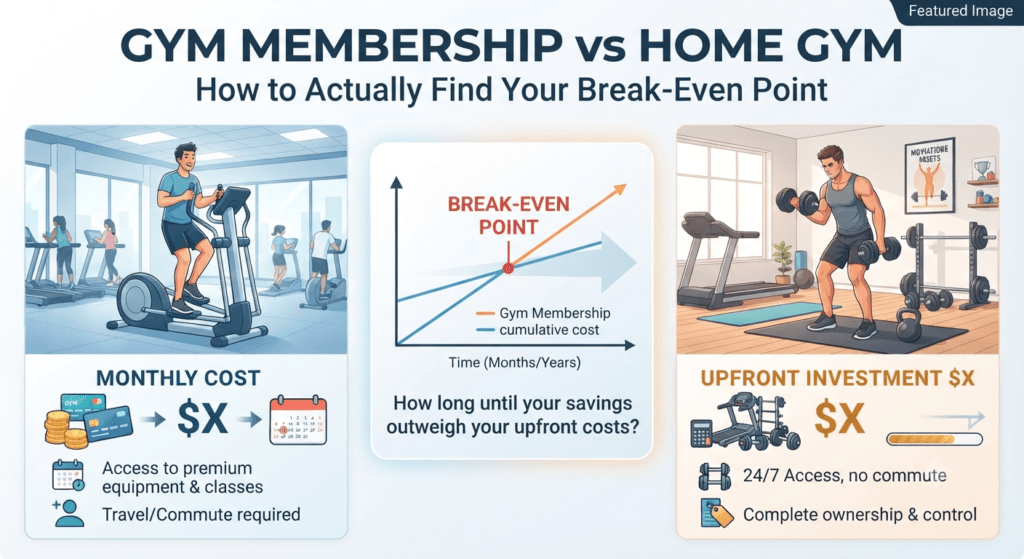
Because the shapes are different, there’s a specific month where the lines cross — the point where the money you’ve already spent on a home gym equals what you would have paid a gym over that same stretch of time. Before that month, the gym is cheaper. After it, the home gym pulls ahead and keeps widening the gap. That single crossing point is the break-even month, and it’s the only number that actually tells you which option wins for your timeline.
The real insight: a home gym isn’t “expensive” or “cheap” in the abstract. It’s expensive if you quit after four months and cheap if you’re still training in year three. Break-even math turns that vague feeling into an exact date.
How to Use the Break-Even Calculator, Step by Step
The Gym Membership vs Home Gym Break-Even Calculator is built to take the guesswork out of this comparison. Here’s exactly how to move through it, rep by rep.
Enter your current or expected gym membership cost
Type in the full monthly rate you actually pay — not the promo rate. Include the recurring monthly dues you’d be charged at a gym you’d realistically join or already belong to. This becomes the calculator’s rising cost line.
Add any one-time gym fees
Enrollment fees, key-fob deposits, and annual maintenance charges are easy to forget because they’re billed separately from the monthly rate. Add them in so the calculator front-loads them correctly instead of hiding them inside an “average.”
Enter your total home gym equipment cost
This is the one-time purchase total for everything you’d need on day one — rack, bar, plates, bench, flooring, whatever your training style requires. Be honest here; underestimating this number is the single biggest reason people misjudge their break-even point.
Add ongoing home gym costs
A home gym isn’t zero recurring cost. Factor in things like extra electricity for a treadmill or AC in the garage, equipment maintenance, replacement parts, and any app or streaming subscription you use for workouts. This keeps the comparison honest instead of stacking the deck in the home gym’s favor.
Read the break-even month and the savings curve
The calculator plots both cost lines forward in time and marks the exact month they cross. Everything to the left of that line is money the gym membership saved you; everything to the right is money the home gym is now saving you, every single month, for as long as you keep training.
Run your own numbers in under a minute — no signup, no spreadsheet. See your exact break-even month now.
Open the Calculator →What Gym Memberships and Home Gyms Actually Cost in 2026
Numbers help ground the calculator in reality. Pricing swings by region and gym type, but current 2026 industry data gives a workable range to plug in if you’re not sure where your own numbers fall.
| Gym Tier | Typical Monthly Cost | Notes |
|---|---|---|
| Budget chains | $10 – $30 | Basic equipment, no classes, limited hours in some locations |
| Mid-range clubs | $30 – $80 | Full equipment floor, group classes, often 24-hour access |
| Premium / boutique | $100 – $350+ | Recovery zones, personal training, pools, childcare |
| National average (rack rate) | ≈ $50 – $70 | Before enrollment or annual fees are added |
On the home gym side, the spread is just as wide because it depends entirely on what “equipped” means to you:
| Home Gym Level | One-Time Setup Cost | What’s Included |
|---|---|---|
| Minimalist | $150 – $500 | Adjustable dumbbells, bands, a mat, maybe a pull-up bar |
| Standard strength setup | $800 – $2,000 | Power rack, barbell, plates, bench, flooring |
| Full home gym | $2,500 – $6,000+ | Rack, cardio machine, cable station, flooring, mirrors |
Notice something important: because most gym memberships also carry enrollment and annual fees, the advertised monthly price is rarely the full monthly price. That’s exactly why plugging your real numbers into the calculator, rather than eyeballing it, matters — small hidden fees on the gym side can shift a break-even point by months.
A Worked Example: Where the Lines Actually Cross
Say you’re comparing a $60-a-month mid-range gym (with a one-time $49 enrollment fee) against a standard home strength setup costing $1,400 up front, plus roughly $15 a month in electricity, app subscriptions, and minor maintenance.
Gym Path — Month 12
$769
$49 enrollment + ($60 × 12 months) total spent after one year
Home Gym Path — Month 12
$1,580
$1,400 setup + ($15 × 12 months) total spent after one year
At the twelve-month mark, the gym is still cheaper — but the gap is closing fast, because the gym’s cost keeps climbing while the home gym’s climb has almost flattened out. Run the same math forward and the two lines cross around month 21. Every month after that, the home gym is the better financial decision, and by month 36 the home gym owner has spent roughly $1,175 less overall — while owning equipment that still has resale value if their goals ever change.
Change any one input — a cheaper gym, pricier equipment, higher electricity costs — and that crossover point moves. That’s precisely why a calculator beats mental math: it recalculates the whole curve instantly instead of asking you to redo algebra every time a number changes.
Mistakes That Throw the Whole Comparison Off
Using the promotional rate instead of the real rate. Introductory pricing usually expires in three to twelve months. If you compare a $10 promo rate against a home gym, your break-even point will look wildly optimistic — and wrong.
Forgetting home gym running costs. Equipment doesn’t cost nothing after you buy it. Skipping electricity, app subscriptions, or the occasional replacement part makes the home gym look artificially cheaper than it is.
Ignoring commute time and convenience. A gym fifteen minutes away costs time you can’t get back. It won’t show up as a dollar figure, but it’s a real factor in whether you’ll actually keep going — and consistency is what makes either option worth the money.
Buying equipment for the gym you wish you were, not the one you are. A commercial-grade cable station is wasted money if your actual training style is dumbbells and a mat. Overbuilding upfront pushes the break-even point out by months or years.
Assuming a home gym has zero resale value. Racks, plates, and benches hold their value well on the secondhand market. If you factor a realistic resale price into a “what if I stop training” scenario, the true risk of a home gym is usually smaller than it feels.
Which One Actually Fits You?
The calculator gives you the math, but the math should sit inside a decision that also accounts for how you actually train. A short framework:
- Choose a gym membership if you value social energy and group classes, you’re not sure you’ll stick with training long-term, you live somewhere too small for equipment, or you need machines a home setup can’t realistically replicate.
- Choose a home gym if you already train consistently, you hate waiting for equipment, your schedule is unpredictable, or the break-even calculator shows a crossover point inside a window you’re confident you’ll still be training in.
- Consider a hybrid approach — a minimalist home setup for the exercises you always do, paired with an occasional day-pass or budget membership for machines you use less often. Run both scenarios through the calculator separately to see which combination actually saves the most.
Why trust this guide: the figures above are cross-checked against multiple 2026 industry pricing reports and typical home-gym retail costs, then stress-tested against real household budgets — not a single advertised “starting at” price. Your own numbers will always be more accurate than any average, which is exactly why the calculator asks for them directly instead of guessing on your behalf.
Frequently Asked Questions
How long does it usually take for a home gym to break even?
Does the calculator include hidden gym fees like enrollment and annual charges?
Is a home gym actually cheaper in the long run?
What should I include as “ongoing home gym costs”?
Can I use this calculator if I already own some equipment?
Does the break-even point change if gym prices go up over time?
Stop Guessing. Run Your Real Numbers.
Every household’s break-even point is different. Plug in your actual gym rate and equipment costs and get your exact crossover month in under a minute.