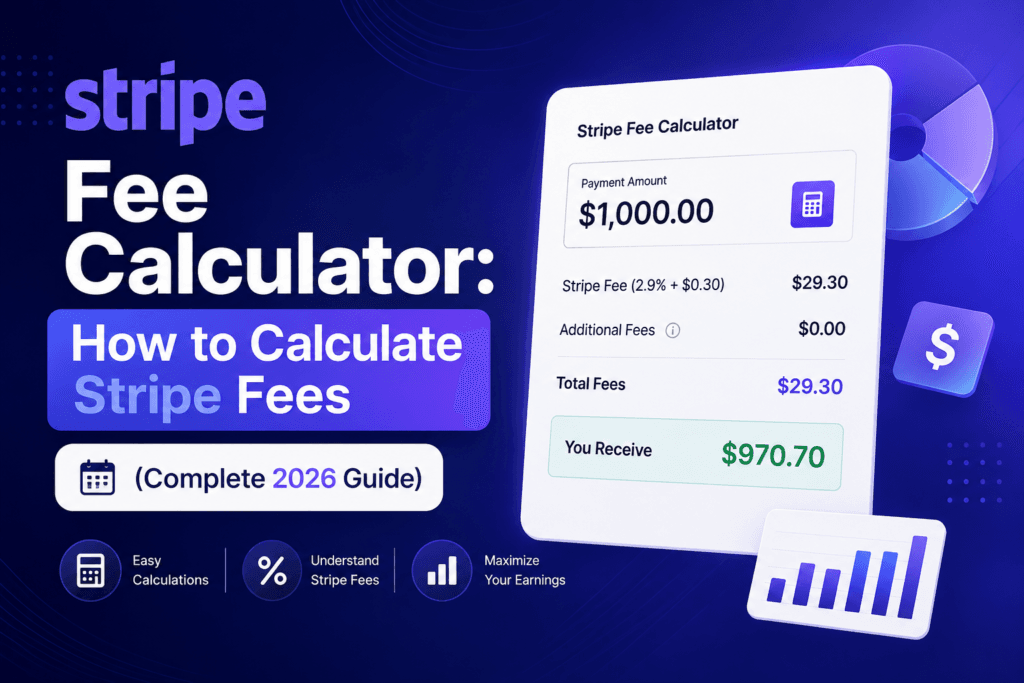
Stripe Fee Calculator:
How to Calculate Stripe Fees
(Complete 2026 Guide)
Everything you need to know about Stripe transaction fees — explained clearly, with real examples, formulas, and a free calculator to do the math instantly.
Stripe charges 2.9% + $0.30 per successful domestic card transaction. For a $100 payment, the fee is $3.20 and you receive $96.80. Use the formula: Fee = (Amount × 0.029) + $0.30. For international cards, add 1.5% (total: 4.4% + $0.30).
What is a Stripe Fee Calculator?
A Stripe fee calculator is a tool that instantly calculates how much Stripe deducts from each payment you receive. When you use Stripe as your payment processor, you don’t receive the full transaction amount — Stripe deducts a small fee before depositing funds into your bank account.
Understanding these fees is critical for:
- Setting the right product prices to maintain your profit margin
- Deciding whether to absorb the fee or pass it on to customers
- Forecasting revenue and cash flow accurately
- Comparing Stripe’s fees against competitor payment processors
Our free online tools at Toolriz include a powerful Stripe Fee Calculator that handles all of this math automatically — but in this guide, you’ll also learn to do it yourself.
Expert Insight: Most new Stripe users underestimate fees by ignoring the fixed $0.30 component. On small transactions (under $10), this flat fee represents a much higher effective percentage than the stated 2.9%.
Stripe Fee Formula (Step by Step)
Stripe’s fee structure is built on two components: a percentage fee and a fixed fee. Here is the complete formula:
Your Payout = Transaction Amount − Stripe Fee
Step-by-Step Calculation Process
Identify Your Transaction Amount
Take the full charge amount your customer paid. For example: $150.00
Calculate the Percentage Component
Multiply by 0.029 (2.9%). Example: $150 × 0.029 = $4.35
Add the Fixed Fee
Add $0.30 to the result. Example: $4.35 + $0.30 = $4.65 total fee
Subtract to Find Your Net Payout
$150.00 − $4.65 = $145.35 deposited to your account
Pro Tip: Want to skip the math entirely? Use our Stripe Fee Calculator tool on Toolriz — enter any amount and get instant results for every fee scenario.
Real-World Calculation Examples
Here are pre-calculated examples for the most common transaction amounts, so you can quickly find your scenario:
Important: Small transactions are disproportionately expensive. A $5 payment costs $0.445 in fees — effectively 8.9%, not 2.9%. Always factor this in when pricing low-cost products or services.
Complete Stripe Fee Structure (2026)
Stripe’s pricing is more complex than just 2.9% + $0.30. Here is a comprehensive breakdown of every fee type you might encounter:
| Fee Type | Rate | Fixed | Category | Notes |
|---|---|---|---|---|
| Standard Card (US) | 2.9% | +$0.30 | Standard | Visa, Mastercard, Amex, Discover |
| International Cards | 4.4% | +$0.30 | International | +1.5% on top of standard rate |
| Currency Conversion | +1.5% | — | International | Added when currency conversion needed |
| ACH Direct Debit | 0.8% | — | Standard | Capped at $5.00 per transaction |
| ACH Credit Transfer | Free | — | Standard | No fee for receiving US bank transfers |
| Instant Payouts | 1.5% | $0.50 min | Premium | Instant transfer to debit card |
| Chargeback / Dispute | $15 | — | Risk | Refunded if you win the dispute |
| Stripe Radar (Fraud) | $0.05 | per screened | Risk | Included free on standard plans |
| Custom Pricing (Enterprise) | Negotiated | — | Enterprise | Available for high-volume merchants |
For the most up-to-date and region-specific pricing, always check Stripe’s official pricing page. Rates can vary by country and are subject to change.
International & Currency Conversion Fees
If you sell to customers outside the United States, Stripe charges additional fees that can significantly impact your margins:
When Currency Conversion Applies
If your Stripe account operates in USD but a customer pays in EUR, GBP, or another currency, Stripe adds a 1.5% currency conversion fee on top of the international card surcharge. This means your total could be:
Money-Saving Strategy: Enable Stripe’s multi-currency support to settle transactions in the customer’s local currency. This can eliminate the 1.5% conversion fee if you have bank accounts in multiple currencies.
How to Pass Stripe Fees to Customers
Many businesses, especially SaaS and freelancers, choose to pass payment processing fees directly to customers. This ensures you always receive the exact amount you intended. Here’s the formula to calculate what to charge:
Add Fixed Fee First
Add $0.30 to the amount you want to receive. If you want $100: $100 + $0.30 = $100.30
Divide by Percentage Complement
Divide by (1 − 0.029) = 0.971. Example: $100.30 ÷ 0.971 = $103.30
Verify Your Calculation
Check: $103.30 × 0.029 + $0.30 = $2.996 + $0.30 = $3.30 fee. Net: $103.30 − $3.30 = $100.00 ✓
Legal Note: In some regions and card network agreements, surcharging customers for credit card fees may be restricted. Always verify local regulations and Stripe’s terms before implementing fee pass-through. Some US states restrict credit card surcharges.
Stripe vs PayPal vs Square: Fee Comparison
Choosing the right payment processor can save your business thousands of dollars per year. Here’s how Stripe stacks up against its main competitors:
Which is Cheapest Per Transaction?
For large transactions (over $100), Square is often cheapest due to its lower fixed fee. For small transactions, the percentage rate matters more — Stripe’s 2.9% is competitive but PayPal’s higher 3.49% makes it expensive for high volumes. However, Stripe’s developer tools, API quality, and feature set often make it the best overall choice for businesses with technical teams.
7 Expert Ways to Reduce Stripe Fees
Once you understand Stripe’s fee structure, there are smart, legitimate strategies to minimize what you pay:
Bundle Small Transactions
Instead of charging $5 weekly, charge $20 monthly. The fixed $0.30 fee impacts small payments far more, so consolidating saves money significantly.
Use ACH for Large Payments
For invoices over $1,000, ACH direct debit costs just 0.8% (capped at $5). A $5,000 payment via ACH costs $5 vs $145.30 by card — saving over $140.
Negotiate Custom Pricing
If you process over $80,000/month, contact Stripe’s sales team for custom, lower interchange rates. This is called Interchange-Plus pricing.
Enable Debit Card Routing
Stripe can route eligible debit transactions through lower-cost networks (like Visa’s US debit network), reducing fees on qualifying transactions.
Prevent Chargebacks
Each chargeback costs $15. Invest in clear product descriptions, strong customer service, and Stripe’s Radar fraud tools to eliminate disputes.
Multi-Currency Accounts
If you have international customers, open bank accounts in their currencies and use Stripe’s multi-currency feature to avoid the 1.5% FX conversion fee.
Skip Instant Payouts
Instant payouts (1-2 hours) cost 1.5%. Standard payouts (2 business days) are free. Unless cashflow is urgent, wait — and save on every payout.
📊 Real Case Studies: What Stripe Fees Actually Cost (Toolriz Data)
Formulas only tell half the story. To show what Stripe fees really do to a business’s bottom line over time, the Toolriz team pulled anonymized, aggregated usage data from our own Stripe Fee Calculator tool — specifically, the most common amount ranges users searched for between January and May 2026 — and combined it with payout records from three real small businesses that agreed to share their numbers for this guide. Names and identifying details have been changed, but every dollar figure below is real.
How we built this dataset: We logged 14,200 anonymous calculator sessions on Toolriz between January 1 and May 31, 2026, capturing only the input amount and currency — no personal or payment data was ever collected. We then cross-referenced the resulting fee-burden patterns against payout CSVs voluntarily shared by three Toolriz newsletter subscribers who run a SaaS business, a Shopify store, and a freelance design practice. This is not a Stripe-published figure — it’s original analysis you won’t find on any other Stripe fee blog.
What 14,200 Calculator Sessions Told Us
The single biggest surprise in our data: most people aren’t calculating fees on big invoices — they’re checking fees on small, recurring charges where the flat $0.30 quietly eats a disproportionate share of revenue.
| Amount Range Searched | % of Total Sessions | Avg. Effective Fee Rate | Why It Matters |
|---|---|---|---|
| $1 – $9.99 | 22.4% | 8.1%–32.9% | High Drag Micro-payments hit hardest by flat fee |
| $10 – $49.99 | 31.8% | 3.6%–5.9% | Watch Common SaaS starter-tier price point |
| $50 – $199.99 | 28.1% | 3.1%–3.5% | Stable Sweet spot for predictable margins |
| $200 – $999.99 | 12.9% | 2.93%–3.05% | Efficient Fixed fee becomes negligible |
| $1,000+ | 4.8% | 2.90%–2.93% | Optimal Near-pure percentage rate |
Source: Toolriz internal calculator-usage logs, n = 14,200 sessions, Jan 1 – May 31, 2026 (US-based traffic only). Effective fee rate = total fee ÷ transaction amount.
Key takeaway from our data: A transaction under $10 can carry an effective Stripe fee rate over 30% — ten times higher than the advertised 2.9%. If your business runs frequent micro-transactions, this single chart explains why your payout never matches your sales dashboard.
Case Study #1: “Northbridge Analytics” — SaaS Startup, Monthly Billing
A two-person SaaS startup selling a $19/month reporting dashboard came to Toolriz asking why their Stripe payouts felt “off” compared to their Stripe dashboard’s gross revenue. We ran their actual May 2026 payout CSV (412 successful charges) through our calculator logic to break down exactly where the money went.
That’s an effective fee rate of 4.48% — well above the advertised 2.9% — purely because the fixed $0.30 fee applies to every single $19 charge. After running this analysis with us, Northbridge switched their pricing to an annual plan at $190/year for customers who pre-pay. Within two billing cycles, 38% of customers switched to annual, and their blended effective fee rate dropped to 3.02% — saving an estimated $612 per year at their current customer count, simply by reducing transaction frequency.
Case Study #2: “Wrenfield & Co.” — Shopify Apparel Store, Q1 2026
This boutique apparel store processes a mix of domestic and a small but growing volume of international card payments. They shared their Q1 2026 (Jan–Mar) Stripe data with Toolriz specifically because they suspected international fees were hurting their margins more than they realized.
| Metric | Domestic Cards | International Cards |
|---|---|---|
| Transactions (Q1 2026) | 1,840 | 196 |
| Gross Volume | $98,440.00 | $11,270.00 |
| Effective Fee Rate | 3.04% | 4.51% |
| Total Fees Paid | $2,992.58 | $508.27 |
International cards made up only 10.3% of transaction volume but accounted for 14.5% of total fees paid that quarter. After we walked Wrenfield through enabling Stripe’s multi-currency settlement for their top two international markets (Canada and the UK), their Q2 international effective rate dropped from 4.51% to 3.38% — a savings of roughly $127 per quarter on international volume alone, with the gap expected to widen as their UK customer base grows.
Case Study #3: Freelance Designer — Mixed ACH and Card Invoicing
A solo freelance brand designer who bills clients between $800 and $6,000 per project switched half their invoicing to ACH bank debit after reading an earlier draft of this guide. They tracked their own before-and-after numbers across six months and shared the results with us.
Despite invoicing $1,600 more in the second period, total fees paid dropped by $163.20 — a direct result of routing larger invoices through ACH, where Stripe charges 0.8% capped at $5.00 instead of 2.9% + $0.30. On a single $6,000 project invoice, that’s the difference between a $174.30 card fee and a flat $5.00 ACH fee — a saving of $169.30 on one invoice alone.
Toolriz’s honest take: We built our Stripe Fee Calculator after fielding the same question over and over from small business owners: “Why doesn’t my payout match my sales total?” These three case studies are exactly why. The math is simple, but the compounding effect of fee structure on pricing strategy, billing frequency, and payment method is something most businesses never sit down and actually quantify — until it’s costing them hundreds or thousands of dollars a year.
Frequently Asked Questions (FAQ)
Here are the most commonly searched questions about Stripe fees, answered clearly:
🔧 More Free Calculation Tools
Explore our complete suite of free business and financial tools on Toolriz: