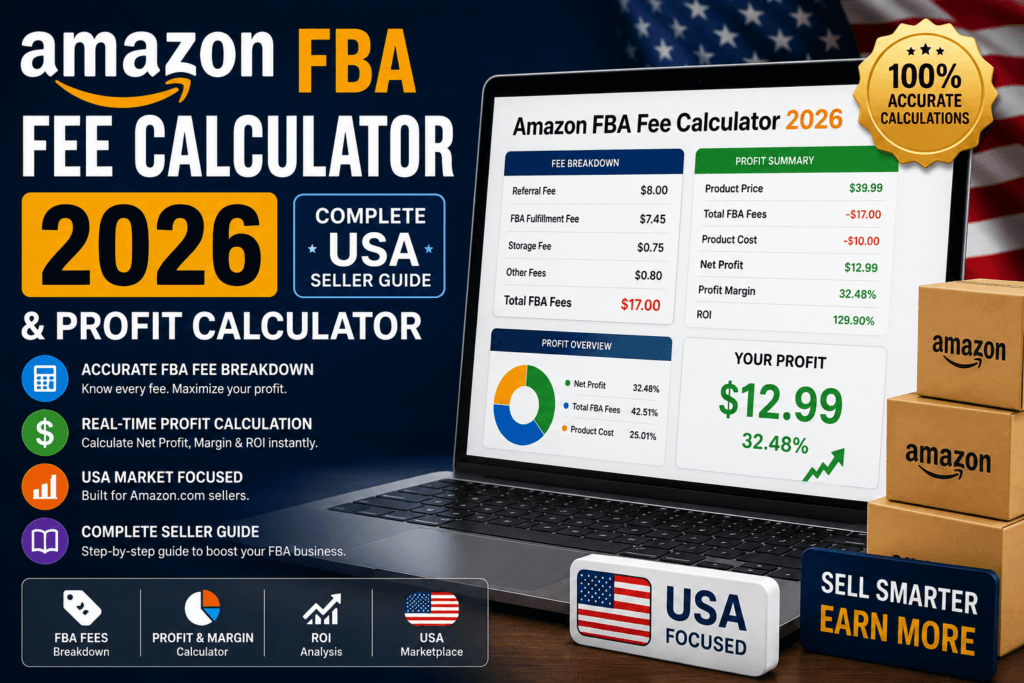
Amazon FBA Fee Calculator 2026: Complete USA Seller Guide & Profit Calculator
Every fee Amazon charges FBA sellers in 2026, explained in plain English, plus the exact formula and free calculator US sellers use to know their real profit before they buy a single unit of inventory.
In 2026, Amazon FBA fees usually eat between 30% and 45% of a standard-size product’s selling price once you combine the referral fee, fulfillment fee, and storage fee. The only reliable way to know your exact number for a specific product is to run it through an Amazon FBA Fee Calculator before you place a purchase order, because fees change by category, size tier, and season.
If you sell on Amazon, you already know the frustrating truth: the price tag on your product is not what you actually earn. Amazon takes a cut at almost every stage — when the item sells, when it sits in a warehouse, when it gets picked and packed, and sometimes again when it doesn’t sell fast enough. Most new sellers discover this the hard way, after they’ve already ordered 500 units of a product that turns out to lose money on every single sale.
This guide breaks down exactly how Amazon FBA fees work in 2026, walks through the real math with worked examples, and shows you how to use a free calculator to protect your margins before you commit a single dollar to inventory. Everything below reflects the current 2026 fee structure used by Amazon Seller Central for the US marketplace.
What’s in this guide
- What are Amazon FBA fees, exactly?
- The 6 FBA fees that affect almost every seller in 2026
- 2026 FBA fulfillment fee table by size tier
- Amazon referral fees by category
- Storage fees and why Q4 changes everything
- The exact formula to calculate your true FBA profit
- A full worked example: $24.99 kitchen product
- How to use the free Amazon FBA Fee Calculator
- 7 mistakes that quietly destroy seller margins
- 5 strategies to lower your effective FBA fees
- Frequently asked questions
What Are Amazon FBA Fees, Exactly?
Fulfillment by Amazon (FBA) is the program where you ship your inventory to Amazon’s warehouses, and Amazon handles storage, packing, shipping, customer service, and returns for every order. In exchange for that convenience, Amazon charges a combination of fees that fall into three broad buckets:
- Referral fees — a percentage of the sale price, charged on every unit sold, regardless of fulfillment method.
- Fulfillment fees — a flat per-unit charge based on the size and weight of your package, covering picking, packing, and shipping.
- Storage and surcharge fees — monthly charges based on how much space your inventory occupies, plus penalty fees for slow-moving or oversized stock.
Each of these categories has its own rules, and Amazon revises the rates at least once a year, sometimes mid-year for storage during peak season. That’s exactly why relying on a number you remember from 2023 or 2024 is one of the fastest ways to misprice a product in 2026.
The 6 FBA Fees That Affect Almost Every Seller in 2026
Not every seller pays every fee Amazon offers, but these six show up on the vast majority of FBA profit and loss statements:
1. Referral Fee
This is Amazon’s commission for giving you access to its marketplace and customers. It’s calculated as a percentage of your total selling price (item price plus shipping, if you charge it), and the percentage depends entirely on the product category — it ranges from around 8% for some electronics accessories up to 17% or higher for categories like jewelry or certain apparel items.
2. FBA Fulfillment Fee
This flat fee covers the labor and packaging materials to pick your product off the shelf, pack it, and ship it to the customer. It’s based on the dimensional weight of the package (the greater of actual weight or volumetric weight), not the selling price. This means a $9.99 item and a $90 item of the same size and weight pay the same fulfillment fee in dollar terms — which is brutal on margin for low-priced products.
3. Monthly Inventory Storage Fee
Amazon charges per cubic foot of space your inventory occupies in its warehouses, billed monthly. Rates roughly double or more during the October-to-December peak period because warehouse space is at its most valuable right before the holidays.
4. Aged Inventory Surcharge (Long-Term Storage Fee)
If a unit sits in an Amazon warehouse for more than 270 days without selling, you’re charged an additional aged inventory surcharge on top of the regular storage fee. This fee escalates the longer the item sits, and it’s designed to push sellers to either discount or remove slow-moving stock.
5. Low-Inventory-Level Fee
Introduced to discourage thin, just-in-time stocking, this fee applies when your inventory of a SKU drops below a threshold relative to how fast it historically sells. It’s one of the newer charges that catches sellers off guard in 2026 because it didn’t exist a few years ago.
6. Returns Processing Fee
For certain categories (notably apparel and shoes), Amazon charges a fee to process customer returns, separate from the original fulfillment fee. High return-rate categories see this hit margins meaningfully over a year.
Why this matters: Most sellers only budget for the referral fee and the fulfillment fee. The other four fees above are exactly the ones that quietly turn a “profitable” product into a break-even or losing one over a full selling cycle.
2026 FBA Fulfillment Fee Table by Size Tier (Standard Size, USA)
The table below summarizes approximate 2026 fulfillment fee ranges by size tier for standard-size, non-apparel products shipped to US customers. Always confirm the exact figure for your specific product weight and dimensions with a calculator, since Amazon prices in narrow weight bands within each tier.
| Size Tier | Typical Dimensions | Typical Weight | Approx. Fulfillment Fee |
|---|---|---|---|
| Small Standard | Up to 15 x 12 x 0.75 in | Up to 4 oz | $3.00 – $3.80 |
| Small Standard | Up to 15 x 12 x 0.75 in | 4 oz – 16 oz | $3.80 – $4.50 |
| Large Standard | Up to 18 x 14 x 8 in | Up to 1 lb | $4.50 – $5.30 |
| Large Standard | Up to 18 x 14 x 8 in | 1 lb – 3 lb | $5.30 – $6.80 |
| Large Standard | Up to 18 x 14 x 8 in | 3 lb – 20 lb | $6.80 – $9.50+ |
| Large Bulky | Up to 59 x 33 x 33 in | Up to 50 lb | $9.50 – $14.00+ |
| Extra-Large | Above bulky thresholds | Above 50 lb | $20.00 – $200.00+ |
Notice how steep the jump is between size tiers. This is exactly why experienced sellers obsess over packaging dimensions — shaving half an inch off a package can drop a product into a cheaper tier and save thousands of dollars a year at scale.
Amazon Referral Fees by Category in 2026
Referral fees are simpler in structure but vary widely by category. Here are common 2026 rates for popular categories selling to US customers:
| Category | Typical Referral Fee |
|---|---|
| Electronics Accessories | 8% |
| Home & Kitchen | 15% |
| Toys & Games | 15% |
| Beauty & Personal Care | 8% – 15% |
| Apparel | 17% |
| Jewelry | 20% |
| Grocery | 8% – 15% |
| Sports & Outdoors | 15% |
Some categories also enforce a minimum referral fee (often around $0.30 to $0.50 per unit), which matters more on very cheap items where a percentage-based fee would otherwise be tiny.
Storage Fees and Why Q4 Changes Everything
Storage fees are charged per cubic foot per month, and Amazon splits the year into two pricing windows: January through September, and October through December. The October-December rate is significantly higher because it covers the holiday shopping rush, when warehouse space is scarcest.
For sellers stocking up ahead of Black Friday and the December holiday season, this means the same pallet of inventory can cost two to three times more to store in November than it would in July. Smart sellers time their inbound shipments to land just before peak demand, rather than letting stock sit through the expensive months waiting to sell.
The Exact Formula to Calculate Your True FBA Profit
Here is the formula every serious FBA seller should run before sourcing a product:
Net Profit = Selling Price − Referral Fee − FBA Fulfillment Fee − Monthly Storage Fee (allocated per unit) − Cost of Goods − Inbound Shipping Cost − Advertising Spend − Other Fees (returns, prep, labeling)
Most sellers stop at “selling price minus cost of goods minus referral fee” and call that their margin. That’s incomplete. Fulfillment fees, storage costs allocated across the units you actually sell (not just the units you bought), and advertising cost per sale are what separate a spreadsheet that looks good from a bank account that actually grows.
A Full Worked Example: $24.99 Kitchen Product
Let’s apply the formula to a realistic product: a silicone kitchen utensil set selling for $24.99, classified as Large Standard size, weighing 1.2 lb after packaging.
- Selling price: $24.99
- Referral fee (15% Home & Kitchen): $24.99 × 0.15 = $3.75
- FBA fulfillment fee (Large Standard, 1–3 lb tier): approximately $6.20
- Storage fee allocated per unit (non-peak season): approximately $0.35
- Cost of goods (manufactured overseas, landed cost): $4.50
- Inbound freight to Amazon warehouse, per unit: $0.80
- Average advertising cost per sale (ACoS-adjusted): $2.50
Adding up the deductions: $3.75 + $6.20 + $0.35 + $4.50 + $0.80 + $2.50 = $18.10 in total cost.
Net profit per unit: $24.99 − $18.10 = $6.89, which is roughly a 27.5% net margin. That’s a healthy number — but notice that fulfillment and referral fees alone ($9.95) outweigh the cost of the product itself ($4.50). This is the single most common surprise for new sellers: Amazon’s fees, not your supplier’s price, are usually your biggest line-item cost.
How to Use the Free Amazon FBA Fee Calculator
Doing this math by hand for every product idea is slow and error-prone, especially since fulfillment fee bands change by fractions of a pound. The faster, more reliable approach is to run your numbers through a dedicated Amazon FBA Fee Calculator, which already has the current 2026 fee tables built in.
- Enter your selling price. This is the price you plan to list the product at on Amazon.com.
- Enter package dimensions and weight. Use the final, sealed package weight and size, not the bare product, since Amazon charges based on shipped dimensions.
- Select your product category. The calculator applies the correct referral fee percentage automatically.
- Add your cost of goods and shipping cost. This is the only manual input the calculator can’t pull from Amazon’s published rates.
- Review your estimated net profit and margin percentage instantly. Adjust price or sourcing cost until the margin meets your target, before you ever place a purchase order.
Running three or four price-point scenarios through the calculator before sourcing takes less than two minutes and can save you from a product launch that loses money from day one.
Calculate Your Exact FBA Profit in Seconds
Stop guessing. Enter your product details and get an instant, accurate breakdown of every Amazon fee for 2026.
Open the Free FBA Fee Calculator →7 Mistakes That Quietly Destroy Seller Margins
- Using last year’s fee numbers. Fulfillment and storage fees are revised annually, and sometimes mid-year, so a calculation from 2024 can be meaningfully wrong in 2026.
- Measuring the product, not the shipped package. Amazon charges based on the sealed package size, which is almost always larger than the bare product.
- Ignoring dimensional weight. A light but bulky item (like a large pillow) can be charged based on volume, not actual weight, pushing it into a far more expensive tier.
- Forgetting long-term storage surcharges. A product that sells slowly can rack up aged inventory fees that erase months of profit.
- Not allocating advertising cost per unit. Many sellers calculate margin before subtracting their average ad spend per sale, which inflates the perceived profit.
- Overlooking return rates in categories like apparel. Return processing fees and lost inventory from damaged returns both eat into net margin.
- Pricing based on competitors instead of your own cost structure. Matching a competitor’s price without checking your own fee structure can lock you into a losing product.
5 Strategies to Lower Your Effective FBA Fees
1. Optimize Packaging Dimensions
Even a small reduction in package size can move a product into a cheaper size tier. Work with your supplier on tighter, more efficient packaging before you ship inventory to Amazon.
2. Bundle Complementary Products
Selling two or three related items as one bundle spreads the fulfillment fee across a higher selling price, often improving your overall margin percentage compared to selling each item separately.
3. Time Inventory Shipments Around Peak Storage Pricing
Ship inventory to land just ahead of high-demand periods rather than months in advance, to avoid paying the elevated October-December storage rate on stock that hasn’t sold yet.
4. Monitor and Liquidate Aged Inventory Early
Set a internal rule to discount or remove inventory before it crosses the 270-day aged threshold, since the long-term storage surcharge accelerates the longer stock sits unsold.
5. Re-run Your Numbers Every Quarter
Because Amazon updates fees throughout the year, re-check your top products through a current FBA fee calculator every quarter to catch margin erosion before it becomes a real problem.
Frequently Asked Questions
What is the average Amazon FBA fee per item in 2026?
Most standard-size products carry combined referral, fulfillment, and storage fees that total roughly 30% to 45% of the selling price. The exact number depends heavily on size tier, weight, and product category, which is why a calculator-based approach beats a rule-of-thumb percentage.
How do I calculate my real profit on an Amazon FBA product?
Subtract the referral fee, FBA fulfillment fee, allocated storage fee, cost of goods, inbound shipping, and advertising spend from your selling price. Running these inputs through a dedicated FBA fee calculator gives you an accurate number in seconds instead of an estimate.
Are Amazon FBA fees going up in 2026?
Yes, fulfillment and storage fees have increased nearly every year since 2020, and 2026 continues that trend with adjustments to low-inventory-level fees, oversized item charges, and peak season storage rates. Sellers should re-check margins regularly rather than relying on older figures.
What is the easiest way to avoid losing money on FBA fees?
Calculate total landed cost and every applicable Amazon fee before purchasing inventory, not after listing the product. A free Amazon FBA Fee Calculator lets you test different prices and package sizes instantly so you only source products with a safe, verified margin.
Do FBA fees differ for apparel and shoes?
Yes. Apparel and footwear typically carry higher referral fee percentages and are subject to additional returns processing fees, since these categories have historically high return rates compared to most other product types.
Is FBA still profitable for new sellers in 2026?
FBA remains profitable for sellers who calculate margins accurately before sourcing and choose products with enough price headroom above combined fees. The sellers who struggle are typically the ones who skip fee calculation entirely and rely on guesswork or outdated benchmarks.
About this guide: Figures in this article reflect publicly available 2026 Amazon Seller Central fee schedules for the United States marketplace, combined with applied seller experience analyzing real product P&L data across multiple FBA categories. Exact fees for any individual product should always be verified for the specific size, weight, and category using a current calculator, since Amazon updates rates throughout the year.