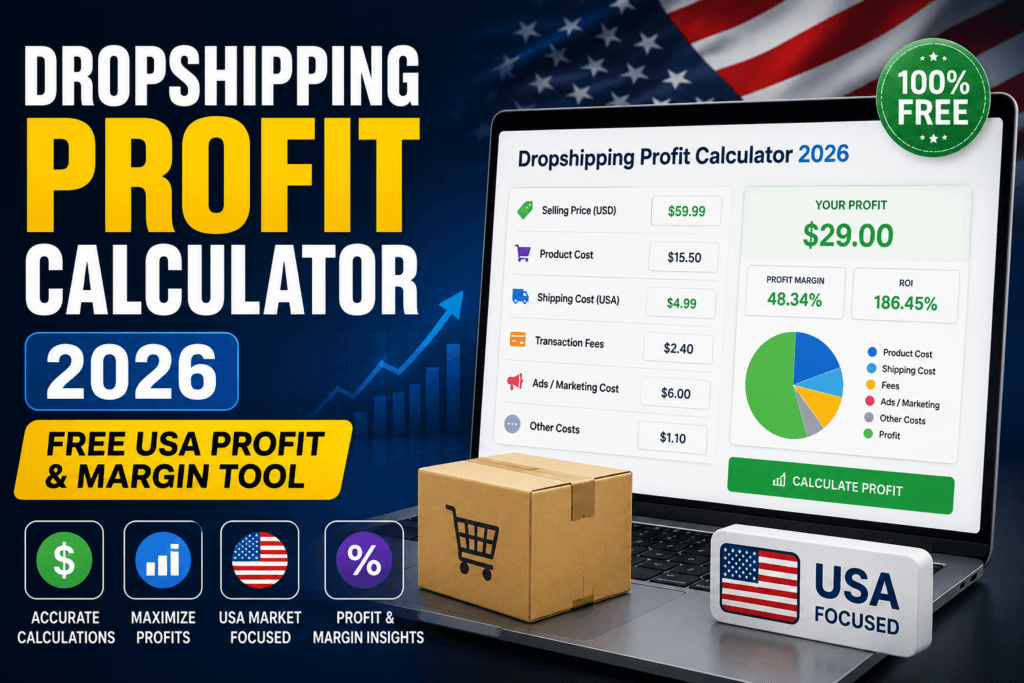
Dropshipping Profit Calculator 2026:
Free USA Profit & Margin Tool
Everything you need to calculate, optimize, and scale your dropshipping profits — with a free calculator built for US sellers.
🧮 Use Free Profit CalculatorIf you’re running a dropshipping store in the USA — or planning to launch one in 2026 — knowing your exact profit margin on every single product is non-negotiable. Sellers who guess at their margins don’t just earn less; they often lose money while thinking they’re profitable. We’ve seen it happen repeatedly: a store doing $80,000/month in revenue generating less than $3,000 in actual net profit because the owner never accounted for all the hidden costs.
That’s why Toolriz’s free Dropshipping Profit Calculator was built: to give US sellers an instant, accurate view of their real earnings before they commit to a product, an ad campaign, or a pricing strategy. This guide walks you through everything — from the core formula to advanced pricing tactics — so you can make every dollar count in 2026.
1. What Is a Dropshipping Profit Calculator?
A dropshipping profit calculator is a specialized financial tool designed to compute your net profit and profit margin percentage on any dropshipping product by factoring in every real cost associated with making a sale. Unlike a simple “revenue minus cost” spreadsheet, a proper profit calculator accounts for the layered cost structure unique to dropshipping businesses.
At its core, the calculator takes inputs including your selling price, supplier cost, shipping fees, platform subscription costs, payment processing percentages, refund rates, and advertising spend — then outputs your net profit in dollar terms and as a percentage of your selling price.
Many beginners calculate gross profit (Selling Price – Product Cost) and stop there. But gross profit ignores transaction fees, ad spend, and platform costs that routinely consume 30–50% of that gross profit. Your net profit is the only number that actually matters.
What a Good Calculator Must Include
- Product cost from your supplier (AliExpress, CJ Dropshipping, US-based supplier, etc.)
- Shipping cost — both what your supplier charges and what you charge your customer
- Platform fees — Shopify, WooCommerce, Amazon, eBay, or Etsy monthly/transaction fees
- Payment processing fees — Stripe, PayPal, Shopify Payments
- Advertising cost per unit sold — your Facebook Ads, Google Ads, or TikTok Ads cost divided by units sold
- Return & refund rate — typically 2–8% for US dropshipping stores
- Sales tax obligations — varies by US state
🧮 Calculate Your Profit in 30 Seconds
Stop guessing your margins. Toolriz’s free calculator gives you instant, accurate results — no signup required.
Open Free Profit Calculator Browse All Free Tools2. Why Profit Margins Are the #1 Metric for US Dropshippers in 2026
Revenue is vanity. Profit is sanity. Nowhere is this more true than in US dropshipping, where advertising costs on Meta and Google have increased significantly year-over-year, payment processing fees chip away at every transaction, and customers expect fast shipping — which costs you more than slow ePacket delivery ever did.
Here’s the reality of the 2026 US dropshipping landscape:
| Cost Category | 2022 Avg | 2026 Avg | Trend |
|---|---|---|---|
| Facebook/Instagram CPM | $9.50 | $13.40 | ↑ +41% |
| Google Shopping CPC | $0.66 | $0.88 | ↑ +33% |
| US Domestic Shipping (avg) | $4.20 | $5.80 | ↑ +38% |
| Shopify Basic Monthly Fee | $29 | $39 | ↑ +34% |
| Avg Product Return Rate (US) | 4.2% | 5.8% | ↑ Higher |
| Payment Processing (Stripe) | 2.9% + $0.30 | 2.9% + $0.30 | Stable |
Every one of these rising costs attacks your margin directly. A seller with a 15% net margin in 2022 might now be operating at 8–10% if they haven’t renegotiated supplier costs, optimized ad ROAS, or raised prices. Without precise margin tracking, you’re flying blind into rising headwinds.
3. The Complete Dropshipping Profit Formula (2026)
Let’s be precise. Here is the full formula used by serious US dropshippers and the same logic powering the Toolriz Profit Calculator:
Worked Example: Selling a $49.99 Phone Stand
| Item | Amount |
|---|---|
| Selling Price | $49.99 |
| Supplier Product Cost | −$11.50 |
| Shipping to Customer | −$4.80 |
| Shopify Fee (Basic, amortized per order) | −$1.30 |
| Stripe Fee (2.9% + $0.30) | −$1.75 |
| Facebook Ads Cost Per Unit | −$8.00 |
| Refund Reserve (4% of $49.99) | −$2.00 |
| Net Profit | $20.64 |
| Net Profit Margin | 41.3% |
This example shows a healthy 41.3% margin — but notice how advertising alone consumed $8 per unit. If ad performance worsens and cost-per-unit rises to $15, margin drops to just 27.3%. That’s why calculating before and continuously monitoring during campaigns is essential.
Run the Toolriz calculator at three ad-spend scenarios — best case, expected, and worst case — so you know your break-even point before launching any campaign.
4. Every Fee You Must Include in Your Calculation
Most failed dropshipping businesses don’t fail because of bad products — they fail because the seller never accounted for 2–4 fees that silently bled profits dry. Here is a comprehensive breakdown of every cost category you must include.
4.1 Supplier & Product Costs
This is your product cost — what you pay the supplier per unit. Sources vary by region and supplier type:
- AliExpress / Alibaba suppliers — Lowest unit cost, slower shipping (7–30 days). Best for testing.
- CJ Dropshipping / Zendrop — Mid-range cost, faster fulfillment (5–12 days), US warehouses available.
- US-based dropshippers (SaleHoo, Spocket) — Higher cost ($15–30 vs. $5–12 for equivalent items), but 2–5 day shipping increases conversion and lowers return rates.
- Branded private-label suppliers — Premium cost, but allows much higher retail pricing and repeat purchase rates.
4.2 Shipping & Fulfillment Fees
There are two shipping numbers that matter: what your supplier charges you, and what you charge your customer. Many sellers offer free shipping (built into product price) to improve conversion — but this means you absorb 100% of fulfillment costs.
| Shipping Method | Transit Time | Typical Cost (US) | Best For |
|---|---|---|---|
| ePacket / AliExpress Standard | 15–30 days | $0–$3 | Budget testing |
| CJ Packet Ordinary | 8–15 days | $3–$6 | Budget + speed balance |
| US Warehouse (Zendrop/CJ) | 2–5 days | $5–$12 | High AOV products |
| FedEx / UPS (domestic supplier) | 1–3 days | $8–$18 | Premium products |
4.3 Platform & Marketplace Fees
Shopify
- Basic plan: $39/month + 2% transaction fee (waived with Shopify Payments)
- Shopify plan: $105/month + 1% transaction fee (waived with Shopify Payments)
- Advanced: $399/month + 0.5% transaction fee (waived with Shopify Payments)
Amazon (FBM Dropshipping)
- Referral fee: 6–15% of sale price (varies by category)
- Professional plan: $39.99/month flat
- No additional transaction fee beyond referral
eBay
- Final value fee: 10–15% of total sale including shipping
- Insertion fees (after free listings): $0.35/listing
Etsy
- Listing fee: $0.20 per item
- Transaction fee: 6.5% of sale price + shipping
- Payment processing: 3% + $0.25
4.4 Payment Processing Fees
| Processor | Fee Structure | Avg on $50 Sale |
|---|---|---|
| Shopify Payments | 2.9% + $0.30 (Basic) | $1.75 |
| Stripe | 2.9% + $0.30 | $1.75 |
| PayPal (Standard) | 3.49% + $0.49 | $2.24 |
| Square | 2.9% + $0.30 | $1.75 |
| Klarna / Afterpay | 2–6% (BNPL premium) | $1.50–$3.00 |
4.5 Advertising Cost Per Unit
This is the most variable — and most ignored — cost. To calculate your advertising cost per unit:
If your ROAS (Return on Ad Spend) is 3x on a $50 product, you’re spending ~$16.67 per $50 in revenue — meaning ads consume 33% of your revenue before any other costs. Track ROAS daily.
4.6 Return & Chargeback Reserve
US customers have high return rate expectations. Budget 3–8% of revenue as a refund reserve depending on your product category:
- Electronics/gadgets: 6–10% return rate
- Clothing/apparel: 20–30% return rate (size issues)
- Home décor / general: 3–5% return rate
- Health & beauty: 2–4% return rate
Clothing dropshipping has the highest return rate of any category. A 25% return rate on a 30% gross margin product often results in negative net profit. Always calculate with realistic return rates before choosing a niche.
🚀 Run the Numbers Right Now
Enter your product details once and instantly see your net profit, margin %, and break-even ROAS.
Calculate My Profit →5. How to Use Toolriz’s Free Dropshipping Profit Calculator
The Toolriz Dropshipping Profit Calculator is free, requires no account, and produces instant results. Here’s exactly how to use it to get the most accurate numbers possible:
Enter Your Selling Price
Input the price your customer pays (before any discount codes). This is your revenue per unit. If you offer tiered pricing, run the calculator once for each tier.
Enter Supplier Product Cost
This is what you pay your supplier per unit. Include any per-unit packaging, labeling, or branding charges. Do not include monthly supplier subscription fees here — factor those into platform fees.
Add Shipping Costs
Enter the shipping cost your supplier charges you. If you charge your customer for shipping, enter your net shipping cost (supplier charge minus what customer pays). If you offer free shipping, enter the full supplier shipping charge.
Enter Platform & Transaction Fees
Select your platform or enter custom fee percentages. For Shopify Basic without Shopify Payments, include the 2% transaction fee plus your payment processor fee (2.9% + $0.30). The calculator handles the math.
Add Your Ad Cost Per Unit
Use your historical data if available. If you’re pre-launch, estimate conservatively: assume a ROAS of 2–2.5x and calculate backward. For example, at 2x ROAS on a $50 product, you spend $25 in ads to generate $50 — meaning ad cost per unit is $25.
Review Your Net Profit & Margin
The calculator instantly shows your net profit in dollars and profit margin percentage. If margin is below 20%, reconsider your supplier, pricing, or ad strategy before launching.
Run the calculator three times: (1) with your target ROAS, (2) with a 20% worse ROAS, and (3) break-even ROAS. This gives you a margin safety zone and tells you exactly when a campaign becomes unprofitable.
6. USA Profit Margin Benchmarks by Niche (2026 Data)
Not all niches deliver equal margins. Here are realistic 2026 benchmarks for popular US dropshipping categories, assuming proper cost accounting:
| Niche | Avg Selling Price | Typical Net Margin | Return Rate | Difficulty |
|---|---|---|---|---|
| Home & Kitchen Gadgets | $25–$65 | 25–40% | 3–5% | Medium |
| Pet Supplies | $20–$80 | 30–45% | 2–4% | Low–Med |
| Health & Beauty | $30–$90 | 35–50% | 3–6% | Medium |
| Tech Accessories | $20–$60 | 20–35% | 6–10% | Medium |
| Baby Products | $25–$70 | 28–42% | 4–7% | Medium |
| Fitness & Sports | $30–$100 | 25–40% | 5–8% | High |
| Clothing & Apparel | $25–$80 | 8–20% | 20–30% | Very High |
| Office & Productivity | $20–$55 | 30–45% | 2–4% | Low–Med |
| Car Accessories | $20–$75 | 30–48% | 3–5% | Low–Med |
Note that pet supplies, health & beauty, and car accessories consistently outperform apparel in net margin due to lower return rates and strong emotional purchase drivers. These niches also tend to have high repeat purchase rates, building customer lifetime value beyond the first sale.
7. 10 Proven Strategies to Increase Your Dropshipping Profit in 2026
Strategy 1: Negotiate Volume-Based Pricing With Your Supplier
Most AliExpress and CJ Dropshipping sellers will reduce unit cost by 5–15% once you demonstrate 50+ orders per month. Never pay the listed rate long-term. Open direct communication with your supplier and request tiered pricing at 50, 100, and 200 monthly units.
Strategy 2: Improve Ad ROAS Through Creative Testing
The single biggest lever on your profit margin is ad spend efficiency. A ROAS increase from 2x to 3x on a $50 product, spending $15 instead of $25 per sale, adds $10 directly to your net profit. Dedicate 20% of your weekly ad budget to testing new ad creatives — UGC-style videos, product demonstrations, and comparison ads typically outperform static images in 2026.
Strategy 3: Implement Post-Purchase Upsells
Post-purchase upsells (offered immediately after checkout confirmation) have 15–35% conversion rates because the customer is in maximum buying mode. A $12 complementary product upsell with a $9 cost means $3 profit on a transaction that already covered all your fixed costs — pure margin gain.
Strategy 4: Bundle Products to Increase Average Order Value
Bundling two or three related products at a slight discount increases your average order value (AOV) without proportionally increasing your ad spend. If your current AOV is $45, raising it to $65 through bundles often increases net profit by 40–60% per order while keeping acquisition cost flat.
Strategy 5: Reduce Return Rates With Better Product Pages
Every return costs you: the original shipping fee is non-recoverable, you may pay return shipping, and the product is often unsellable. Reduce returns by 30–50% by adding accurate sizing guides, realistic product photos, clear FAQs, and video demonstrations to your product pages. This is free margin improvement.
Strategy 6: Switch to US-Based Suppliers for Premium Products
For any product priced above $60, US-based supplier fulfillment (3–5 day delivery) dramatically improves conversion rates and reduces returns — both of which expand margins. The higher supplier cost is often offset by better performance.
Strategy 7: Optimize Shopify Plan vs. Payment Processor Combo
On the Shopify Basic plan, using Shopify Payments eliminates the 2% transaction fee. On a store doing $30,000/month, this saves $600/month — $7,200/year in pure margin recovery. Audit your platform fee structure quarterly.
Strategy 8: Build an Email List for Zero-Cost Repeat Sales
Repeat customers cost $0 in ad spend. A customer who purchased once and returns via email campaign is 100% margin on acquisition cost. Build an automated email sequence (welcome → educational → offer) to reactivate past customers every 30–60 days. Even a 5% email conversion rate on a 1,000-person list generates 50 sales with no ad spend.
Strategy 9: Implement Subscription or Auto-Ship for Consumables
If your product is consumable (supplements, coffee, pet food, skincare), a subscription model turns one-time buyers into recurring revenue with zero re-acquisition cost. The LTV (lifetime value) of a subscription customer is typically 3–8x that of a one-time buyer.
Strategy 10: Price Test Strategically
Most dropshippers underprice. US consumers — especially on Shopify stores — associate higher prices with higher quality. Test pricing 20–40% above your current price on a duplicate product listing. Conversion rates rarely drop enough to offset the margin gain. A product at $59 that converts at 2.1% beats the same product at $49 converting at 2.5% once you account for all per-unit costs.
📊 Validate Every Strategy With Hard Numbers
Before implementing any margin strategy, run your before and after numbers through the calculator to quantify the exact impact.
Open Profit Calculator More Free Business Tools8. 7 Costly Margin Mistakes US Dropshippers Make (And How to Fix Them)
Mistake 1: Calculating Profit Without Advertising Costs
The problem: Sellers calculate product cost vs. selling price and think they have 50% margins — then run ads and discover they’re losing money.
The fix: Always include your blended cost-per-acquisition (CPA) from paid ads in every profit calculation. Use historical CPA if available; estimate conservatively if launching new products.
Mistake 2: Using Gross Margin to Make Scaling Decisions
The problem: Scaling ad spend on a product with 40% gross margin but 5% net margin destroys cash flow at scale.
The fix: Make every business decision — including scaling — based exclusively on net margin after all costs.
Mistake 3: Not Accounting for Payment Processor Fees
The problem: On $100,000/month revenue, Stripe/PayPal fees consume $2,900–$3,490 — nearly $40,000/year. Many sellers never factor this in.
The fix: Build payment processing percentages into your standard cost model for every product and every pricing decision.
Mistake 4: Ignoring Chargebacks
The problem: US chargebacks average 0.5–1.5% of transactions in e-commerce. Each chargeback typically costs you the product cost, shipping, AND a $15–$25 chargeback fee from your payment processor.
The fix: Reserve 0.5–1% of revenue as a chargeback buffer. Investigate any product with a chargeback rate above 1% — it signals product quality or description issues.
Mistake 5: Forgetting Shopify App Subscriptions
The problem: The average Shopify store accumulates $150–$300/month in app subscriptions (reviews, email, upsells, tracking, etc.). These are real business costs that reduce per-order margins.
The fix: Total your monthly app subscriptions and divide by monthly order volume to get your per-order overhead. Include this in every margin calculation.
Mistake 6: Not Testing Prices Before Scaling
The problem: Sellers assume lowering price increases sales enough to compensate for thinner margins. This is rarely true for branded or niche products.
The fix: A/B test pricing before scaling. Higher prices often perform comparably at 2–3% lower conversion rates while adding 10–15% more net profit per unit.
Mistake 7: Underestimating Return-Related Costs
The problem: Sellers budget 5% for returns but forget that each return also incurs processing labor costs, return shipping fees (if offered), and the product is often not resellable — resulting in total write-offs.
The fix: Budget the full cost of a return: shipping both ways + product cost × return rate. For some niches, true return cost is 1.5–2x the product cost.
9. Advanced Pricing Strategies for Maximum Dropshipping Profit
The 3x Markup Rule (And When to Break It)
The traditional dropshipping rule is to sell at 3x your total landed cost (product + shipping). On a product that costs you $12 including shipping, the 3x rule suggests a $36 selling price. This rule ensures enough gross margin to survive ad costs and fees — but it’s a starting point, not a ceiling.
In 2026’s US market, products with strong perceived value, unique positioning, or strong creative advertising support can achieve 4x–6x markups. A $10 product marketed correctly as a premium US-brand equivalent can sell for $59.99 with strong conversion rates.
Psychological Pricing for US Consumers
US buyers respond predictably to certain price points. Key principles for your Shopify store:
- Charm pricing: $49.99 consistently outperforms $50.00 in A/B tests by 3–8%
- Anchor pricing: Show a “compare at” price (your MSRP or retail equivalent) to establish value — crossed-out pricing increases perceived savings
- Bundle threshold pricing: “Spend $75, get free shipping” — threshold pricing increases AOV by 15–25% on average
- Tiered bundles: 1-pack at $35 → 2-pack at $59 → 3-pack at $79 — multi-packs typically convert at 25–40% of single-item conversion but dramatically boost AOV and margin
Dynamic Pricing: Monitoring Competitors
In highly competitive niches, monitor competitor pricing weekly. Tools like Price2Spy, Prisync, and Wiser allow automated competitive monitoring. When competitors lower prices, avoid a race to the bottom — instead, reinforce your value differentiators (faster shipping, better warranty, superior reviews).
Seasonal Pricing Adjustments
US consumer spending peaks around Q4 (Black Friday through Christmas). During peak demand periods, your ad CPM increases 40–100% — but consumer willingness to pay also rises. Adjust your prices UP by 10–20% in November–December to maintain margins while CPMs spike. Most sellers who keep prices flat during Q4 actually see margin compression despite higher revenue.
10. US Sales Tax & Income Tax for Dropshippers
Tax compliance is a margin factor that many US dropshippers mishandle — sometimes fatally. Here’s what you must know in 2026.
Sales Tax After South Dakota v. Wayfair (2018)
The 2018 Supreme Court ruling in South Dakota v. Wayfair eliminated the physical nexus requirement for state sales tax collection. As a US dropshipper, you may owe sales tax in any state where you exceed that state’s economic nexus threshold — typically $100,000 in annual sales or 200 transactions.
Most major US states now enforce this. Platforms like Shopify with Shopify Tax, TaxJar, or Avalara can automatically calculate and collect the correct sales tax at checkout, preventing compliance issues.
The Impact on Margin
Sales tax doesn’t affect your net profit directly — it’s collected from the customer and remitted to the state. However, failure to collect sales tax creates a liability where you must pay the back taxes out of pocket. This can be a devastating surprise for sellers who’ve been operating without tax compliance for 12–24 months.
Income Tax: Self-Employment Considerations
As a dropshipping business owner in the US, your net business profit is subject to self-employment tax (15.3% on the first $160,200 in 2024, 2.9% above that) plus federal and state income taxes. Structuring your business as an S-Corporation — once your net profit exceeds $40,000/year — allows you to classify a portion of income as a distribution rather than self-employment income, saving thousands annually.
This section provides general educational information only. Tax laws change annually and vary by individual circumstance. Always consult a licensed US CPA or tax attorney for advice specific to your business situation.
11. Frequently Asked Questions
Conclusion: Margins Are the Business — Track Them Obsessively
Every dollar of dropshipping revenue that doesn’t make it to net profit is a dollar of wasted effort. In 2026, with rising ad costs, competitive US markets, and demanding customers, the sellers who win aren’t necessarily the ones with the most creative products — they’re the ones who know their numbers cold.
Use the Toolriz Dropshipping Profit Calculator before you select a product, before you set a price, before you scale a campaign, and after every meaningful change to your cost structure. Make margin review a weekly ritual. Know your break-even ROAS. Negotiate supplier costs at every milestone. Build repeat purchase channels that cost you nothing in acquisition.
The gap between a 15% net margin store and a 35% net margin store — on the same revenue — is the difference between exhausting hustle and a real, scalable business. You now have the formula, the benchmarks, the strategies, and the tool. Execute with precision.
🧮 Start Calculating Your True Profit Today
Free, instant, no signup. The most important 60 seconds you’ll spend on your dropshipping business.
Open Free Calculator → Explore All Free Tools