

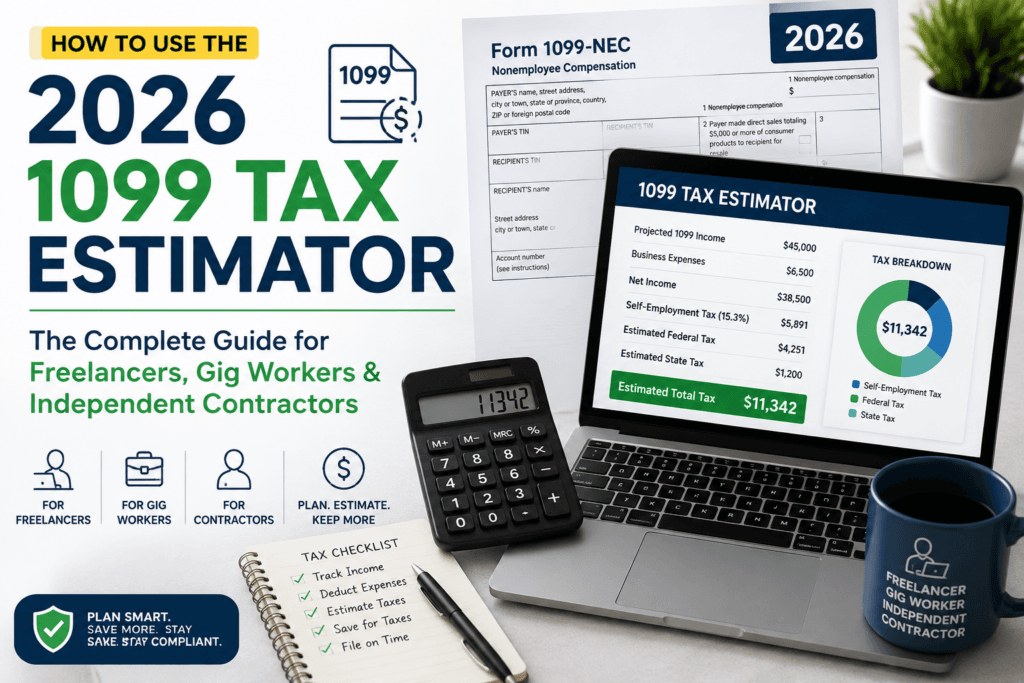
How to Use the 2026 1099 Tax Estimator: The Complete Guide for Freelancers, Gig Workers & Independent Contractors
A practical, step-by-step walkthrough of the 1099 tax calculator 2026 — including real dollar examples, quarterly deadlines, and the exact deductions that lower what you owe.
What You’ll Learn in This Guide
- What “1099 Tax” Actually Means
- How the 1099 Tax Estimator Works, Step by Step
- Understanding the 15.3% Self-Employment Tax
- Real Tax Examples: $30K, $50K, $80K, and $100K in 1099 Income
- Quarterly Estimated Tax Payments for 2026
- 1099 vs. W-2: Why Your Tax Bill Looks So Different
- Tax Notes for Etsy Sellers, Freelance Writers, and Rideshare Drivers
- Deductions That Actually Move the Needle
- Common Mistakes That Trigger Penalties
- Frequently Asked Questions
If you’ve ever opened a 1099-NEC form in January and felt a small wave of panic, you’re not alone. Nobody withholds taxes from freelance income the way an employer withholds them from a paycheck, which means the entire burden of figuring out — and setting aside — the right amount lands on you. That’s exactly the gap a 1099 tax estimator is built to close.
This guide walks through exactly how to use a 1099 tax calculator for the 2026 tax year, why the math works the way it does, and how much you should realistically expect to set aside based on your actual income level. We’ll use real numbers, not vague percentages, because “set aside 25-30%” only helps if you know what that means for your specific paycheck.
What “1099 Tax” Actually Means
When a business pays you as a contractor instead of an employee, they report your earnings on a Form 1099 (usually a 1099-NEC for services, or a 1099-K if you were paid through a platform like PayPal, Etsy, or a rideshare app). No federal income tax, no Social Security, and no Medicare tax is withheld from those payments. That entire responsibility shifts to you, and it shows up in two separate layers:
- Self-employment tax — this covers your share of Social Security and Medicare, and it’s a flat 15.3% on most of your net earnings.
- Federal (and often state) income tax — calculated on a graduated scale based on your total taxable income, filing status, and deductions.
Together, these two layers are what people mean when they talk about “1099 taxes.” A 1099 tax calculator 2026 tool combines both layers into a single, realistic estimate so you’re not caught off guard when the tax deadline arrives.
How the 1099 Tax Estimator Works, Step by Step
A well-built 1099 tax estimator isn’t just a percentage multiplier. It’s meant to mirror the actual IRS calculation as closely as possible, using the inputs that genuinely change your tax bill. Here’s the process behind a tool like the free 1099 Tax Estimator on Toolriz:
- Enter your gross 1099 income. This is the total amount reported across all your 1099-NEC and 1099-K forms for the year, before any expenses are subtracted.
- Subtract business expenses. Software subscriptions, mileage, home office costs, equipment, and other ordinary business expenses reduce your net self-employment income — and that net figure is what actually gets taxed.
- Calculate net earnings from self-employment. The IRS applies a 92.35% factor to your net profit before calculating self-employment tax, which accounts for the “employer half” you’re effectively paying yourself.
- Apply the 15.3% self-employment tax rate. This funds Social Security (12.4%, up to the annual wage base) and Medicare (2.9%, uncapped, with an additional 0.9% surtax at higher income levels).
- Add estimated federal income tax. The calculator layers on federal income tax using the current bracket structure, factoring in your filing status and the standard or itemized deduction.
- Factor in state tax, if applicable. Some states have no income tax at all; others tax self-employment income at rates ranging from roughly 3% to over 10%.
- Display your total estimated tax and suggested quarterly payment. The final number is broken down into what you’d owe for the full year and what that means per quarter if you’re paying estimated taxes.
Skip the manual math
Plug in your income and expenses once, and let the calculator handle the self-employment tax, income tax, and quarterly breakdown for you.
Try the Free 1099 Tax Estimator →Understanding the 15.3% Self-Employment Tax
This is the single most misunderstood part of 1099 taxes, so it’s worth slowing down here. The self-employment tax rate of 15.3% is made up of two separate pieces:
| Component | Rate | Applies To |
|---|---|---|
| Social Security portion | 12.4% | Net self-employment earnings up to the annual Social Security wage base |
| Medicare portion | 2.9% | All net self-employment earnings, no cap |
| Additional Medicare surtax | 0.9% | Earnings above roughly $200,000 (single) or $250,000 (married filing jointly) |
A W-2 employee only pays half of this — their employer quietly covers the other half. As a 1099 contractor, you’re both the employee and the employer, so you’re on the hook for the full 15.3%. The one silver lining: you get to deduct half of your self-employment tax when calculating your adjusted gross income, which softens the blow slightly on your income tax bill.
Real Tax Examples: $30K, $50K, $80K, and $100K in 1099 Income
Percentages are abstract. Dollar figures aren’t. Below are simplified, illustrative estimates for a single filer taking the standard deduction, assuming no dependents and no additional income sources. Actual numbers will vary based on your state, deductions, and business expenses — this table exists to show the shape of the curve, not to replace a personalized calculation.
| Net 1099 Income | Est. Self-Employment Tax | Est. Federal Income Tax | Approx. Total Set-Aside |
|---|---|---|---|
| $30,000 | ~$4,240 | ~$1,600–2,300 | ~20–22% |
| $50,000 | ~$7,065 | ~$4,300–5,200 | ~24–26% |
| $80,000 | ~$11,304 | ~$9,000–10,500 | ~26–28% |
| $100,000 | ~$14,130 | ~$13,500–15,000 | ~28–30% |
Notice the pattern: the self-employment tax rate itself stays fixed at 15.3% of net earnings, but your overall tax burden climbs as income rises because federal income tax is progressive. This is exactly why a flat “set aside 25%” rule of thumb works reasonably well around the $40,000–$60,000 range but starts to undershoot at higher income levels — someone earning $100,000 on 1099 income genuinely needs closer to 28–30% set aside, not 25%.
Quarterly Estimated Tax Payments for 2026
The IRS expects self-employed taxpayers to pay taxes as they earn income throughout the year, not in one lump sum the following April. If you expect to owe $1,000 or more for the year, you’re generally required to make quarterly estimated payments. Missing these deadlines can result in an underpayment penalty, even if you pay everything owed by the annual filing deadline.
| Quarter | Income Period Covered | Typical Due Date |
|---|---|---|
| Q1 | January 1 – March 31 | April 15 |
| Q2 | April 1 – May 31 | June 15 |
| Q3 | June 1 – August 31 | September 15 |
| Q4 | September 1 – December 31 | January 15 (following year) |
A practical habit that experienced freelancers swear by: every time you’re paid, immediately move your estimated tax percentage into a separate savings account before you spend or budget the rest. Treat it as money that was never really yours to begin with. By the time each quarterly deadline arrives, the payment is already sitting there waiting — no scrambling required.
1099 vs. W-2: Why Your Tax Bill Looks So Different
People switching from traditional employment to freelance or contract work are often blindsided by how different their tax situation becomes. A quick side-by-side makes the reason obvious:
- Withholding: W-2 employees have taxes withheld automatically every paycheck. 1099 contractors withhold nothing unless they set money aside themselves.
- Employer tax match: A W-2 employer pays half of the 15.3% Social Security and Medicare tax on your behalf. A 1099 contractor pays the entire 15.3% alone.
- Deductible expenses: W-2 employees generally can’t deduct work expenses. 1099 contractors can deduct a wide range of ordinary and necessary business expenses, which lowers taxable income.
- Payment schedule: W-2 tax is paid continuously through payroll. 1099 tax is typically paid in quarterly installments that the contractor has to calculate and send in themselves.
This is precisely why a 1099 vs W2 tax calculator comparison is so useful when someone is deciding between a salaried offer and a contract position: the headline pay rate can look similar on paper while the actual take-home amount differs significantly once these factors are accounted for.
Tax Notes for Etsy Sellers, Freelance Writers, and Rideshare Drivers
Self-employment tax rules apply the same way across professions, but the practical details — what counts as income, what counts as an expense — differ enough that it’s worth breaking down separately.
1099 Tax Calculator for Etsy Sellers
Etsy issues a 1099-K once you cross the reporting threshold, and that figure represents gross sales, not profit. Before estimating your tax, subtract Etsy’s listing fees, transaction fees, payment processing fees, shipping costs, and the cost of materials. Many new sellers accidentally calculate their tax set-aside on gross sales instead of net profit and end up saving far more than they actually need to.
1099 Tax Calculator for Freelance Writers
Freelance writers typically receive multiple smaller 1099-NEC forms from different clients throughout the year rather than one large one. It’s easy to lose track of the running total. Deductible expenses commonly include a portion of internet and phone bills, writing software subscriptions, a home office deduction if you have a dedicated workspace, and professional development costs like courses or industry memberships.
1099 Tax Calculator for Uber and Lyft Drivers
Rideshare drivers usually have the largest deduction opportunity of any 1099 category because of mileage. The standard mileage deduction can offset a substantial portion of gross platform earnings. Between mileage, a percentage of your phone bill, car washes tied to platform requirements, and any passenger-related supplies, net taxable income often ends up considerably lower than the gross amount shown on the 1099-K.
Deductions That Actually Move the Needle
Lowering your taxable income is the most direct way to lower your tax bill, and it happens before the tax rate is ever applied. The deductions with the biggest real-world impact for most 1099 workers include:
- Home office deduction — a portion of rent/mortgage, utilities, and internet based on the percentage of your home used exclusively for business.
- Mileage or vehicle expenses — either the standard mileage rate or actual vehicle costs, for business-related driving.
- Health insurance premiums — self-employed individuals can often deduct premiums paid for themselves and their family.
- Retirement contributions — a SEP-IRA or Solo 401(k) can shelter a meaningful chunk of income from current-year taxation.
- Half of your self-employment tax — automatically factored in when calculating adjusted gross income.
- Software, tools, and supplies — anything ordinary and necessary for running your specific line of work.
Common Mistakes That Trigger Penalties
Most 1099 tax problems aren’t caused by dishonesty — they’re caused by timing and estimation errors. The most frequent ones:
- Setting aside a flat percentage regardless of income level, instead of recalculating as earnings grow throughout the year.
- Skipping quarterly payments entirely and assuming one annual payment in April is fine — this is what triggers underpayment penalties.
- Calculating tax on gross income instead of net income after business expenses are subtracted.
- Forgetting state estimated taxes, which run on a separate schedule from federal payments in most states.
- Not adjusting the estimate after a big new client or seasonal income spike mid-year.
Frequently Asked Questions
How much should I set aside for 1099 taxes?
Most independent contractors should set aside between 25% and 30% of their net self-employment income, though the exact percentage depends on total income, filing status, and available deductions. Lower earners (under roughly $40,000) can often get by with closer to 20–22%, while higher earners typically need closer to 28–30%.
What is the self-employment tax rate for 2026?
The self-employment tax rate is 15.3%, split between 12.4% for Social Security and 2.9% for Medicare. An additional 0.9% Medicare surtax applies to net earnings above roughly $200,000 for single filers.
When are quarterly estimated tax payments due in 2026?
Quarterly payments are generally due April 15, June 15, September 15, and January 15 of the following year. If a due date falls on a weekend or federal holiday, it typically shifts to the next business day.
Do I have to pay quarterly taxes as a freelancer?
If you expect to owe $1,000 or more in tax for the year after subtracting withholding and credits, the IRS generally expects quarterly estimated payments. Skipping them can result in an underpayment penalty even if the full balance is paid by the annual deadline.
What’s the difference between 1099-NEC and 1099-K?
A 1099-NEC reports payments of $600 or more made directly by a client for services performed. A 1099-K reports payments processed through a third-party platform, such as Etsy, PayPal, or a rideshare app, once you cross the platform’s reporting threshold.
Can I lower my 1099 tax bill legally?
Yes. Deducting ordinary business expenses, claiming the home office deduction, tracking mileage accurately, and contributing to a retirement account like a SEP-IRA are all legitimate ways to reduce your taxable self-employment income before tax is calculated.
Get your exact 2026 number in under a minute
Enter your income and expenses into the free calculator to see your estimated self-employment tax, federal tax, and quarterly payment breakdown.
Use the 1099 Tax Estimator →Taxes are one of the few areas of freelance life where guessing is genuinely expensive — either you set aside too little and face a painful bill in April, or you set aside too much and quietly starve your own cash flow all year. The fix isn’t complicated: run your real numbers, revisit the estimate whenever your income shifts meaningfully, and pay quarterly instead of waiting. A calculator built specifically for 1099 income takes the guesswork out of that process and gives you a number you can actually plan around.
Looking for more free calculators beyond taxes? Toolriz has a full library of free online tools covering everything from e-commerce fees to everyday conversions — all free, with no signup required.