

Your Job Offer Has Two Numbers. Only One of Them Is on the Offer Letter.
A relocation salary calculator is supposed to answer one question: will this move leave you richer or poorer? Most tools online only calculate half of that answer. Here’s how to get the whole number.
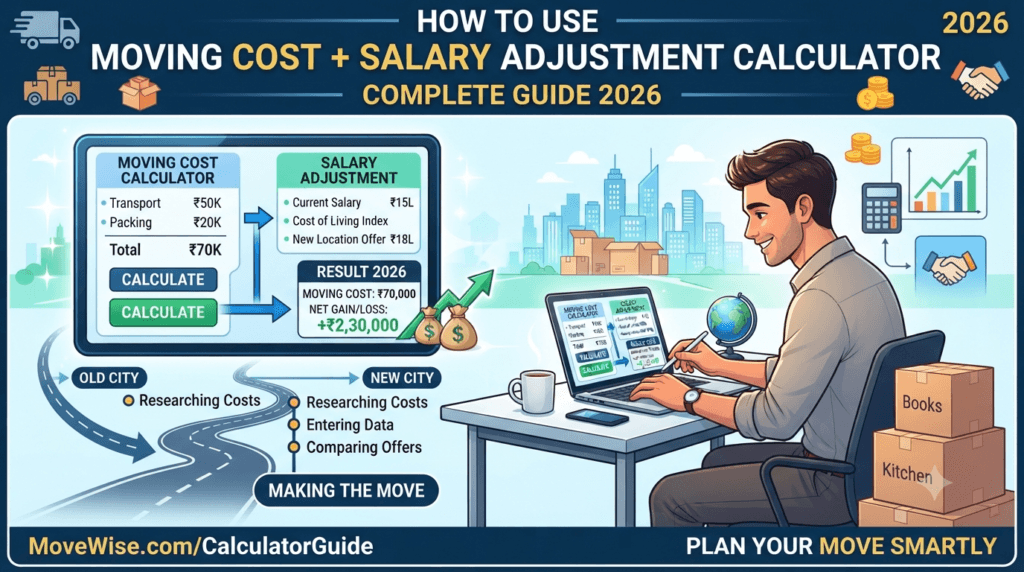
A relocation salary calculator should combine two separate numbers: the equivalent salary (what you need to earn in the new city to keep your current buying power) and the one-time moving bill (movers, deposits, travel, and setup costs). Compare your actual offer against the equivalent salary first, then subtract the moving bill from whatever surplus is left. That final figure — not the raw raise on the offer letter — is what actually lands in your pocket in year one.
- Why most calculators only solve half the problem
- The six inputs that actually move the number
- Worked example: a real relocation, step by step
- What goes into a cost-of-living index
- The moving bill items people forget to budget
- Geo-pay bands and the reverse-relocation trap
- Relocation bonus tax math and the gross-up ask
- Five ways to open the negotiation
- Five relocation myths worth unlearning
- FAQ
01Why most calculators only solve half the problem
Search for a relocation salary calculator and you’ll land on one of two kinds of tool. The first type calculates a cost-of-living adjustment: enter two cities and a salary, and it tells you the equivalent income you’d need to keep your lifestyle intact. The second type is a moving cost estimator: enter your home size and distance, and it spits out a dollar figure for trucks, boxes, and gas.
Almost nobody combines the two, which is a strange gap, because they answer the same underlying question from opposite directions. The cost-of-living tool tells you whether your ongoing paycheck will stretch as far. The moving-cost tool tells you what it takes to get there in the first place. A move can pass the first test and still fail the second — a $12,000 raise means very little if the move itself consumes $14,000 in cash before your first paycheck in the new city even arrives.
Treat the two numbers as a single pipeline instead of two separate lookups: equivalent salary tells you the floor your offer needs to clear, and the moving bill tells you how much of the surplus above that floor you actually get to keep in year one.
Net Year-1 Relocation Gain = (Offered Salary − Equivalent Salary) − One-Time Moving Costs. Anything below zero means you are functionally paying to take the job, at least for the first twelve months.
02The six inputs that actually move the number
Most calculators ask for a dozen fields, but only six of them meaningfully change the output. If you’re comparing tools or building your own spreadsheet, these are the ones worth getting right:
| Input | Why it swings the result |
|---|---|
| Current salary | Sets your purchasing-power baseline; every other number scales off this. |
| Origin and destination metro | Determines which index values get pulled — county-level data can differ sharply from state averages. |
| Household size | Housing and healthcare scale per person; a solo mover and a family of four see very different bills. |
| Home size / bedroom count | Directly sets the weight class for the moving-cost estimate — this alone can swing the bill by thousands. |
| Move distance | Fuel, flights, and mover day-rates scale with mileage, not just with “local vs. long-distance.” |
| Filing status / tax bracket | Determines how much of a raise gets eaten by marginal tax rates before it reaches your budget. |
03Worked example: a real relocation, step by step
Numbers are easier to trust when you can see the arithmetic. Here’s a hypothetical but realistic scenario: a software support lead earning $92,000 in Columbus, Ohio, is offered a role in Boston, Massachusetts, at $118,000.
On paper, a $26,000 raise looks like a career win. Once the cost-of-living gap and the physical move are priced in, this candidate is roughly $9,700 behind where they started for the first year. That doesn’t automatically mean the offer should be rejected — but it does mean the negotiation should center on either a higher base, a relocation bonus, or both, rather than treating $118,000 as a number worth celebrating on its own.
04What goes into a cost-of-living index
Every index blends the same six categories, but the weighting varies by provider, which is exactly why two calculators can give you two different equivalent-salary figures for the same move.
| Category | Typical weight | What actually shifts it |
|---|---|---|
| Housing | 26–32% | Rent vs. buy status, local vacancy rates, property tax and insurance |
| Taxes (state + local) | 14–18% | Zero-income-tax states shift the whole equivalent-salary curve |
| Transportation | 16–20% | Car-dependence, insurance risk pool, transit pass costs |
| Groceries | 13–16% | Distribution costs and local sales tax on food |
| Healthcare | 9–11% | Regional hospital pricing and insurer competition |
| Utilities | 8–11% | Climate extremes — heating and cooling load swing this fastest |
When a tool reports one blended percentage, ask whether it lets you re-weight these categories. A renter with no car cares about a very different basket of goods than a homeowning family with two vehicles, and the “average” number can mislead either of them.
05The moving bill items people forget to budget
Beyond the obvious mover’s quote, several line items rarely appear until the final invoice. Building these into your calculation up front avoids the mid-move scramble.
- Lease-break penalty — often one to two months’ rent if you’re leaving before your term ends.
- Storage-in-transit fees — charged when your new home isn’t ready the same day the truck arrives.
- Pet relocation costs — health certificates, airline crate fees, and in some cases quarantine requirements for international moves.
- School enrollment and record-transfer fees — small individually, but they add up fast for families with multiple kids.
- HOA or building move-in/move-out fees — common in condo and high-rise buildings, frequently $150–$500 each way.
- Address-change administrative costs — vehicle re-registration, new driver’s license, and in some states a use tax on a car you already own.
- Deposit reset — first month, last month, and security deposit on the new place, on top of whatever deposit is tied up in your old one.
Double-paying rent or a mortgage during an overlap period is the single largest unbudgeted cost in most relocations. If there is any chance your old lease and new lease overlap by even two to three weeks, build that overlap cost into the moving bill before you compare offers — not after you’ve already signed.
06Geo-pay bands and the reverse-relocation trap
Remote and hybrid work introduced a version of this problem that runs in the opposite direction. Many employers now set salary bands by location — sometimes called geo-pay or location-based pay — so an employee’s compensation can move even without a change in role or performance.
This creates two distinct scenarios that a calculator needs to treat differently:
Scenario A — Moving to a pricier market
The standard case covered throughout this guide: you need the raise to at least match the cost-of-living gap, ideally with a small buffer for tax bracket creep.
Scenario B — Moving to a cheaper market on a remote salary
This is the reverse-relocation trap. If your employer applies a geo-pay cut when you move to a lower-cost city, the fair question isn’t “did my pay go down” — it’s “did my pay go down by more than the cost of living did.” A 12% pay cut attached to a 25% drop in living costs still leaves you ahead. A 20% pay cut attached to a 12% drop in living costs does not. Run both percentages through the same calculator before agreeing to a geo-adjustment, because employers typically communicate the cut as a flat number without showing the cost-of-living side of the comparison at all.
If your company applies location-based pay, get the new band in writing before you sign a lease. Some employers backdate the adjustment to your move date rather than your notification date, which can create an unexpected clawback on your next paycheck.
07Relocation bonus tax math and the gross-up ask
A relocation bonus is not the same as a comparable amount of base salary. It’s classified as supplemental wages, which means it’s typically withheld at a flat federal rate before state tax and payroll tax are even applied. A $10,000 bonus can easily arrive as $6,200–$6,800 after withholding, depending on your state.
A gross-up is when the employer calculates the withholding in reverse and pays extra so that your after-tax amount equals the number you were promised. It’s a completely standard ask in relocation negotiations — recruiters expect it — but it almost never happens automatically. If a company’s offer includes a relocation bonus and doesn’t mention grossing it up, assume it’s a pre-tax figure and calculate your real moving budget from the after-tax amount instead.
08Five ways to open the negotiation
Numbers are only useful if you use them in the actual conversation. Below are five different angles to raise with a recruiter or hiring manager, depending on what’s actually flexible in your offer.
- Lead with the equivalent-salary gap. State the number your calculator produced and ask directly whether there’s room to close the difference in base pay.
- Shift the ask to the signing or relocation bonus if the base salary band is genuinely fixed — many companies have more flexibility on one-time payments than on recurring salary.
- Request the gross-up explicitly if a relocation bonus is already on the table, since it costs the employer very little to add but meaningfully changes what lands in your account.
- Ask for a delayed start date so you have more runway to sell property, break a lease cleanly, or avoid a double-rent overlap — this can save more than a bonus would.
- Propose a temporary remote bridge — a few weeks of working remotely from your old city before relocating — which removes the overlap-rent cost from the equation entirely.
09Five relocation myths worth unlearning
- “The relocation package covers everything.” Most packages have a hard dollar cap; anything past it comes out of pocket.
- “A no-income-tax state is automatically cheaper.” States without income tax often make it up through higher property or sales tax — check the full basket, not just one line item.
- “My offer letter number is what I’ll take home.” Marginal tax brackets mean a bigger raise nets a smaller percentage increase than the headline number suggests.
- “Moving costs are tax-deductible.” For most W-2 employees this deduction has been suspended at the federal level since 2018; a small number of states still allow it.
- “Cost-of-living data is the same everywhere I look.” Index providers weight categories differently — always re-check the housing and tax weighting before trusting a single number.
Key takeaways
- Compare your offer to the equivalent salary first, then subtract the one-time moving bill — not the other way around.
- Housing and state/local taxes carry the heaviest weight in almost every cost-of-living index.
- Overlap rent between an old lease and a new one is the most commonly underbudgeted moving cost.
- A geo-pay cut is only fair if it’s smaller than the cost-of-living drop — check both numbers, not just the cut.
- Relocation bonuses are taxed as supplemental income; ask for a gross-up in writing before you count on the full amount.
Run your own numbers before you reply to the offer
Plug in your current salary, target city, and home size to see your equivalent salary and estimated moving bill side by side.
Open the calculator →Frequently asked questions
Start with the percentage gap between the two cities’ cost-of-living indexes, then add roughly two to four extra points to cover tax-bracket creep from the bigger paycheck. A city that’s 18% pricier usually needs a 20–23% raise to leave your net lifestyle unchanged.
Not automatically. The bonus is withheld as supplemental income before it reaches you. A gross-up means the employer adds extra so the after-tax amount matches what was promised — you generally have to request it specifically.
Compare the size of the pay cut to the size of the cost-of-living drop. If the cut is smaller than the savings, you come out ahead; if it’s larger, you’re effectively losing ground even though the new city is cheaper.
Housing, transportation, groceries, utilities, healthcare, and state or local taxes are the standard six categories. Some employers layer a separate labor-market adjustment on top, based on what your specific role pays locally rather than what it costs to live there.
Raise it before you move. Once you’ve relocated and accepted the new figure, most employers treat it as settled and revisit it only at the next standard review cycle, which can be six to twelve months out.