

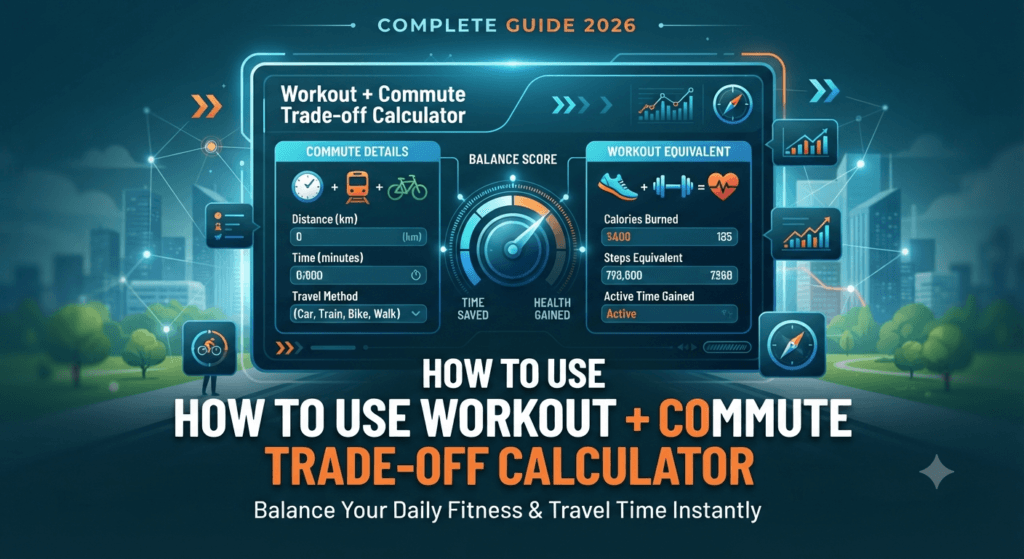
How to Use Workout + Commute Trade-off Calculator: Complete Guide 2026
Stop treating your commute as wasted time and your workout as a chore. Learn how to optimize your daily routine, reclaim hours of lost time, and boost your health using the Toolriz Workout + Commute Trade-off Calculator.
To use a Workout + Commute Trade-off Calculator, input your daily commute distance, current travel time (driving or transit), and the duration of your standard daily workout. The tool compares the total time spent on “travel + exercise” against an “active commute” (like biking or running to work). It calculates the net time saved by combining these two activities into one, while also factoring in financial savings from gas, parking, and gym memberships. In 2026, this tool is essential for busy professionals looking to optimize their schedules and achieve fitness goals without sacrificing personal time. Use the Toolriz Calculator here.
- The 2026 Time-Scarcity Epidemic
- What is the Workout + Commute Trade-off Calculator?
- Step-by-Step: How to Use the Tool
- The Math of Opportunity Cost: Time is Money
- The Rise of Active Commuting in 2026
- The Financial ROI of Ditching Your Car
- Scenario Analysis: Driver vs. Cyclist vs. Transit Rider
- The Hidden Health ROI of Active Commuting
- Overcoming the Barriers: Sweat, Safety, and Weather
- Optimizing the Hybrid Work Schedule
- How to Interpret Your Calculator Results
- Frequently Asked Questions
The 2026 Time-Scarcity Epidemic
In the hyper-connected, return-to-office era of 2026, time has become the most valuable currency. The modern professional is constantly juggling career demands, family obligations, and the ever-present need to maintain physical health. Yet, the structure of the American workday creates a massive logistical inefficiency: we separate our commute from our health routines, resulting in double the time expenditure.
Consider the average American worker. They spend roughly 55 minutes a day driving to and from work. Then, because they sat in a car for an hour, they drive to a gym to spend another 45 minutes on a stationary bike or treadmill. They have effectively spent 100 minutes to achieve 45 minutes of movement. This compartmentalized approach to daily logistics is a massive drain on personal time and energy.
The disconnect between fitness and daily transportation is a primary reason why “I don’t have time to work out” remains the number one excuse for skipping exercise. But what if you could mathematically merge these two blocks of time? What if your commute *was* your workout?
This is the core philosophy behind the Workout + Commute Trade-off Calculator. It is a tool designed to expose the inefficiencies of traditional commuting and quantify the time and financial benefits of active transportation. By calculating the exact trade-off between driving to a gym and actively commuting to work, this tool empowers you to make data-driven decisions about your daily routine.
The “Trade-off” is the realization that active commuting (biking, walking, e-scooting) takes slightly longer than driving, but eliminates the need for a separate workout. When you subtract the gym time you no longer need, you actually save time overall.
What is the Workout + Commute Trade-off Calculator?
The Workout + Commute Trade-off Calculator is a specialized productivity and wellness tool. Unlike a standard map application that simply shows you the fastest route, this calculator performs a holistic time-and-motion study of your daily life. It evaluates whether replacing your motorized commute with an active commute yields a net positive in your daily schedule.
The tool requires several key inputs to function:
- Current Commute Metrics: The time and distance of your current driving or transit commute.
- Active Commute Estimates: The estimated time it would take to cover that same distance via bicycle or foot.
- Fitness Routine Data: The duration of your standard gym or home workout.
- Financial Variables (Optional): Gas costs, parking fees, transit passes, and gym membership fees.
By synthesizing these variables, the calculator outputs a clear comparison. It shows you the total daily time currently spent on “travel + fitness” versus the total time spent if you “actively commute.” The difference is your net time saved (or lost), translated into daily, weekly, and annual hours. Furthermore, it calculates the financial impact of ditching your car or gym membership, providing a complete ROI picture.
Step-by-Step: How to Use the Toolriz Calculator
Using the calculator requires a bit of honesty about your current habits and some basic mapping data. Here is the exact step-by-step process to follow to get the most accurate results.
Map Your Current Commute
Use Google Maps to determine your exact daily driving or transit time from home to work. Do this during your typical commute hours to account for traffic. Note the distance in miles.
Estimate Active Commute Time
Switch Google Maps to the “Cycling” or “Walking” mode. Note the estimated time. Remember, an e-bike will significantly reduce this time compared to a standard bicycle.
Define Your Workout Routine
Enter how many minutes you typically spend exercising per day. If you work out for an hour, 4 days a week, your daily average is 60 minutes on workout days.
Input Financial Data
Enter your monthly gym cost, daily parking fees, and an estimate of gas used. (The IRS standard mileage rate is a good proxy for total vehicle cost per mile).
Calculate the Trade-off
Click calculate. The tool will immediately display your net time saved per day, week, and year by switching to an active commute.
Review Financial Savings
Check the financial output. See how much money you save annually by canceling the gym and reducing driving costs.
Implement the Strategy
Use the data to plan your first active commute. Start with one or two days a week to test the viability of the route.
The Math of Opportunity Cost: Time is Money
To truly appreciate the output of the calculator, you must understand the economic concept of opportunity cost. Opportunity cost is the value of the next best alternative you could be doing with your time.
If you spend 90 minutes a day commuting by car, and 45 minutes at the gym, you are spending 135 minutes on logistics and maintenance. What else could you do with those 135 minutes? You could sleep more, cook healthier meals, spend time with your children, or work on a side hustle.
Let’s assign a dollar value to this. If your hourly wage is $40, and the calculator shows that active commuting (biking to work) saves you 30 minutes a day (because you skip the gym), you are effectively “earning” $20 a day in reclaimed time. Over a 250-day work year, that is $5,000 of value created simply by changing your mode of transport. The calculator helps quantify this often-invisible ROI.
Research shows that every minute spent commuting correlates with lower life satisfaction. A study by the University of Waterloo found that commuting 20 minutes each way has the same effect on job satisfaction as receiving a 19% pay cut. Minimizing commute time—or making it productive—is critical for mental health.
The Rise of Active Commuting in 2026
In 2026, active commuting is no longer just for hardcore cyclists. The infrastructure of American cities has evolved. Protected bike lanes, municipal e-scooter programs, and the explosive popularity of e-bikes have democratized active transportation.
The E-Bike Revolution
E-bikes are the ultimate game-changer for the workout commute trade-off. A traditional bike might make a 10-mile commute take 45-50 minutes, which is too long for many people. An e-bike can reduce that to 25-30 minutes, while still providing moderate cardiovascular exercise (especially if you pedal actively on the flats). Because you arrive at work without being drenched in sweat, e-bikes solve the biggest barrier to active commuting: the office shower problem.
Employer Incentives
In 2026, many US employers offer commuter benefits that extend to bicycles. Under the Bicycle Commuter Act (and its state-level expansions), employers can provide tax-free reimbursements for bike maintenance, storage, and e-bike purchases. If your employer offers this, the financial ROI calculated by the tool gets even better.
The Financial ROI of Ditching Your Car
The time savings of active commuting are obvious, but the financial savings are equally staggering. The Toolriz calculator factors in several financial variables to show your annual savings.
| Expense Category | Car Commuter (Annual) | Active Commuter (Annual) | Savings |
|---|---|---|---|
| Gas / Fuel (20 miles/day) | $1,200 | $0 | $1,200 |
| Vehicle Wear & Tear (Depreciation) | $2,000 | $0 | $2,000 |
| Downtown Parking | $1,500 | $0 | $1,500 |
| Gym Membership | $600 | $0 (Commute is workout) | $600 |
| Equipment Maintenance (Bike) | $0 | $300 | -$300 |
| Total Net Savings | $5,300 | $300 | $5,000 / year |
As the table shows, even when factoring in the cost of maintaining a high-quality bicycle or e-bike, the financial trade-off heavily favors active commuting. The calculator allows you to input your specific numbers to see your exact savings.
Scenario Analysis: Driver vs. Cyclist vs. Transit Rider
Let’s look at three real-world scenarios to understand how the calculator interprets different lifestyles. Assume a 10-mile commute each way (20 miles round trip).
Scenario A: The Solo Driver with a Gym Habit
- Commute Time: 30 minutes each way (60 mins/day).
- Workout Time: 45 minutes at the gym, plus 15 minutes changing/showering (60 mins/day).
- Total Time: 120 minutes (2 hours) daily.
This is the baseline. The user spends 2 hours a day traveling and exercising.
Scenario B: The Active Cyclist
- Commute Time: 40 minutes each way by standard bike (80 mins/day).
- Workout Time: 0 minutes (commute fulfills daily cardio).
- Total Time: 80 minutes daily.
Calculator Result: The active cyclist saves 40 minutes a day compared to the driver. Over a year, that is 166 hours saved—equivalent to over four full 40-hour work weeks.
Scenario C: The Transit Rider who Walks
- Commute Time: 45 minutes on the train each way (90 mins/day).
- Workout Time: 45 minutes at the gym (45 mins/day).
- Total Time: 135 minutes daily.
Calculator Result: The transit rider actually spends *more* time than the driver. However, if this rider alters their route to walk 2 miles to the station instead of taking a bus, they add 35 minutes of walking to their commute, but can cut their gym time to 10 minutes (just strength training). Their new total time is 125 minutes. The calculator helps transit riders find these micro-optimizations.
The Hidden Health ROI of Active Commuting
While the calculator focuses on time and money, the health ROI of active commuting cannot be overstated. The 2026 lifestyle is heavily sedentary. We sit in cars, sit at desks, and sit on couches. Active commuting forces movement into the parts of the day where movement has been engineered out.
Cardiovascular Health
Studies consistently show that active commuting is associated with a lower risk of cardiovascular disease, cancer, and all-cause mortality. A large-scale study published in *The BMJ* found that cycling to work was associated with a 46% lower risk of developing heart disease. Unlike gym workouts, which require intense bursts of effort, active commuting provides steady, moderate-intensity “zone 2” cardio, which is highly effective for fat burning and metabolic health.
Mental Health and Stress Reduction
Driving in traffic is a known stressor, elevating cortisol levels and blood pressure. Active commuting, particularly in green spaces or along dedicated bike paths, has the opposite effect. Cyclists and walkers report arriving at work more alert and in a better mood, and arriving home with their work stress physically pedaled out of their system. For more on the intersection of physical logistics and mental wellness, explore our related wellness and productivity blog posts.
Active commuting naturally keeps your heart rate in “Zone 2” (60-70% of your max heart rate). This is the optimal zone for building mitochondrial density and burning fat without causing excessive fatigue or requiring intense recovery. You get fit without feeling like you “worked out.”
Overcoming the Barriers: Sweat, Safety, and Weather
If active commuting is so great, why doesn’t everyone do it? Because it involves real-world friction. The calculator provides the math, but you still have to solve the logistics. Here is how to overcome the three main barriers.
1. The Sweat Problem
Arriving at work drenched in sweat is the primary fear of new cyclists. Solutions:
- E-Bikes: Let the motor do the work on the hills; you arrive fresh.
- Pace Control: Cycle at 60% effort. Your commute is transportation, not the Tour de France.
- The Sponge Bath: Keep baby wipes, deodorant, and a change of clothes at the office. A 3-minute wipe-down in the restroom is highly effective.
- Run Commute: If your office has a shower, run home instead of running in the morning. You can sweat all you want at 5:00 PM.
2. Safety Concerns
Riding in heavy traffic is intimidating. Don’t just take the route you drive. Use apps like Komoot, Citymapper, or Google Maps’ cycling layer to find designated bike paths, quiet neighborhood streets, or greenways. Often, the safest cycling route is only slightly longer than the driving route.
3. Weather
“But it rains!” Yes, it does. Active commuters do not let weather dictate their transport; they let gear do it. A good waterproof jacket, overpants, and waterproof panniers make rain a non-issue. For winter, studded tires and merino wool base layers keep you warm. Reserve the car or transit for the 10-15 days a year with truly dangerous weather (ice, severe storms).
Optimizing the Hybrid Work Schedule
The 2026 work environment is heavily hybrid. Many professionals are in the office 2-3 days a week and remote the rest. This actually makes the workout commute trade-off *more* viable, not less.
If you are in the office Tuesday through Thursday, you only need to actively commute 3 days a week. The calculator can be set to “3 days/week” to show your specific time and financial savings. On your remote days, you can use the time you saved on Monday and Wednesday to do a dedicated strength training workout at home. The hybrid schedule allows you to balance the cardiovascular benefits of active commuting with the strength benefits of home gym sessions, all while net-saving hours of time.
How to Interpret Your Calculator Results
Once you run your numbers through the Toolriz calculator, you will be faced with data. Here is how to interpret it depending on what it shows.
Result 1: You Save Massive Time (Net Positive)
If the calculator shows you save 30+ minutes a day by biking to work instead of driving + going to the gym, you have a clear mandate. Your next step is to do a “test run” on a Sunday. Map the route, ride it at a leisurely pace, and see how long it takes. If the test run matches the calculator’s estimates, commit to trying it one day a week.
Result 2: It Takes Slightly Longer, But Saves Money
Sometimes the calculator shows that an active commute takes 15 minutes longer than driving, but you save $200 a month in gas and gym fees. In this case, you are trading time for money. If you value the 15 minutes of extra reading or podcast time on the train, or if the $200 is critical to your budget, the trade-off is still worth it.
Result 3: It Doesn’t Make Sense (Negative Trade-off)
If your commute is 40 miles each way on a highway, the calculator will accurately show that active commuting is not viable. In these cases, the tool prevents you from making an unrealistic commitment. Instead, look for micro-trade-offs: can you park 2 miles from the office and walk the last bit? Can you take transit for half the route and bike the rest?
🔑 Key Takeaways
- A Workout + Commute Trade-off Calculator quantifies the time and financial savings of merging your daily travel and fitness routines.
- By replacing a driving commute and a gym workout with an active commute (biking/walking), most people can save 30-60 minutes a day.
- The financial ROI is significant, saving thousands annually on gas, vehicle depreciation, parking, and gym memberships.
- E-bikes have revolutionized active commuting in 2026, making longer distances feasible and eliminating the “sweat” barrier.
- Active commuting provides steady “Zone 2” cardiovascular exercise, improving both physical health and mental well-being.
- Even if the math doesn’t favor a full active commute, the tool helps identify micro-optimizations like parking further away or walking to transit stops.
Calculate Your Commute Trade-off Today
Are you wasting hours in traffic and paying for a gym you barely use? Use our free Workout + Commute Trade-off Calculator to see how much time and money you could reclaim by 2026.
Frequently Asked Questions
A workout commute trade-off calculator is a tool that compares the time and financial costs of different commuting methods (driving, transit, biking, walking) against the time required for a separate gym workout. It calculates the “net time saved” by combining your commute and workout into one active commute session. Try it here.
In dense urban areas with heavy traffic, biking can often be faster than driving during rush hour. Even if driving is technically faster, the workout commute calculator reveals that when you factor in the time you would have spent at the gym anyway, active commuting net-saves you hours per week.
Cycling to work saves money on gas, vehicle depreciation, parking fees, and gym memberships. Depending on your city, replacing a 10-mile driving commute with a bike ride can save between $2,000 and $5,000 annually after factoring in all vehicle maintenance and fitness costs.
The opportunity cost of commuting is calculated by multiplying the time spent commuting by your hourly wage, and adding the direct financial costs (gas, transit fares, wear-and-tear). A calculator automates this to show what else you could be doing with that time and money.
Yes. If your active commute (biking or walking briskly) raises your heart rate into the cardiovascular zone for 20+ minutes, it counts as a legitimate daily workout, fulfilling the CDC’s 150-minute weekly moderate-intensity exercise recommendation.
If your commute is too far for a full active trip, the calculator can still help you evaluate “multi-modal” commuting. This involves driving or taking transit for the majority of the distance, and biking or walking the last 2-3 miles to the office.