

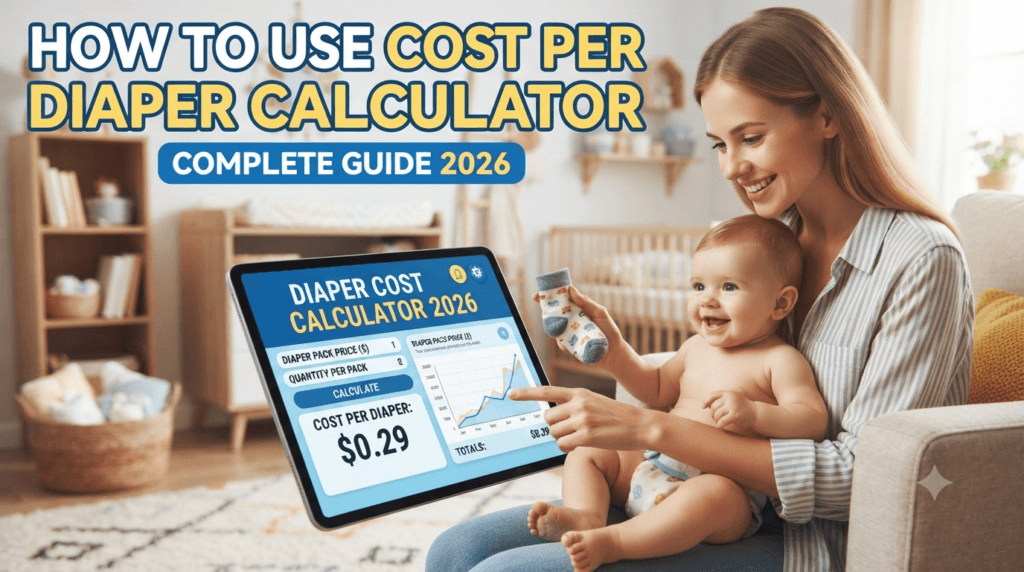
How to Use Cost Per Diaper Calculator: Complete Guide 2026
Stop falling for retail pricing tricks and oversized box illusions. Learn how to calculate the true cost per diaper to save hundreds of dollars on your baby budget in 2026.
To use a Cost Per Diaper Calculator, input the total purchase price of the diaper box (including taxes and shipping) and the total number of diapers inside the box. The tool instantly divides the price by the count to reveal the cost per single diaper. In 2026, a good target price is $0.12 to $0.18 per diaper for standard brands. Using this calculator allows you to compare Pampers, Huggies, and store brands accurately, ignoring the illusion of bulk packaging. Use the Toolriz Calculator here.
- The Hidden Tax on New Parents in 2026
- What is a Cost Per Diaper Calculator?
- The Math: Why Bulk Isn’t Always Cheaper
- Step-by-Step: How to Use the Tool
- The Sizing Trap: Why Size 5 Costs More
- Brand Breakdown: Premium vs. Store Brand
- Amazon Subscribe & Save vs. Costco
- How to Interpret Your Calculator Results
- The Economics of Diaper Materials
- The 2026 Diaper Budgeting Strategy
- Frequently Asked Questions
The Hidden Tax on New Parents in 2026
Welcoming a child into the world brings immense joy, but it also introduces a staggering new line item to your household budget: consumable baby products. In 2026, with inflation having subtly reshaped the cost of everyday goods, parents are feeling the pinch more than ever. Diapers are not a luxury; they are a non-negotiable biological necessity. Yet, the pricing strategies employed by big box retailers and diaper manufacturers are designed to confuse you.
Walk down the diaper aisle at Target or Walmart, and you are met with a wall of pastel boxes. A box of Pampers Swaddlers might cost $29.99. Next to it, a box of Huggies Little Snugglers costs $32.99. At first glance, Pampers seems cheaper. But look closer. The Pampers box contains 120 diapers. The Huggies box contains 156 diapers. Which is the better deal? Doing this division in your head, while holding a crying baby or managing a toddler, is nearly impossible.
This psychological pricing trick—relying on the consumer’s inability to calculate unit pricing on the fly—costs the average American family hundreds of dollars a year. A newborn goes through 10 to 12 diapers a day. Over the first year, you will change roughly 3,000 diapers. If you overpay by just 5 cents per diaper, that’s $150 lost. Over the 2.5 to 3 years a child is in diapers, you could be throwing away $500 or more.
This is exactly why the Toolriz Cost Per Diaper Calculator was created. It strips away the marketing illusions and massive box sizes, leaving you with the only metric that matters: the exact cost per single unit. In this comprehensive 2026 guide, we will teach you how to use this tool to outsmart retail pricing and optimize your family’s budget.
Manufacturers frequently change box sizes and counts. A “Mega Box” today might have 30 fewer diapers than a “Mega Box” did last year, despite costing the same. Relying on memory or brand loyalty is a guaranteed way to lose money. Unit pricing is the only defense.
What is a Cost Per Diaper Calculator?
A Cost Per Diaper Calculator is a specialized financial tool designed for family budgeting. Unlike a generic unit price calculator that might struggle with the odd quantities of baby products, this tool is streamlined for the exact data points found on diaper boxes: Total Price and Total Count.
The tool requires two basic inputs to function:
- Total Price: The exact amount you paid (or will pay) for the box, including taxes and any delivery fees. This is crucial because a $24.99 box often becomes a $27.30 box after sales tax.
- Total Diaper Count: The number printed on the bottom corner of the box (e.g., Size 2, 198 Count).
Once these are entered, the calculator instantly outputs the cost per diaper. This allows you to perform an apples-to-apples comparison between a 40-count bag from the grocery store and a 200-count box from Costco. It democratizes the shopping experience, giving you the same analytical power as retail pricing strategists.
The Math: Why Bulk Isn’t Always Cheaper
To trust the calculator, it helps to understand the math behind it. The formula is simple division, but its application is profound.
The retail industry relies on the “bulk illusion.” Consumers are conditioned to believe that buying the biggest box automatically yields the lowest unit price. While this is often true within a single brand’s product line, it completely breaks down when comparing across brands or retail channels.
Example: You are at the store and see two options for Size 3 diapers.
- Option A (Premium Brand): $34.99 for a box of 140 diapers.
- Option B (Store Brand): $24.99 for a box of 176 diapers.
Mentally, the $24.99 box seems like the obvious choice because it is cheaper and has more diapers. But let’s run the math.
- Option A: $34.99 ÷ 140 = $0.249 per diaper
- Option B: $24.99 ÷ 176 = $0.142 per diaper
The store brand is significantly cheaper per unit. But what if the store brand was on a weird clearance, and the math was reversed? What if a giant “Value Box” of the premium brand was actually $0.30 per diaper? The Toolriz calculator catches these discrepancies instantly, preventing you from assuming your way into a bad deal.
Step-by-Step: How to Use the Toolriz Calculator
Using the tool requires 30 seconds of your time and a quick glance at the packaging. Here is the exact step-by-step process to follow while shopping in-store or online.
Identify the Total Price
Look at the shelf tag or your online cart. Input the exact retail price. If shopping online, factor in an estimate for sales tax to be safe.
Find the Diaper Count
Locate the large number on the front or side of the box indicating the total count (e.g., 120, 198, 252). Enter this into the calculator.
Include Shipping (If Applicable)
If you are paying a delivery fee, divide that fee across the items in your order, or add it to the total price of the diaper box for an accurate cost.
Click Calculate
The tool will instantly output the exact cost per diaper down to the tenth of a cent.
Compare Brands
Reset the tool and run the numbers for a competing brand or a different box size. Compare the unit costs side-by-side.
Check Against the 2026 Baseline
In 2026, aim for $0.12 – $0.18 per diaper for standard brands, and $0.20+ for premium eco-brands. If your number is higher, keep looking.
Purchase with Confidence
Buy the box with the lowest unit cost that meets your quality standards. You have mathematically secured the best deal available.
The Sizing Trap: Why Size 5 Costs More Than Size 1
One of the most shocking revelations for new parents is how the cost per diaper shifts as the baby grows. You might think you are getting a deal because the price of the box stays the same, but the manufacturers are quietly reducing the count.
As babies move from Size 1 to Size 6, they require more material (more Super Absorbent Polymer, more wood pulp, larger fastening tabs). To keep the retail price psychologically appealing (e.g., keeping it under $30), manufacturers reduce the number of diapers in the box.
| Diaper Size | Typical Box Price | Typical Count in Box | Cost Per Diaper |
|---|---|---|---|
| Size 1 | $29.99 | 198 | $0.15 |
| Size 3 | $29.99 | 156 | $0.19 |
| Size 5 | $29.99 | 120 | $0.24 |
Notice how the price of the box remains $29.99, but the cost per diaper jumps by over 60% from Size 1 to Size 5. This is why you must use the Toolriz calculator every single time you size up. The brand that was cheapest for Size 1 might not be the cheapest for Size 5.
Never stockpile massive amounts of Size 1 or Size 2 diapers just because they are on sale. Babies grow out of these sizes in months. If you buy 1,000 Size 1 diapers, you will likely be stuck with 300 of them when your baby moves to Size 2. Only stockpile Size 3 or 4, which babies stay in the longest.
Brand Breakdown: Premium vs. Store Brand in 2026
In 2026, the diaper market is heavily segmented. Understanding the tier you are buying helps you contextualize the calculator’s output. Is a $0.25 Pampers Swaddler actually better than a $0.15 Target Up&Up? That is a personal choice, but the math should be clear.
Tier 1: Premium Brands (Pampers, Huggies)
These brands rely on patented technology like “Air-Dry” channels, umbilical cord cutouts, and ultra-soft materials. They excel in leak protection for overnight use. In 2026, expect to pay $0.22 to $0.30 per diaper for these brands. They are rarely the cheapest option, but parents of heavy wetters often find the premium worth it to avoid nighttime sheet changes.
Tier 2: Mid-Tier Brands (Luvs, Honest Company)
Luvs (made by Pampers) and Honest offer a middle ground. They use slightly less expensive materials but maintain strong brand recognition. Expect $0.18 to $0.22 per diaper. The calculator often reveals that Luvs is just a slightly stripped-down Pampers at a 20% discount.
Tier 3: Store Brands (Target Up&Up, Costco Kirkland, Walmart Parent’s Choice)
This is where the calculator shines brightest. Store brands have improved dramatically in quality. Kirkland Signature diapers (manufactured by Huggies) and Target Up&Up are widely considered equal to premium brands in performance. By using the calculator, you will find these store brands routinely hit $0.10 to $0.14 per diaper. For a family using 8 diapers a day, switching from a $0.25 premium brand to a $0.13 store brand saves $1.00 a day, or $365 a year.
Amazon Subscribe & Save vs. Costco: The Ultimate Showdown
The two primary avenues for bulk diaper purchasing in the US are Amazon (via Subscribe & Save) and Warehouse Clubs (Costco or Sam’s Club). Which is cheaper? The answer changes monthly, which is why you need the calculator.
The Costco Model
Costco offers massive boxes of Kirkland or Huggies. Because Kirkland is a private label, Costco controls the margin. The cost per diaper for Kirkland at Costco is consistently among the lowest in the nation, often hovering around $0.11 to $0.13. The catch? You must pay an annual membership fee ($65 in 2026) and deal with giant boxes that require storage space.
The Amazon Subscribe & Save Model
Amazon offers Subscribe & Save, which gives a 5% to 15% discount plus free shipping. Amazon runs frequent coupons on Pampers and Huggies. If you stack a $5 off coupon with a 15% Subscribe & Save discount, Amazon can briefly beat Costco. However, Amazon’s base prices fluctuate wildly. A box that costs $34.99 today might be $41.99 next week.
Keep an item in your Amazon Subscribe & Save cart, but always check the price the day before your subscription ships. If the price spiked, use the calculator to check Costco’s current price. If Costco is cheaper, skip the Amazon delivery that month and buy at the warehouse.
How to Interpret Your Calculator Results
Once you run your numbers, you will be faced with data. Here is how to act on the results based on what the calculator shows you.
Scenario A: The Clear Winner
You calculate Brand A at $0.25/diaper and Brand B at $0.14/diaper. If you are comfortable with the quality of Brand B, the decision is made. Buy Brand B. The savings are undeniable and immediate.
Scenario B: The Premium Premium
You calculate that your favorite premium brand is $0.28/diaper, while the store brand is $0.15/diaper. The calculator isn’t telling you that you must switch. It is telling you that you are paying a 13-cent premium per diaper for the luxury of the premium brand. If you decide the premium brand prevents blowouts and saves you laundry money, you can make an informed choice to pay the premium. Ignorance is the only true loss.
Scenario C: The “Sale” Illusion
You see a “Buy One Get One 50% Off” sale at a drugstore. Two boxes of 40 diapers, normally $14.99 each. You pay $22.48 for 80 diapers. The math: $22.48 ÷ 80 = $0.28/diaper. The calculator reveals that even at 50% off the second box, the drugstore price is still double what you would pay at Target for a bulk box. The calculator saves you from falling for flashy sale signs. For more on decoding retail tricks, explore our family finance blog.
The Economics of Diaper Materials
To truly understand why diapers cost what they do in 2026, you have to look at what is inside them. The modern disposable diaper is a marvel of chemical engineering, not just a piece of paper.
Super Absorbent Polymer (SAP)
The magic ingredient in a diaper is SAP. When mixed with water, it turns into a gel. This gel traps urine and prevents it from leaking back onto the baby’s skin. The cost of SAP is tied to the global petrochemical market. When oil prices rise, the cost of manufacturing SAP rises, and diaper prices follow. Premium brands use more SAP, allowing them to hold more liquid without increasing thickness.
Wood Pulp
The fluffy padding inside the diaper is made from wood pulp. This provides the structural backbone. The price of wood pulp fluctuates with the housing market and lumber demand. During the 2021-2023 lumber crisis, diaper manufacturing costs spiked significantly, a cost that was eventually passed down to consumers and has kept 2026 baseline prices elevated.
When you use the calculator and see a premium brand costing $0.30 a diaper, you are essentially paying for a higher dose of SAP and a more engineered fit. When you see a store brand at $0.12, it uses slightly less SAP, requiring slightly more frequent changes. The math helps you decide if the chemical premium is worth your dollars.
The 2026 Diaper Budgeting Strategy
Now that you know how to use the calculator, here is a holistic strategy for managing your diaper budget in 2026.
- Establish Your Baseline: Use the calculator to find the absolute lowest cost per diaper you have access to (likely Costco Kirkland or Target Up&Up). Let’s say it is $0.13.
- Calculate Your Monthly Burn Rate: An older baby uses about 6-8 diapers a day. 8 diapers × 30 days = 240 diapers a month.
- Set Your Budget: 240 diapers × $0.13 = $31.20 per month. This is your baseline budget.
- Hunt for Anomalies: Keep your eye on Amazon coupons and Target Gift Card promotions (e.g., “Spend $100 on baby products, get a $20 gift card”). Run these deal prices through the calculator.
- Stockpile Size 3 and 4: When the calculator shows a price below $0.13 per diaper for Size 3 or 4, buy in bulk. Babies stay in these sizes for 6-12 months. Do not stockpile Size Newborn or Size 1.
- Re-evaluate at Every Size Change: The brand that was cheapest at Size 2 might not be cheapest at Size 3. Run the numbers every time you move up a size.
🔑 Key Takeaways
- A Cost Per Diaper Calculator reveals the true unit price, stripping away the illusions of bulk packaging and flashy retail sales.
- Always input the total price (including tax/shipping) and divide by the exact diaper count on the box.
- Manufacturers reduce the diaper count in boxes as sizes go up, meaning the cost per diaper increases as your baby grows.
- In 2026, a good target price is $0.12 to $0.18 per diaper. Store brands (Kirkland, Up&Up) consistently offer the best unit economics.
- Amazon Subscribe & Save can beat Costco, but only when coupons are stacked. Use the calculator monthly before subscriptions ship.
- Never stockpile Newborn or Size 1 diapers. Focus your bulk buying on Size 3 and 4, which babies wear the longest.
Stop Guessing Your Baby Budget
Don’t let retail marketing tricks steal your money. Use our free Cost Per Diaper Calculator to find the absolute lowest price per diaper before your next shopping trip.
Frequently Asked Questions
To calculate the cost per diaper, take the total purchase price of the diaper pack (including taxes and shipping) and divide it by the total number of diapers in the pack. A Cost Per Diaper Calculator automates this math, allowing you to easily compare different box sizes and brands to find the true cheapest option.
In 2026, a good price per diaper ranges from $0.12 to $0.18 for standard sizes. Premium brands like Pampers or Huggies might run $0.20 to $0.30 per diaper, while store brands like Target’s Up&Up or Costco’s Kirkland can be found for $0.10 to $0.12 per diaper when bought in bulk.
Yes, the cost per diaper almost always increases as the size goes up. While the retail price of a box might stay the same (e.g., $29.99), manufacturers put fewer diapers in the box for larger sizes. A Size 1 box might have 198 diapers, while a Size 5 box has only 120 diapers for the exact same price.
It depends on the brand and current promotions, but Costco (or Sam’s Club) generally offers the lowest baseline price per diaper for bulk sizes. However, Amazon Subscribe & Save can occasionally beat warehouse club prices if you stack the 5-15% subscription discount with Amazon coupons or registry completion discounts. Use the calculator to verify every time.
In the first year, a baby will typically use between 2,500 and 3,000 diapers. Newborns go through 10-12 a day, tapering down to 6-8 a day by the time they are a year old. Using a Cost Per Diaper Calculator helps you realize that saving just 5 cents per diaper adds up to $125-$150 in savings that first year alone.
Yes! The exact same math applies to training pants (like Pull-Ups or Pampers Easy Ups). Because training pants use slightly more material and have stretchy sides, they are naturally more expensive per unit than standard diapers. Running them through the calculator will help you find the best deal on potty training gear as well.