

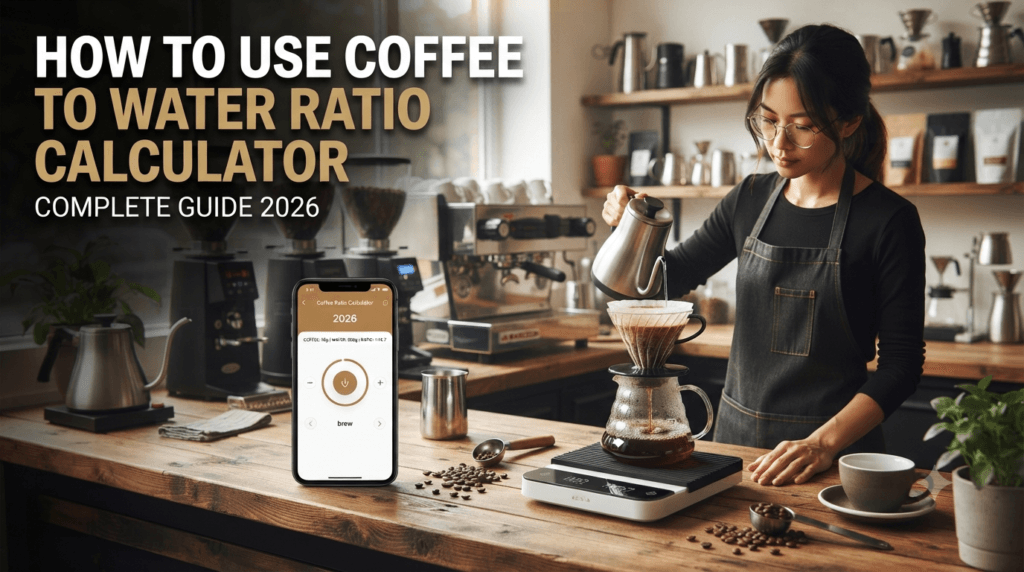
How to Use Coffee to Water Ratio Calculator: Complete Guide 2026
Stop guessing your brew and throwing away under-extracted cups. Master the exact science of coffee ratios to brew café-quality pour-over, French press, and drip coffee at home in 2026.
To use a Coffee to Water Ratio Calculator, input your desired total yield of brewed coffee (in grams or ounces) and select your preferred brewing ratio (e.g., 1:16 for standard drip). The calculator instantly divides the water weight by the ratio number to output the exact amount of dry, ground coffee you need to weigh out on a digital scale. For a 350g cup at a 1:16 ratio, the tool will tell you to use 21.8g of coffee. Use the Toolriz Calculator here.
- The 2026 Home Barrenaissance
- What is a Coffee to Water Ratio Calculator?
- Why You Must Weigh, Not Scoop
- The SCA Golden Ratio Explained
- Step-by-Step: How to Use the Tool
- Ratio Breakdowns by Brewing Method
- Dialing In: Adjusting for Taste
- The Hidden Variable: Water Quality
- How Grind Size Impacts Your Ratio
- Top 5 Brewing Math Mistakes
- Frequently Asked Questions
The 2026 Home Barrenaissance
The craft of home coffee brewing has reached unprecedented heights in 2026. What was once a simple morning routine of scooping Folgers into a Mr. Coffee machine has evolved into a precise, scientific pursuit of flavor. Today, home baristas invest in burr grinders, gooseneck kettles, and specialty single-origin beans. Yet, despite having the best equipment and the most expensive beans, millions of people still brew bitter, sour, or weak coffee. Why? Because they guess their coffee-to-water ratio.
Brewing coffee is fundamentally an act of extraction. You are using hot water as a solvent to dissolve soluble flavor compounds from the ground coffee. If you use too much water for the amount of coffee you have, you over-extract, pulling out bitter tannins and astringent flavors. If you use too little water, you under-extract, resulting in a sour, salty, and weak cup. The coffee-to-water ratio is the mathematical foundation that determines this balance.
For decades, people relied on volumetric measurements—tablespoons of coffee per “scoop” or “cup” of water. This method is hopelessly flawed because coffee beans vary wildly in density based on their roast level, origin, and time since roasting. A tablespoon of dark roast Ethiopian beans weighs completely differently than a tablespoon of light roast Sumatran beans. The only accurate way to brew is by weight.
This is where the Toolriz Coffee to Water Ratio Calculator becomes an essential kitchen tool. It eliminates the math and the guesswork, providing exact gram measurements for any brewing method.
Coffee extraction is a chemistry experiment. The ratio of solvent (water) to solute (coffee) dictates the concentration of the final solution (your cup). A calculator ensures this ratio remains perfectly consistent every single morning.
What is a Coffee to Water Ratio Calculator?
A Coffee to Water Ratio Calculator is a specialized digital tool designed for beverage preparation. Unlike a generic liquid volume calculator, this tool understands the standard brewing ratios used in specialty coffee, from the intense 1:2 ratio of espresso to the standard 1:18 drip ratio.
The tool requires two basic inputs to function:
- Desired Yield (Water): How much brewed coffee you want to make in your cup, carafe, or French press, measured in grams or milliliters (1ml of water = 1g).
- Brew Ratio: The strength preference you are aiming for, expressed as 1 part coffee to X parts water (e.g., 1:15, 1:16, 1:17).
Once these are entered, the calculator uses simple division to output the exact amount of dry ground coffee you need to weigh out. It translates the abstract concept of a “ratio” into a concrete, actionable gram measurement.
Why You Must Weigh, Not Scoop
If you take only one piece of advice from this 2026 guide, let it be this: throw away your coffee scoop. Measuring coffee by volume is the number one cause of inconsistent brewing.
The Density Problem
During the roasting process, coffee beans lose moisture and expand, becoming less dense. Therefore, a dark roast bean is physically larger and lighter than a light roast bean. If you use a tablespoon to measure a dark roast, you are fitting fewer beans (by weight) into the scoop than if you measured a light roast. You end up using less coffee than intended, leading to a weak, over-extracted brew.
The Grind Size Problem
How you grind coffee also changes its volume. A fine espresso grind packs tightly into a scoop, while a coarse French press grind leaves massive air gaps. A level tablespoon of fine grind might weigh 7 grams, while a tablespoon of coarse grind might weigh only 4 grams. If you use the same scoop for both methods, your ratios will be completely broken.
Weighing your coffee in grams bypasses all these variables. 20 grams is 20 grams, whether it is a dark roast, a light roast, finely ground, or coarsely ground. The Toolriz calculator operates entirely on weight (grams) to ensure scientific accuracy.
The SCA Golden Ratio Explained
You have likely heard of the “Golden Ratio” in coffee. This standard was established by the Specialty Coffee Association (SCA) after extensive sensory testing. The SCA determined that the optimal concentration for most drip and pour-over coffee is 1.15% to 1.35% dissolved coffee solids.
To achieve this concentration, the SCA recommends a brewing ratio of 1 part coffee to 18 parts water (1:18). In metric terms, this is roughly 55 grams of coffee per 1 liter (1000 grams) of water.
However, the 1:18 ratio is considered a baseline. Many modern specialty coffee roasters in 2026 prefer a slightly stronger cup and recommend starting at a 1:16 or 1:17 ratio. Ultimately, the calculator allows you to input whatever ratio you prefer, but if you are unsure where to start, 1:16 is the sweet spot for most manual brewing methods.
Step-by-Step: How to Use the Toolriz Calculator
Using the tool is the easiest part of your morning routine. Follow these steps for a flawless brew.
Determine Your Yield
Decide how much coffee you want to drink. A standard mug holds about 12 ounces, which is roughly 340 grams of water. Enter 340 into the ‘Water’ field of the calculator.
Choose Your Ratio
For a standard pour-over or drip, enter 16 into the ratio field. If you prefer a stronger cup, enter 15. For a weaker cup, enter 17.
Calculate the Dose
Click calculate. The tool will instantly display the exact grams of coffee needed (e.g., 340 ÷ 16 = 21.25g).
Weigh the Beans
Place a container on your digital scale, tare it to zero, and weigh out the exact gram amount of whole coffee beans calculated by the tool.
Grind and Prep
Grind your beans to the appropriate size for your brewing method. Place your brewing vessel on the scale and tare it again.
Brew to Weight
Pour your hot water into the coffee grounds, watching the scale closely. Stop pouring the moment the scale reaches your original water yield number (340g).
Repeat with Consistency
Because you measured both the coffee and the water by weight, this cup will taste exactly the same tomorrow as it does today.
Ratio Breakdowns by Brewing Method
Not all brewing methods use the same ratio. The physics of how the water interacts with the coffee changes the math. Here is the breakdown for 2026’s most popular brewing methods.
| Brewing Method | Standard Ratio | Grind Size | Notes |
|---|---|---|---|
| Pour-Over (V60, Chemex) | 1:16 to 1:17 | Medium-Fine | Allows for precise control of extraction via pour speed. |
| French Press (Immersion) | 1:15 to 1:12 | Coarse | Requires a tighter ratio because immersion is less efficient at extracting than percolation. |
| Standard Drip Machine | 1:17 to 1:18 | Medium | Home machines often under-heat water; a slightly lower ratio can compensate. |
| Espresso | 1:2 to 1:2.5 | Extra Fine | Highly concentrated. A 18g dose yields 36g of liquid espresso in 25-30 seconds. |
| Cold Brew | 1:5 to 1:8 | Extra Coarse | Brewed as a concentrate. You dilute it 1:1 with water before drinking. |
Espresso uses a “brew ratio” that measures input (dry grounds) to output (liquid espresso). If you are pulling espresso, a standard ratio is 1:2 (e.g., 18g in, 36g out). Do not use the 1:16 drip ratio for espresso, or your machine will explode with water!
Dialing In: Adjusting for Taste
The calculator provides the mathematically correct starting point, but your palate is the ultimate judge. Once you have brewed a cup using the calculator, taste it. If it doesn’t taste right, use these diagnostic principles to adjust your ratio or grind for the next cup.
Problem 1: The coffee tastes sour, salty, or weak.
Diagnosis: Under-extraction. The water didn’t have enough time or coffee surface area to pull out the sweet and bitter compounds that balance the acidic sour notes.
Fix: Use a tighter ratio (e.g., go from 1:16 to 1:15, meaning more coffee for the same amount of water). Alternatively, grind the coffee finer to increase surface area and slow down the flow of water.
Problem 2: The coffee tastes bitter, dry, or astringent.
Diagnosis: Over-extraction. The water pulled too much out of the coffee, dissolving the bitter tannins at the end of the extraction curve.
Fix: Use a looser ratio (e.g., go from 1:16 to 1:17, meaning less coffee for the same amount of water). Alternatively, grind the coffee coarser to speed up the water flow and reduce extraction.
When dialing in a new bag of coffee, only change one thing per day. If your cup is sour, change the ratio on day one. If it is still sour on day two, keep that ratio and change the grind size on day two. Changing multiple variables at once makes it impossible to know what fixed the problem. For more advanced dialing-in techniques, explore our related articles in the Toolriz culinary blog.
The Hidden Variable: Water Quality
You can use the Coffee to Water Ratio Calculator perfectly, weigh everything to the tenth of a gram, and still brew terrible coffee if your water is bad. Coffee is 98.5% water. If your tap water smells like chlorine or tastes heavily of minerals, your coffee will taste like chlorine and minerals.
The Ideal Brewing Water
The SCA has strict standards for brewing water. It should be clean, odorless, and have a Total Dissolved Solids (TDS) level between 75 and 225 ppm, with a hardness of 4-6 grains. Crucially, water needs some minerals (specifically calcium and magnesium) to extract coffee properly; 100% distilled water will result in a flat, lifeless brew.
The 2026 Solution
Most home baristas in 2026 use either a high-quality carbon filter (like a Brita or Pur) to remove chlorine, or they buy bottled spring water. If you are serious about your coffee, using a remineralized water recipe (adding specific amounts of Epsom salt and baking soda to distilled water) is the ultimate way to control this variable.
How Grind Size Impacts Your Ratio
While the calculator handles the weight math perfectly, the physical size of the coffee grounds dictates how easily the water can dissolve the coffee. This is where the ratio and the grind size work together.
Imagine two 20g doses of coffee. One is ground very fine (like table salt), the other very coarse (like sea salt). The fine grind has vastly more surface area than the coarse grind. When water hits the fine grind, it extracts flavor very quickly. When it hits the coarse grind, it extracts very slowly.
If you use a 1:16 ratio with a coarse French press grind, the water will pass through quickly, and you might get a weak cup. If you use a 1:16 ratio with a fine espresso grind in a pour-over, the water will pool up, over-extract, and the cup will take 10 minutes to drip through, tasting terribly bitter. The calculator assumes you are matching the correct grind size to your brewing method. Always ensure your grinder is dialed in to match the ratio you calculated.
Top 5 Brewing Math Mistakes
- Using “Cups” instead of Grams: A “cup” on a coffee maker is usually 5 or 6 ounces, not 8. And a “cup” on your coffee scoop is arbitrary. Always weigh your final yield in grams.
- Forgetting to Tare the Scale: If you weigh your coffee in a heavy glass jar but don’t hit “tare” (zero), you are only putting 15g of coffee in instead of 20g. This throws the entire ratio off.
- Weighing After Grinding:
When you grind coffee, some fine dust gets left behind in the grinder chute. If you weigh 20g of whole beans, you get 20g of grounds. If you grind first, then try to weigh out 20g from the catcher, you are leaving extraction behind in the machine. Always weigh whole beans before grinding.
- Not Accounting for Water Absorption: If you are brewing a French press and calculate 500g of water, you will yield less than 500g of liquid coffee because the grounds absorb about 2g of water per 1g of coffee. The calculator accounts for the brewing weight, not the final poured weight. Don’t panic when your yield is slightly lower than your water input.
- Using Boiling Water: Boiling water (212°F) burns coffee, making it taste ashy. The ideal brewing temperature is between 195°F and 205°F. Let your kettle sit off the boil for 1 minute before pouring. This doesn’t change the ratio math, but it ruins the extraction the ratio is trying to achieve.
🔑 Key Takeaways
- A Coffee to Water Ratio Calculator translates brewing ratios (like 1:16) into exact gram measurements for your specific cup size.
- Always measure coffee and water by weight (grams), never by volume (tablespoons or cups), to account for variations in bean density and grind size.
- The SCA Golden Ratio is 1:18, but 1:16 is the modern standard for a stronger, sweeter cup of pour-over or drip coffee.
- Different methods require different ratios: Espresso uses 1:2, French press uses 1:15, and cold brew concentrate uses 1:5.
- If your coffee tastes sour, use a tighter ratio or finer grind. If it tastes bitter, use a looser ratio or coarser grind.
- Perfect math cannot save bad water. Always use filtered, odorless water between 195°F and 205°F for brewing.
Brew the Perfect Cup Tomorrow Morning
Stop wasting specialty coffee on bad math. Use our free, precise Coffee to Water Ratio Calculator to weigh your grounds and water perfectly every single time.
Frequently Asked Questions
The Specialty Coffee Association (SCA) defines the golden ratio as 1 part coffee to 18 parts water (1:18). This translates to roughly 55 grams of coffee per 1 liter (1000 grams) of water. However, personal preference and brewing methods often dictate ratios between 1:15 and 1:17 for a stronger cup. Use the Toolriz calculator to find your perfect math.
Assuming one cup is 8 ounces (approximately 236 grams of water), two cups equal 472 grams of water. Using a standard 1:16 brewing ratio, you would divide 472 by 16, which equals 29.5 grams of ground coffee.
You should always measure coffee by weight (grams) rather than volume (tablespoons). Coffee beans vary drastically in density based on roast level and origin. A tablespoon of dark roast weighs significantly less than a tablespoon of light roast, making volume measurements highly inaccurate.
The best ratio for French press coffee is typically 1:15 or 1:12. Because French press is an immersion method where water loses heat quickly, a tighter ratio (more coffee) ensures a robust extraction. A 1:15 ratio yields a rich, heavy body without tasting bitter.
Espresso uses a much tighter brew ratio, typically 1:2. This means if you dose 18 grams of ground coffee into the portafilter, you should extract 36 grams of liquid espresso out. The Toolriz Coffee to Water Ratio Calculator can help you determine these inputs and outputs.
If your math is correct but the coffee is sour, you are under-extracting. Try changing your ratio to be tighter (e.g., from 1:17 to 1:15, meaning more coffee per water). If that doesn’t work, your grind size is likely too coarse, and you need to dial your grinder finer to slow down the water flow.