

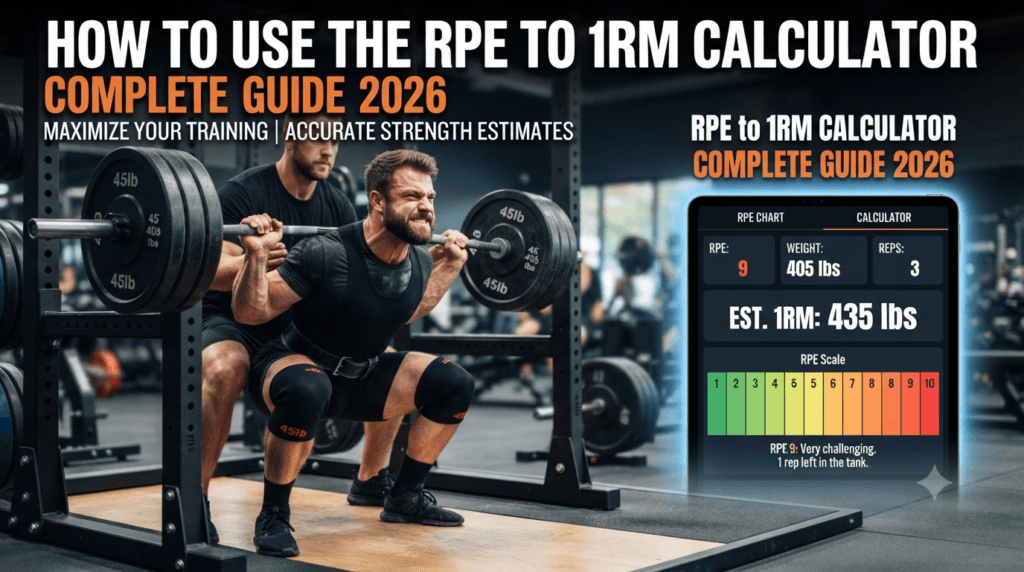
How to Use the RPE to 1RM Calculator: Complete Guide 2026
A practical, no-nonsense breakdown for lifters who want to estimate their true one-rep max from a training set — without grinding through a dangerous, all-out attempt.
Most lifters find out their true strength the hard way: by loading a bar to the point of failure and hoping the last rep doesn’t bury them. It’s a method that works, technically, but it’s also how good training cycles get derailed by fatigue, joint stress, and missed lifts. An RPE to 1RM calculator solves the same problem without any of that risk — it takes a submaximal set you’ve already performed, factors in how hard it felt, and estimates your one-rep max from there.
The catch is that most people either don’t know how to rate a set accurately, or don’t understand what the calculator is actually doing behind the scenes, which leads to numbers that are off by 10, 15, sometimes 20 pounds. This guide walks through exactly how RPE and 1RM relate to each other, how to use the calculator correctly, and how to avoid the mistakes that make an estimated max meaningless.
What Is RPE, and Why Does It Matter for Strength Training?
RPE stands for Rate of Perceived Exertion — a simple 1-to-10 scale lifters use to describe how hard a set actually felt, independent of the exact weight on the bar. It was adapted for strength sports from endurance training scales and popularized in powerlifting by coach Mike Tuchscherer’s Reactive Training Systems methodology, where it’s paired with a companion concept called RIR, or Reps in Reserve.
The scale works like this: an RPE of 10 means you couldn’t have completed another rep with good form — the set was an absolute maximal effort. An RPE of 9 means you had exactly one more rep left in the tank. An RPE of 8 means two reps were left. As the RPE number drops, the amount of reserve strength you were holding back increases.
| RPE | Reps in Reserve (RIR) | What it feels like |
|---|---|---|
| 10 | 0 | Maximal effort — no reps left, form may break down |
| 9.5 | 0–1 | Could maybe grind out one more, unclear |
| 9 | 1 | Definitely one more rep left, would be hard |
| 8.5 | 1–2 | One to two reps left, effort is climbing |
| 8 | 2 | Two clean reps left in the tank |
| 7.5 | 2–3 | Working set, still controlled |
| 7 | 3 | Solid working weight, bar speed still fast |
RPE matters because it lets you train relative to how your body is performing on that specific day, rather than chasing a fixed percentage of a max that might be stale, outdated, or simply wrong. This is called autoregulation, and it’s the reason RPE-based programming has become standard practice across modern powerlifting, weightlifting, and strength-focused bodybuilding programs.
What Is 1RM, and Why You Need to Know Yours
Your one-rep max, or 1RM, is the single heaviest weight you can lift for exactly one complete repetition with proper technique. It’s the foundation that most strength programming is built around — percentage-based training blocks, competition attempt selection, and progress tracking all reference the 1RM as their baseline number.
The problem is that testing a true 1RM directly is taxing on the joints and nervous system, and it isn’t something most lifters should be doing every few weeks just to check progress. That’s exactly the gap an RPE to 1RM calculator fills: it lets you estimate a current, accurate max from a submaximal set you’ve already trained through, with no extra risk added to your session.
How RPE and 1RM Are Mathematically Connected
Every combination of reps and RPE corresponds to a fairly consistent percentage of your true 1RM. A set of 5 reps performed at RPE 8, for example, represents a fairly predictable percentage of your max — usually somewhere in the low-to-mid 80s — regardless of what the actual weight on the bar happens to be. This relationship is what a calculator uses to work backward from a training set to an estimated max.
The general logic looks like this: more reps performed at a given RPE means a lower percentage of 1RM, because fatigue accumulates across the set. And at a fixed rep count, a higher RPE means a higher percentage of 1RM, because you were closer to true failure. A calculator combines both variables — reps performed and RPE rating — against a reference chart to solve for the one number you don’t directly know: your current max.
RPE-Based Training vs. Fixed Percentage Training
Traditional strength programs are often written as a flat percentage of a tested 1RM — squat 5 sets of 5 at 75%, for example. That approach works well right after a max test, but the number it’s built on starts going stale within a few weeks as strength, fatigue, and recovery shift. RPE-based programming solves this by prescribing a target effort instead of a fixed weight: “5 sets of 5 at RPE 8” tells the lifter to find whatever weight produces that specific level of difficulty on that specific day, which might be heavier than the percentage-based number on a good day and lighter on a fatigued one.
Neither approach is strictly better — many advanced programs blend both, using percentages for early volume work and RPE targets for top sets closer to a competition or testing block. What an RPE to 1RM calculator adds to either style of programming is a fast way to translate between the two: take an RPE-based top set, run it through the calculator, and instantly get an updated percentage-based number to plan the following weeks of training around. That back-and-forth is what keeps a long training block accurate without requiring a dedicated max-out session every time the plan needs a fresh number.
RPE to %1RM Across Different Rep Ranges
The single-rep chart above is useful, but most training actually happens in the 2-to-5 rep range, not as singles. As reps increase at the same RPE, the equivalent percentage of your 1RM drops, because your body is managing accumulated fatigue across the whole set, not just the final rep. Here’s how that plays out at RPE 8 — a common, sustainable working intensity — across different rep counts.
| Reps at RPE 8 | Approx. %1RM | Example (400 lb squat max) |
|---|---|---|
| 1 | 92.2% | ≈ 369 lbs |
| 2 | 89.5% | ≈ 358 lbs |
| 3 | 86.5% | ≈ 346 lbs |
| 4 | 84.0% | ≈ 336 lbs |
| 5 | 81.1% | ≈ 324 lbs |
This is exactly why a calculator that only asks for weight and RPE, without also asking for reps performed, will give you an unreliable answer. Reps and RPE work together as a pair — neither number means much for estimating a max without the other. A well-built RPE to 1RM calculator always takes both inputs before returning a result, and understanding this relationship is also what makes it possible to sanity-check a calculator’s output by hand instead of blindly trusting whatever number appears on screen.
This same logic is also why two lifters can post the same “top set” weight and rep count on social media and mean two very different things by it. A 300-pound squat for a triple at RPE 7 represents meaningfully less relative strength than a 300-pound triple at RPE 9.5 — the number on the bar is identical, but the percentage of true capacity being used is not. RPE is what turns a raw weight into a genuinely comparable measure of effort.
How to Use the RPE to 1RM Calculator (Step by Step)
-
Complete a genuine working set
Perform a set at a weight and rep count you can rate honestly — this works best with sets between 1 and 6 reps, since accuracy drops the further you get from your max effort range.
-
Rate the set immediately, not after resting
As soon as the set ends, assign an RPE based on how many more reps you believe you could have completed with the same weight. Waiting even a few minutes lets recovery distort your honest read on the set.
-
Open the calculator and enter your numbers
Head to the RPE to 1RM calculator and input the weight you lifted, the number of reps you completed, and the RPE you assigned to the set.
-
Read your estimated 1RM
The calculator cross-references your reps and RPE against the percentage chart and returns an estimated one-rep max in the same units you entered.
-
Treat the number as an estimate, not gospel
Use the result to guide programming — selecting training percentages, planning a peak, or picking a realistic competition attempt — rather than treating it as a certified max until you actually test it.
-
Re-test periodically
Run the calculation again every few weeks using a fresh working set. Because it only takes one submaximal set, you can track strength progress far more often than you could with a true max attempt.
Real Example: Estimating a Bench Press 1RM
Say a lifter works up to a set of 3 reps at 185 lbs on the bench press, and it feels like an RPE 8 — meaning roughly two more reps were possible with good form. Based on standard rep-RPE relationships, a triple at RPE 8 represents approximately 86–87% of a true 1RM.
| Working set | Est. %1RM | Estimated 1RM |
|---|---|---|
| 185 lbs × 3 @ RPE 8 | ≈ 86.5% | ≈ 214 lbs |
That 214-pound estimate gives the lifter a working number for the next several weeks of programming — enough to plan training percentages accurately, without ever having to attempt a true single-rep max in the gym that week. The same process applies identically to the squat, deadlift, overhead press, or any barbell lift where bar speed and effort can be judged set to set.
Common Mistakes When Using RPE to Estimate 1RM
- Rating the set too generously. New lifters especially tend to underestimate how many reps they actually had left, which inflates the RPE and produces an estimated max that’s higher than reality.
- Using sets outside the 1–6 rep range. RPE accuracy degrades on higher-rep sets because fatigue and pacing distort perceived effort — a set of 12 at RPE 8 is far less reliable for max estimation than a triple at RPE 8.
- Rating exertion after resting. Waiting too long after a set lets partial recovery cloud your judgment of how hard it actually felt in the moment.
- Ignoring technical breakdown. If form fell apart on the last rep, the set should be rated higher regardless of how it felt cardiovascularly — technical failure counts the same as muscular failure for RPE purposes.
- Treating one estimate as permanent. Strength shifts week to week with fatigue, sleep, and nutrition. A single RPE-based estimate is a snapshot, not a fixed number carved in stone.
Tips for More Accurate RPE Ratings
- Practice rating lighter sets first. Before trusting an RPE call on a heavy set, calibrate by rating easy warm-up sets where the reserve reps are obvious.
- Watch bar speed, not just feeling. A noticeable slowdown in bar speed on the final rep is one of the most reliable signals that a set was closer to true failure than it felt.
- Use half-point RPE values. Sticking to whole numbers only (7, 8, 9) throws away useful precision — 7.5 and 8.5 ratings sharpen the calculator’s output meaningfully.
- Log every set, not just top sets. Tracking RPE across an entire training block reveals patterns — like a rep max that consistently outperforms projections on certain days — that a single test can’t show.
- Cross-check against a real test occasionally. Every few months, validate your RPE-based estimates against an actual tested max to confirm your internal sense of effort is still calibrated correctly.
Powerlifters selecting competition attempts, intermediate and advanced lifters running autoregulated programs, and coaches managing multiple athletes’ training percentages without requiring frequent max-out sessions.
An RPE-based 1RM estimate is not a substitute for proper coaching, warm-up protocol, or safe attempt selection in competition. Always prioritize technique and recovery over chasing a bigger estimated number.
Frequently Asked Questions
How accurate is an RPE to 1RM calculator?
For experienced lifters who can rate effort accurately, estimates typically land within a few percent of a true tested max. Accuracy drops for beginners still learning to judge reps in reserve, and for sets performed well outside the 1–6 rep range.
What’s the difference between RPE and RIR?
RPE rates effort on a 1-to-10 scale where 10 is maximal, while RIR directly states how many reps were left in reserve. They describe the same underlying idea from opposite directions — an RPE of 8 corresponds to roughly 2 RIR.
Can I use RPE to 1RM calculations for any lift?
Yes. The reps-and-RPE-to-percentage relationship applies to any compound barbell lift, including the squat, bench press, deadlift, and overhead press, since it’s based on general fatigue and effort patterns rather than a specific exercise.
How often should I re-test my estimated 1RM?
Every 2 to 4 weeks is common for lifters running an active training block, since it only requires one submaximal working set rather than a dedicated max-testing session.
Is a calculated 1RM the same as a tested 1RM?
No. A calculated 1RM is an estimate based on a submaximal set and your perceived effort rating. A tested 1RM is measured directly through an actual maximal attempt. The estimate is useful for programming, but the tested number is the definitive one.
Why does RPE-based training matter more than fixed percentages?
Fixed percentages assume your max never changes, but daily readiness fluctuates with sleep, stress, and recovery. RPE-based training adjusts the actual weight used to match how you’re performing that day, while still targeting the same relative intensity.
Final Thoughts
Estimating your one-rep max doesn’t require grinding through a risky, all-out attempt every time you want an updated number. Once you understand how reps and RPE combine to represent a percentage of your true max, a calculator turns a single honest working set into an accurate, usable training number — one you can safely re-check every few weeks as your strength changes. Rate your next working set honestly, run it through the tool below, and program with a number you can actually trust.
Explore More on Toolriz
- Looking for other quick, free utilities? Browse the full collection of online tools on Toolriz.
- Want more guides like this one? Check out related posts in the Toolriz blog.