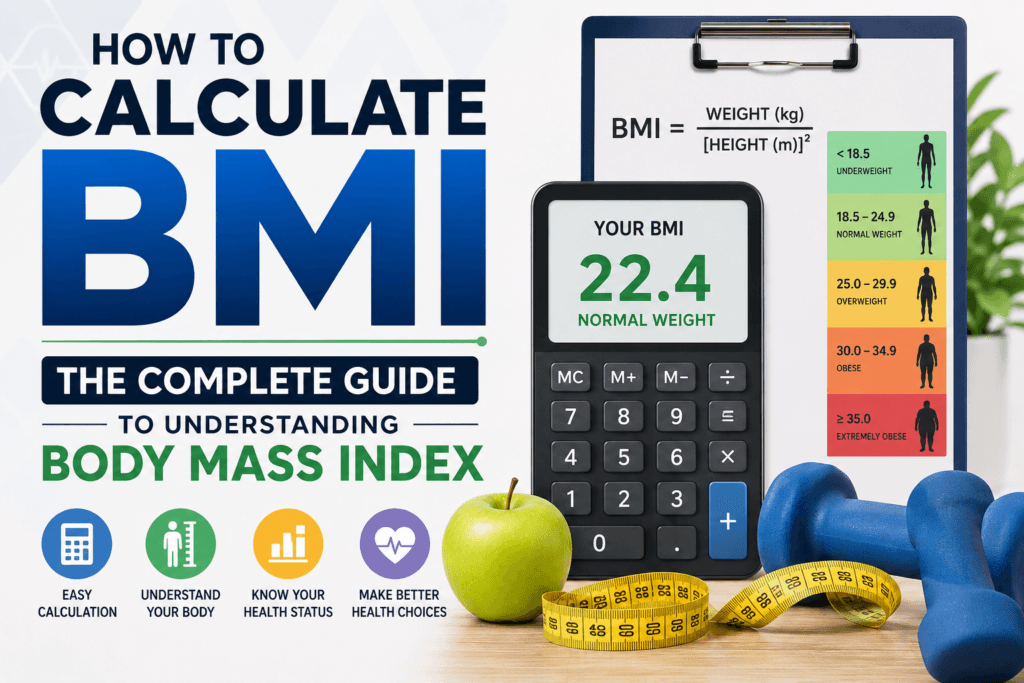
How to Calculate BMI: The Complete Guide to Understanding Body Mass Index
A step-by-step, evidence-based guide to calculating, interpreting, and applying your Body Mass Index — with real formulas, charts, and a free calculator.
Table of Contents
- What Is BMI and Why Does It Matter?
- The BMI Formula Explained (Metric & US Units)
- How to Calculate BMI Manually: Step-by-Step
- Worked Examples With Real Numbers
- BMI Chart: Categories for Adults
- Use a Free Online BMI Calculator
- How BMI Calculation Differs for Children and Teens
- Limitations of BMI: What It Doesn’t Tell You
- Better Alternatives and Complementary Metrics
- Practical Tips for Using Your BMI Result
- Frequently Asked Questions
If you have ever filled out a medical intake form or scrolled through a fitness app, you have likely encountered the term Body Mass Index (BMI). It is one of the most widely used screening tools in modern healthcare, referenced by the Centers for Disease Control and Prevention (CDC), the World Health Organization (WHO), and nearly every primary care physician in the United States. Yet despite its popularity, most people have never actually calculated their own BMI by hand or fully understood what the number represents.
This guide walks you through exactly how to calculate BMI, the science behind the formula, real worked examples, a complete adult BMI chart, and the well-documented limitations that every health-conscious reader should know before drawing conclusions from a single number.
1. What Is BMI and Why Does It Matter?
Body Mass Index is a numerical value derived from a person’s weight and height. It was originally developed in the 1830s by Belgian mathematician Adolphe Quetelet as a population-level statistical tool, not as an individual diagnostic measure. Over time, BMI was adapted by public health agencies as a quick, low-cost screening method to estimate whether a person’s weight falls within a range typically associated with lower health risk.
Today, BMI is used by:
- Primary care doctors during annual checkups
- Insurance companies for underwriting and risk assessment
- Public health researchers tracking obesity trends across populations
- Fitness professionals as one of several intake metrics
Despite criticism (which we cover in detail later), BMI remains relevant because it is inexpensive, requires no special equipment beyond a scale and a tape measure, and correlates reasonably well with body fat percentage at a population level.
2. The BMI Formula Explained (Metric & US Units)
There are two versions of the BMI formula depending on the unit system you use. Both produce the same result mathematically — they are simply adjusted for different units of measurement.
Metric Formula
BMI = Weight (kg) ÷ [Height (m)]²
US Customary Formula (Pounds and Inches)
BMI = [Weight (lb) ÷ (Height (in))²] × 703
The constant 703 in the US formula is a conversion factor that allows you to use pounds and inches directly instead of converting to kilograms and meters first. This is the formula used by the CDC’s official BMI calculation guidelines for American adults.
3. How to Calculate BMI Manually: Step-by-Step
Follow these four steps to calculate your BMI by hand using a calculator or even pen and paper.
Step 1: Get an Accurate Weight Measurement
Weigh yourself first thing in the morning, after using the restroom, and before eating or drinking, for the most consistent reading. Use a calibrated digital scale on a hard, flat surface rather than carpet.
Step 2: Measure Your Height Precisely
Stand barefoot against a wall with your heels, back, and head touching it. Use a stadiometer if available, or a flat object and tape measure as a substitute. Round to the nearest quarter inch or half centimeter.
Step 3: Square Your Height
Multiply your height by itself. For example, if you are 68 inches tall, you would calculate 68 × 68 = 4,624.
Step 4: Apply the Formula
Divide your weight by the squared height value, then multiply by 703 (for US units) or skip the multiplication step if using meters and kilograms.
4. Worked Examples With Real Numbers
Example 1: US Units
A person weighs 160 lb and is 5 feet 6 inches tall (66 inches).
- Square the height: 66 × 66 = 4,356
- Divide weight by squared height: 160 ÷ 4,356 = 0.0367
- Multiply by 703: 0.0367 × 703 ≈ 25.8
This places the individual in the “overweight” category, which begins at 25.0.
Example 2: Metric Units
A person weighs 70 kg and is 1.75 meters tall.
- Square the height: 1.75 × 1.75 = 3.0625
- Divide weight by squared height: 70 ÷ 3.0625 ≈ 22.9
This falls squarely within the “normal weight” range of 18.5–24.9.
5. BMI Chart: Categories for Adults
| BMI Range | Category | General Health Context |
|---|---|---|
| Below 18.5 | Underweight | May indicate nutritional deficiency or other health concerns |
| 18.5 – 24.9 | Normal weight | Generally associated with lower weight-related health risk |
| 25.0 – 29.9 | Overweight | Associated with increased risk of certain conditions |
| 30.0 – 34.9 | Obesity (Class 1) | Higher risk; lifestyle evaluation often recommended |
| 35.0 – 39.9 | Obesity (Class 2) | Significantly elevated risk profile |
| 40.0 and above | Obesity (Class 3 / Severe) | Highest risk category; medical consultation strongly advised |
Skip the Manual Math — Get Instant, Accurate Results
Want your BMI calculated instantly without doing the math yourself? Use our free, accurate, and mobile-friendly BMI calculator tool below.
Try the Free BMI Calculator →6. Use a Free Online BMI Calculator
While manual calculation is useful for understanding the underlying math, most people prefer a faster and error-free method. An online calculator instantly applies the correct formula, eliminates rounding mistakes, and often includes additional context like category classification and healthy weight ranges for your specific height.
You can use the Toolriz BMI Calculator to enter your height and weight in either metric or US units and receive an instant, accurate BMI score along with your weight category — no manual math required.
7. How BMI Calculation Differs for Children and Teens
The core formula for calculating BMI is identical for children and adults. However, interpretation differs significantly. Because children’s bodies change rapidly during growth, pediatric BMI results are plotted on age- and sex-specific percentile growth charts rather than fixed numeric categories.
- Below the 5th percentile: Underweight
- 5th to below the 85th percentile: Healthy weight
- 85th to below the 95th percentile: Overweight
- 95th percentile and above: Obesity
Parents and caregivers should always interpret a child’s BMI in consultation with a pediatrician, since growth patterns vary widely by age and developmental stage.
8. Limitations of BMI: What It Doesn’t Tell You
Despite its widespread use, BMI has well-documented limitations that researchers and clinicians have raised for decades:
- Does not distinguish muscle from fat: A muscular athlete and a sedentary individual of the same height and weight will have identical BMI scores despite very different body compositions.
- Doesn’t account for fat distribution: Visceral fat around organs poses different health risks than subcutaneous fat, and BMI cannot differentiate between the two.
- Age and sex variations: Body composition naturally shifts with age and differs between sexes, which the standard formula does not adjust for.
- Ethnic and population differences: Some research suggests certain population groups face elevated health risks at lower BMI thresholds than the standard chart suggests.
- Not diagnostic on its own: BMI is a screening tool, not a diagnostic measurement of disease or individual health status.
9. Better Alternatives and Complementary Metrics
Health professionals increasingly recommend pairing BMI with additional measurements for a fuller picture:
- Waist-to-hip ratio: Helps assess fat distribution and cardiovascular risk.
- Body fat percentage: Measured via skinfold calipers, bioelectrical impedance, or DEXA scans.
- Waist circumference: A simple tape-measure metric linked to metabolic risk.
- Resting blood pressure and bloodwork: Cholesterol, glucose, and other biomarkers offer a more complete health profile than weight-based metrics alone.
10. Practical Tips for Using Your BMI Result
- Recalculate your BMI periodically (every few months) rather than obsessing over daily fluctuations.
- Use BMI alongside other metrics, not as a sole indicator of fitness or health.
- Discuss unusual or borderline results with a licensed healthcare provider before making major lifestyle changes.
- Remember that muscle gain can raise BMI even while body fat decreases — context always matters.
- Use a reliable, consistent measurement method each time you calculate, to track meaningful trends over time.
11. Frequently Asked Questions
What is the formula to calculate BMI?
BMI is calculated by dividing weight in kilograms by height in meters squared (BMI = kg/m²). In US units, the formula is BMI = (weight in pounds ÷ height in inches²) × 703.
What is considered a healthy BMI?
According to the CDC and WHO, a BMI between 18.5 and 24.9 is generally classified as a healthy weight range for most adults.
Is BMI accurate for everyone?
No. BMI does not account for muscle mass, bone density, fat distribution, age, or sex, which can make it misleading for athletes, older adults, pregnant women, and highly muscular individuals.
How often should I check my BMI?
Most health professionals recommend checking BMI every few months or during routine annual physical exams, since it is intended to track long-term trends rather than daily changes.
Can I calculate BMI without a calculator?
Yes. The manual formula only requires basic multiplication and division, making it possible to calculate by hand with a pen and paper, though an online calculator reduces the chance of rounding errors.
Reference context: BMI classification ranges and calculation methodology referenced in this article align with publicly published guidelines from the Centers for Disease Control and Prevention (CDC) and the World Health Organization (WHO) on adult and pediatric weight classification.
Pingback: Healthy BMI by Age: Chart for Women & Men (2026)