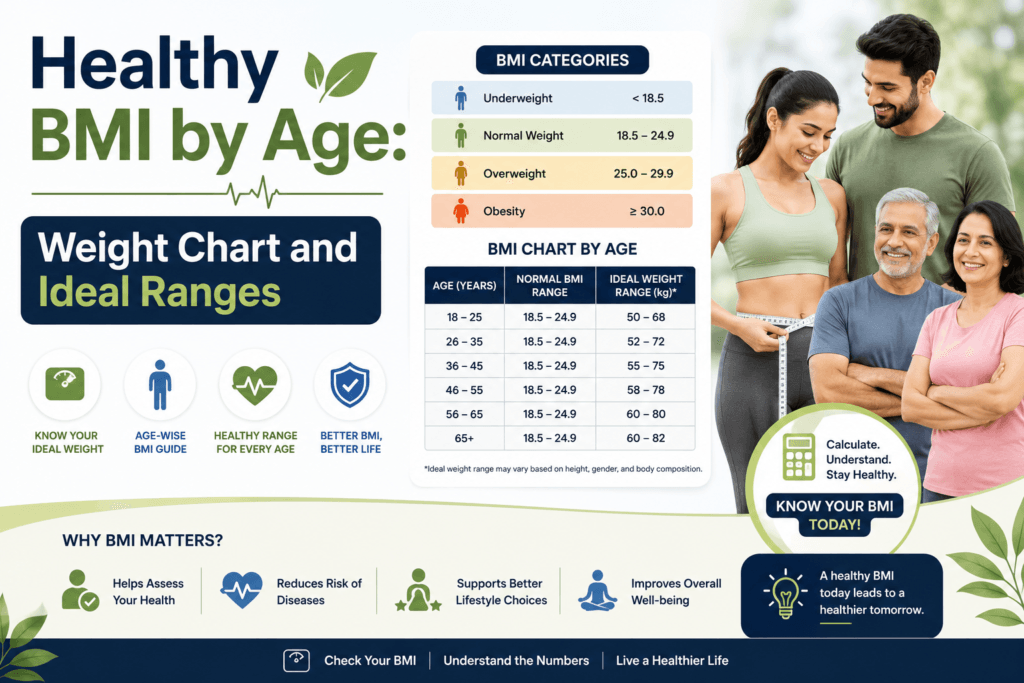
A 24-year-old, a 45-year-old, and a 72-year-old can all post the exact same Body Mass Index score and walk away with three very different health pictures. That is one of the most overlooked facts about a healthy BMI by age in the United States: the standard 18.5–24.9 “healthy” range was built as a single, one-size-fits-all formula, but the way that number should be read changes significantly as you move through your 20s, 40s, 60s, and beyond.
This guide breaks down what a healthy BMI actually looks like at every adult life stage, why the “ideal” number quietly shifts with age, and how US clinicians increasingly interpret BMI for older adults differently than they do for someone in their twenties. If you are looking for the basic formula or step-by-step calculation method instead, our complete guide on how to calculate BMI covers that in full detail.
Table of Contents
- Why a “Healthy” BMI Isn’t the Same at Every Age
- Healthy BMI by Age Chart (Men & Women, 20s–90s)
- BMI in Your 20s
- BMI in Your 30s
- BMI in Your 40s
- BMI in Your 50s
- Healthy BMI for Men Over 50
- BMI for Men Over 65
- BMI for Seniors Over 65 (Women)
- BMI in Your 70s and Beyond
- The “Obesity Paradox” in Older Adults, Explained
- Do Men and Women Need Different BMI Targets?
- Why Muscle Loss Makes BMI Less Reliable After 65
- How to Track Your BMI Trend Over Time
- Frequently Asked Questions
Why a “Healthy” BMI Isn’t the Same at Every Age
The Centers for Disease Control and Prevention defines a single healthy-weight band for all adults aged 20 and older: a BMI between 18.5 and 24.9. On paper, that range never changes whether you are 21 or 81. But population health research tells a more nuanced story. As the body ages, several things happen at once: resting metabolic rate slows, muscle mass naturally declines (a process called sarcopenia), bone density drops, and fat tends to redistribute toward the abdomen even when total weight stays flat.
Because BMI cannot see any of that — it only sees weight and height — a “perfect” BMI of 21 in a 70-year-old might actually reflect low muscle mass and frailty risk, while a BMI of 27 in the same person might reflect a healthy reserve of muscle and fat that protects against illness. This is why most geriatricians and many primary care providers in the US now treat BMI as a starting conversation, not a final verdict, especially once a patient passes age 65.
Key takeaway: The CDC’s official healthy range (18.5–24.9) is the correct reference point for adults of any age. What shifts with age is the clinical interpretation — how much weight that number should carry relative to muscle mass, mobility, and overall health context.
Healthy BMI by Age Chart (Men & Women, 20s Through 90s)
The table below combines the standard CDC/WHO adult classification with the age-related context that US research has highlighted for each decade of life. These are general reference points, not individual prescriptions — your own healthy number depends on muscle mass, frame size, and personal medical history.
| Age Range | Standard Healthy BMI | Clinical Context for This Age |
|---|---|---|
| 20–29 | 18.5 – 24.9 | Standard range applies directly; this is typically when bone density and muscle mass peak. |
| 30–39 | 18.5 – 24.9 | Metabolic rate begins a gradual annual decline; weight creep often starts here without diet changes. |
| 40–49 | 18.5 – 24.9 | Hormonal shifts (perimenopause in women, gradual testosterone decline in men) can change fat distribution even at a stable BMI. |
| 50–59 | 18.5 – 25.9 (upper end increasingly tolerated) | Many clinicians give more flexibility toward the upper-normal/low-overweight range if muscle mass and mobility are strong. |
| 60–69 | 22 – 27 | Slightly higher BMI is frequently associated with better resilience during illness and surgery recovery. |
| 70–79 | 23 – 29 | Unintentional weight loss becomes a bigger concern than moderate excess weight for many patients in this group. |
| 80 and older | 23 – 30 | Maintaining weight and muscle mass is often prioritized over weight loss; being underweight carries notably higher risk. |
Calculate Your Exact BMI Instantly with the Free ToolRiz Calculator →
BMI in Your 20s: Setting a Baseline
Your 20s are typically when your body reaches peak bone density and lean muscle mass, assuming a generally active lifestyle. A BMI between 18.5 and 24.9 is the most reliable indicator of healthy weight at this life stage, with fewer of the complicating factors (hormonal shifts, muscle loss, medication side effects) that show up later. This makes your 20s an ideal time to establish a baseline BMI reading that you can compare against in later decades — not to chase a single “perfect” number, but to notice meaningful trends over time.
BMI in Your 30s: Where Slow Creep Begins
Resting metabolic rate begins declining by roughly 1 to 2 percent per decade starting around age 30, according to metabolic research cited by US clinical nutrition organizations. Combined with desk-based careers, reduced recreational activity, and early parenthood for many adults, this is frequently the decade where BMI quietly climbs from the low-20s into the mid-20s without any single dramatic cause. Catching this early — through periodic BMI checks rather than waiting for an annual physical — gives you the best chance to course-correct with small, sustainable changes.
BMI in Your 40s: Hormones Start Changing the Picture
For women, the 40s often include perimenopause, a transitional period marked by fluctuating estrogen that is linked to increased abdominal fat storage even when total body weight and BMI remain unchanged. For men, gradually declining testosterone can have a similar effect on fat distribution. Because of this, two people in their 40s with an identical BMI of 24 can have meaningfully different body composition and abdominal fat levels. This is the decade where pairing BMI with a waist circumference measurement becomes especially valuable.
BMI in Your 50s: A Wider Acceptable Range
By the 50s, several long-running US and international cohort studies have found that adults with a BMI modestly above the traditional 24.9 cutoff — into the 25 to 27 range — do not show meaningfully worse long-term outcomes than those in the “normal” range, provided blood pressure, blood sugar, and cholesterol remain in healthy ranges. This doesn’t mean the standard chart is wrong; it means the number alone matters less than the surrounding health picture at this stage.
Weight Chart for Women Over 50: What a Healthy BMI Looks Like by Height
For women specifically, the years around and after age 50 typically overlap with menopause, when declining estrogen tends to shift fat storage toward the abdomen even at a stable weight. Many clinicians suggest a slightly narrower target — roughly BMI 20 to 25 — for women in their early 50s to help protect bone density, since low body weight is a known risk factor for osteoporosis. A rough weight chart for women over 50 by height looks like this: a woman at 5’2″ generally falls in a healthy BMI range between about 109 and 136 pounds; at 5’5″, that range is roughly 120 to 150 pounds; and at 5’8″, roughly 131 to 164 pounds. These figures are general reference points, not personalized targets, and should be reviewed alongside a healthcare provider’s guidance.
Weight Chart for Women Over 60: Why the Target Shifts Again
Past age 60, the picture changes once more. Large-scale studies tracking more than a million older adults have found that women in this group with a BMI between roughly 25 and 30 often have the lowest mortality risk — higher than the standard “normal” cutoff of 24.9. This is closely tied to bone protection, illness recovery capacity, and resistance to the muscle and weight loss that frequently precedes serious decline in this age group. A woman over 60 who is 5’4″ and has a BMI around 27, for example, may be in a healthier position than a woman of the same height with a BMI of 21 and low muscle mass.
Healthy BMI for Men Over 50: What Changes and What Doesn’t
Men generally don’t experience an equivalent to menopause, but a slow, steady decline in testosterone — often starting in the late 40s and continuing through the 50s and 60s — has a real effect on body composition even when weight and BMI stay flat. Lower testosterone is associated with reduced muscle protein synthesis and a tendency to store more fat around the abdomen, which is why two men with an identical BMI of 26 can have very different waistlines and metabolic risk depending on their muscle mass. For men in their 50s, most clinicians still apply the standard 18.5–24.9 healthy range, but increasingly pair it with a waist circumference check (generally recommending under 40 inches) rather than relying on BMI alone.
BMI for Men Over 65: A Similar Shift, With Different Risk Factors
Much like the senior data for women, research tracking older men has found that a BMI in the roughly 23 to 28 range is often associated with better resilience during illness and hospitalization than a BMI under 22. However, the mechanism differs slightly: men tend to lose muscle mass earlier and more steadily than women across midlife, so a “normal” BMI in an older man is more likely to mask significant muscle loss than the same BMI in an older woman. Because of this, many geriatric providers treat unexplained weight loss in older men as a higher-priority warning sign than a BMI a few points above the standard cutoff.
BMI for Seniors Over 65: When Higher Can Mean Healthier
This is where the research becomes genuinely counterintuitive for most readers. Multiple long-term studies tracking adults over 65 have found a U-shaped or J-shaped relationship between BMI and mortality risk: both very low and very high BMI carry elevated risk, but the lowest risk often sits closer to a BMI of 23 to 27 rather than the lower end of the traditional “normal” range. A BMI under 22 in this age group is increasingly flagged by clinicians as a potential signal of muscle loss or undernutrition rather than celebrated as ideal.
BMI in Your 70s and Beyond: Protecting Against Unintentional Weight Loss
For adults in their 70s, 80s, and beyond, unplanned weight loss is frequently a bigger red flag to clinicians than a BMI in the high-normal or mildly overweight range. Losing muscle and fat reserve at this stage is associated with frailty, slower recovery from illness or surgery, and higher fall risk. Many geriatric care guidelines now treat a BMI as low as 21 to 22 in this age group as a reason for nutritional follow-up, while a BMI of 27 to 29 with stable weight and good mobility is often considered low-risk.
The “Obesity Paradox” in Older Adults, Explained
You may come across the term “obesity paradox” when researching BMI and aging. It refers to the consistent finding across multiple studies that older adults with a BMI in the overweight range sometimes have better survival outcomes during serious illness, surgery, or hospitalization than those with a “normal” or low BMI. Researchers believe this happens because extra weight can act as a metabolic and nutritional reserve during periods of high physical stress, when the body burns through energy stores rapidly. It is called a paradox precisely because it runs counter to how BMI is interpreted in younger adults, where a higher number more consistently correlates with elevated risk.
Do Men and Women Need Different BMI Targets?
The standard BMI formula and category thresholds are applied identically to men and women in US clinical practice — there is no separate official chart by sex. However, women naturally carry a higher percentage of body fat than men at the same BMI, due to differences in hormone profiles and reproductive biology. This means two people of the same height, weight, and BMI may have meaningfully different body fat percentages depending on sex, which is one reason many clinicians supplement BMI with waist circumference or body fat percentage testing rather than relying on BMI as a sex-neutral measure of health.
Why Muscle Loss Makes BMI Less Reliable After 65
Starting around age 30, adults lose roughly 3 to 8 percent of their muscle mass per decade if they remain inactive, with the rate of loss accelerating after 60. This condition, known clinically as sarcopenia, creates a tricky blind spot for BMI: a person can lose several pounds of muscle while gaining a similar amount of fat, leaving their total weight and BMI almost unchanged on paper while their actual health risk increases substantially. This is the single biggest reason BMI becomes a less complete picture with age, and why strength-based assessments like grip strength testing are increasingly used alongside BMI in US geriatric care.
How to Track Your BMI Trend Over Time (Not Just One Reading)
- Recalculate every 3 to 6 months, not daily — BMI is meant to reveal long-term trends, not short-term fluctuations from water weight or a single meal.
- Use the same conditions each time — similar time of day, similar clothing, and a consistent scale for the most comparable readings.
- Log it alongside waist circumference, especially once you’re past your 30s, since fat distribution often shifts even when BMI stays flat.
- Watch the direction, not just the number — a steady upward or downward trend across several readings tells you far more than any single result.
- Bring your trend data to your annual physical so your provider can interpret it alongside bloodwork, blood pressure, and your personal and family health history.
Get Your Current BMI Reading in Seconds →
Frequently Asked Questions
Does a healthy BMI really change as you get older?
The official CDC and WHO healthy-weight range (18.5–24.9) technically applies to all adults aged 20 and up. What changes with age is how clinicians interpret that number, since research consistently shows older adults with a BMI modestly above 25 often have equal or better health outcomes than those at the low end of “normal.”
What is a good BMI for a woman in her 40s?
A BMI between 18.5 and 24.9 remains the standard reference point, but because perimenopause can shift fat distribution toward the abdomen at any stable BMI, many providers recommend tracking waist circumference alongside BMI during this decade for a fuller picture.
Is a BMI of 27 bad for a 65-year-old?
Not on its own. Several long-term studies on adults over 65 have linked a BMI in the roughly 23 to 30 range with equal or better survival outcomes compared with a BMI under 22, partly because additional reserve can help the body withstand illness. Context from a healthcare provider matters more than the number alone.
At what age does BMI start to matter less as a standalone measure?
BMI never becomes irrelevant, but its reliability as a sole indicator weakens after roughly age 65, mainly due to natural muscle loss. Past this age, most geriatric specialists pair BMI with strength, mobility, and waist circumference measurements rather than relying on BMI in isolation.
Why is my BMI in the “overweight” category but my doctor isn’t worried?
Providers typically weigh BMI alongside blood pressure, bloodwork, muscle mass, weight stability, and family history. A BMI in the overweight range paired with otherwise strong health markers is treated very differently than the same number alongside other risk factors.
What is a healthy BMI for a man over 50?
Most clinicians still use the standard 18.5–24.9 range for men over 50, but increasingly check waist circumference (generally recommending under 40 inches) alongside BMI, since declining testosterone in this age group can shift fat toward the abdomen even when BMI itself stays in the normal range.
Related reading: For the full formula and worked calculation examples, see our guide on how to calculate BMI step by step, or read how the BMI formula was originally developed and what it does and doesn’t measure.
TR
ToolRiz Health Editorial Team
Our editorial team researches and fact-checks every health and wellness guide against publicly available CDC and WHO guidance to ensure accuracy, clarity, and trustworthiness for our readers. This article was independently researched and written for ToolRiz, drawing on publicly available CDC, WHO, and clinical aging research.
Medical Disclaimer: This article is for educational purposes only and is not a substitute for professional medical advice, diagnosis, or treatment. BMI is a screening tool, not a diagnostic measurement. Always consult a qualified healthcare provider regarding your individual health, weight, or fitness concerns.
© 2026 ToolRiz. All rights reserved. | This article was last reviewed for accuracy in June 2026.
Related Guides & Tools
Explore more BMI resources and calculate your Body Mass Index instantly.
👉 Complete BMI Guide
👉 BMI Formula Explained
👉 Try Free BMI Calculator