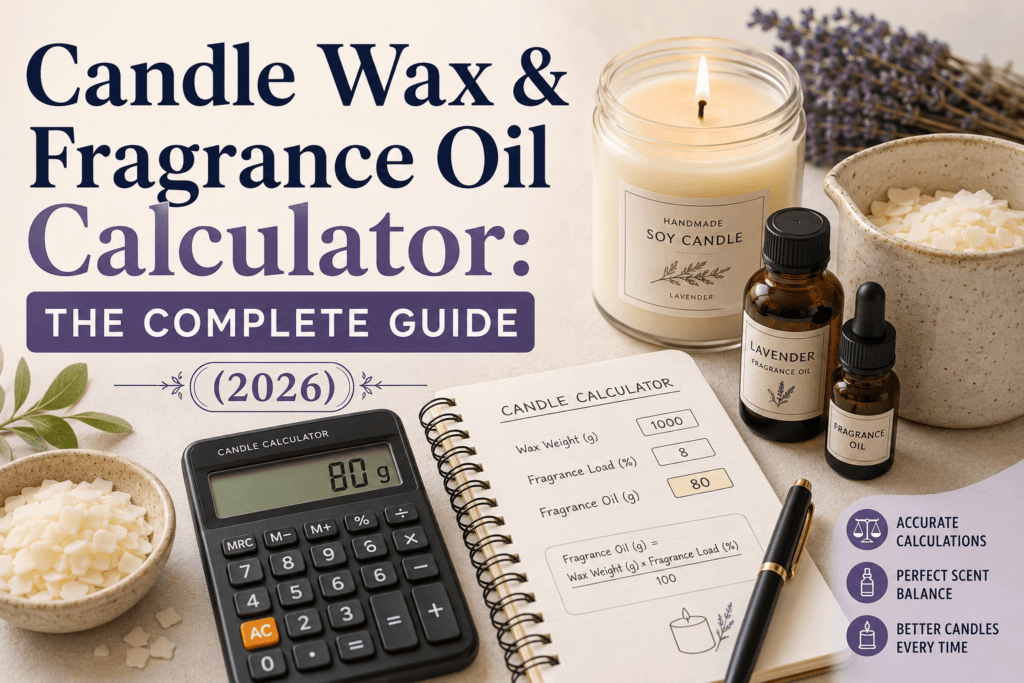
Candle Wax & Fragrance Oil Calculator: The Complete Guide (2026)
The exact fragrance load percentages, formulas, and container-size charts serious candle makers use to get strong hot throw without sweating, frosting, or wasted wax.
What a Candle Wax & Fragrance Oil Calculator Actually Does
A candle wax and fragrance oil calculator solves one problem that trips up almost every new candle maker: figuring out exactly how much scent to add to a given amount of wax so the candle smells strong when it burns, without becoming unsafe, greasy, or unstable.
Instead of guessing or eyeballing a "glug" of fragrance oil into melted wax, the calculator takes the total weight of your wax and a fragrance load percentage, then returns the precise weight of fragrance oil you need in ounces or grams. It removes the two most common causes of a failed candle batch: under-scenting, which produces a candle with almost no hot throw, and over-scenting, which causes sweating, frosting, and poor wick performance.
If you want to skip the manual math entirely, the free Candle Wax & Fragrance Oil Calculator does this instantly. You enter your wax weight and choose a fragrance load percentage, and it returns the exact fragrance oil amount, along with the remaining wax weight, so you never have to do the arithmetic by hand mid-pour.
Quick Answer: Fragrance Load by Wax Type
Short answer
Most candle waxes hold between 6% and 10% fragrance oil by weight. Soy wax performs best at 8-10%, paraffin can handle up to 10-12%, coconut and coconut-soy blends do well at 8-9%, and beeswax should stay under 5-6% because it already carries a natural scent and has a lower saturation point.
| Wax Type | Typical Fragrance Load | Maximum Safe Load |
|---|---|---|
| Soy Wax (natural) | 8% – 10% | ~10% |
| Paraffin Wax | 6% – 10% | ~12% |
| Coconut Wax / Coco-Soy Blend | 8% – 9% | ~10% |
| Beeswax | 3% – 5% | ~6% |
| Palm Wax | 6% – 8% | ~9% |
| Gel Wax | 3% – 5% | ~5% |
These figures come from manufacturer data sheets and repeated small-batch testing, but every fragrance oil is different. Always check the supplier's recommended usage rate on the product page or safety data sheet, since some concentrated blends are only rated up to 6%, while others are formulated to be used as high as 12%.
The Science Behind Fragrance Load
Wax is not a sponge with unlimited capacity. Every wax has a saturation point, the maximum amount of fragrance oil its molecular structure can bind before the excess oil separates out. Vegetable waxes like soy are made of long-chain triglycerides that form a looser crystal structure than petroleum-based paraffin, which is part of why soy candles are more prone to visible sweating when overloaded.
When fragrance oil is added within the wax's capacity, it becomes trapped between wax crystals as they cool and solidify. When the candle burns, heat from the flame vaporizes the trapped oil at the surface of the melt pool, releasing scent into the room. This is why hot throw depends on more than just the percentage of oil you added; wick size, melt pool depth, burn time, and even room humidity all influence how much of that bound fragrance actually reaches the air.
Push past the saturation point and the excess fragrance oil has nowhere to bind. It pools on the surface as a greasy film, seeps between the wax and the container wall as "wet spots," or migrates to the top as sweat beads once the candle sits for a few days. In addition to looking unfinished, unbound oil sitting on the surface is a fire hazard because it can flash before the wick even reaches it.
How to Calculate Fragrance Oil for Candle Wax (Step-by-Step)
The math behind every candle wax and fragrance oil calculator is simple once you see it broken down. Here is the exact formula, followed by worked examples for the most common batch sizes.
Total Batch Weight = Wax Weight + Fragrance Oil Weight
Worked Example 1: 16 oz of Soy Wax at 8% Fragrance Load
16 oz × 0.08 = 1.28 oz of fragrance oil. Your finished batch weighs 17.28 oz total, and the wax itself still makes up roughly 92.6% of that weight.
Worked Example 2: 5 lb (80 oz) of Paraffin Wax at 10% Fragrance Load
80 oz × 0.10 = 8 oz of fragrance oil. This is a common ratio for pillar and votive candle production runs.
Worked Example 3: 32 oz of Coconut-Soy Blend at 9% Fragrance Load
32 oz × 0.09 = 2.88 oz of fragrance oil, giving a total pour weight of 34.88 oz.
Skip the manual math and get your exact fragrance oil amount in seconds.
Open the Free Candle Wax & Fragrance Oil Calculator →Container Size Chart: Wax and Fragrance Oil by Jar Size
If you sell or gift candles in standard jar sizes, this chart saves you from recalculating every time you switch containers. Figures assume soy wax at an 8% fragrance load and roughly 20% wax shrinkage room for the melt pool, which is standard practice for U.S. candle makers filling straight-sided jars.
| Jar Size | Wax Needed | Fragrance Oil (8%) | Typical Wick |
|---|---|---|---|
| 4 oz (mini tin) | 3.2 oz | 0.26 oz | CD-6 / ECO-4 |
| 8 oz (tumbler) | 6.5 oz | 0.52 oz | CD-10 / ECO-6 |
| 9 oz (classic jar) | 7.3 oz | 0.58 oz | CD-10 / ECO-8 |
| 16 oz (large jar) | 13 oz | 1.04 oz | CD-12 / HTP-104 |
| 22 oz (3-wick jar) | 18 oz | 1.44 oz | 3× CD-6 |
These wick sizes are starting points, not guarantees. Wick performance changes with fragrance load, dye, and container diameter, so always burn a test candle for 3-4 hours before finalizing a wick choice for a full batch.
Common Mistakes That Ruin Scent Throw
- Adding fragrance oil at the wrong temperature. Pouring oil into wax that's too hot burns off volatile top notes before the candle even sets; pouring too cold prevents it from binding evenly. Most soy waxes should be scented between 175°F and 185°F.
- Not stirring long enough. Fragrance oil needs 1-2 full minutes of steady stirring to disperse evenly through the wax. Short stirring leaves pockets of unscented wax and pockets of overloaded wax in the same candle.
- Skipping the cure time. Testing hot throw on the day of pouring almost always undersells the fragrance. Give the wax time to fully bind before judging strength.
- Using the wrong wick for the fragrance load. A wick sized for unscented wax often burns too cool once fragrance oil is added, leaving a shallow melt pool that can't vaporize enough scent.
- Ignoring the fragrance oil's recommended usage rate. Some oils are pre-diluted or heavily concentrated; using a flat 10% across every oil regardless of its data sheet is one of the most common reasons batches turn out inconsistent.
Cold Throw vs. Hot Throw, Explained
Cold throw is how strong a candle smells before it's lit, usually judged by sniffing the wax surface or the jar after a day or two of curing. Hot throw is how strong it smells once lit, with a full melt pool releasing fragrance into the room.
A candle can have excellent cold throw and disappointing hot throw. This mismatch is almost always caused by one of three things: insufficient cure time, a wick that's too small for the fragrance load, or a fragrance oil that simply performs better cold than hot due to its specific chemical makeup. If cold throw is strong but hot throw is weak after a proper cure and correct wick, the issue is usually the fragrance oil itself rather than your ratio.
How Long to Cure Candles Before Burning
| Wax Type | Minimum Cure | Ideal Cure |
|---|---|---|
| Soy Wax | 1 week | 2 weeks |
| Coconut / Coco-Soy Blend | 5-7 days | 10-14 days |
| Paraffin Wax | 2-3 days | 3-5 days |
| Beeswax | 3-4 days | 1 week |
Curing lets fragrance oil molecules fully migrate into the spaces between cooling wax crystals. Cutting this step short is one of the most common reasons a candle maker thinks their ratio failed when the real issue was simply testing too early.
How to Calculate Cost Per Candle
Once you know your wax and fragrance oil weights, pricing a candle correctly becomes straightforward. The formula below covers wax, fragrance oil, wick, jar, and label, giving you a realistic per-unit cost before markup.
For example, a 9 oz soy candle using $0.28/oz wax and $1.10/oz fragrance oil at an 8% load costs roughly: (7.3 × $0.28) + (0.58 × $1.10) + $0.35 wick + $1.40 jar + $0.20 label = $4.42 in raw materials, before labor, packaging, or profit margin. Most U.S. small-batch sellers apply a 2.5x to 3.5x markup over raw material cost to account for labor and overhead.
Troubleshooting: Frosting, Wet Spots, and Sinkholes
Frosting (white crystalline patches on soy wax)
Frosting is a natural characteristic of pure soy wax and is not caused by fragrance oil in most cases. It happens when wax crystals grow at the surface as the candle cools. Pouring at a slightly cooler temperature and avoiding rapid temperature swings during cooling can reduce it, but some frosting is normal and does not affect burn quality.
Wet Spots (gaps between wax and glass)
Wet spots form when wax contracts away from the container wall as it cools. They're more common with rapid cooling, cold pouring environments, or fragrance loads pushed close to the maximum. Pouring at a warmer, more consistent room temperature and avoiding drafts near cooling candles usually reduces them.
Sinkholes (craters in the wax surface)
Sinkholes are caused by wax shrinking as it solidifies, especially in deep containers. A second "top-off" pour of melted wax once the first layer has partially set almost always fixes this and is standard practice in commercial candle production.
Fragrance Oil Safety and Flash Points
Every fragrance oil has a flash point, the temperature at which its vapors can ignite. Reputable suppliers list this on the product's safety data sheet. As a safety rule, fragrance oil should always be added below the flash point listed by the manufacturer, and finished candles should never be burned unattended, near flammable materials, or for longer than 3-4 hours at a time.
In the United States, fragrance oils intended for candles should also comply with IFRA (International Fragrance Association) usage guidelines, which cap safe usage percentages for specific ingredients regardless of how much a wax can physically hold. A supplier's recommended maximum usage rate already accounts for this, which is why it should always take priority over a generic percentage found online.
Need to size a full production batch, not just one candle? Try the calculator with your total order weight.
Calculate My Batch Now →Frequently Asked Questions
How much fragrance oil should I use per pound of candle wax?
Most home candle makers use 6% to 10% fragrance oil by weight of wax. For one pound (16 oz) of wax, that's roughly 1 to 1.6 ounces of fragrance oil, depending on your wax type and the oil's recommended usage rate.
What is the ideal fragrance load for soy candles?
Soy wax generally performs best between 8% and 10% fragrance load. Pushing past 10% frequently causes sweating and wet spots rather than a noticeably stronger scent.
Do I calculate fragrance oil by weight or by volume?
Always by weight. Fragrance oils vary in density, so measuring by fluid ounces instead of weight ounces can throw your ratio off by 10% or more. A digital kitchen scale set to ounces or grams is the standard tool.
Can you add too much fragrance oil to candle wax?
Yes. Exceeding a wax's maximum load, typically 10-12% depending on the wax type, causes poor adhesion, sweating, an oily surface film, and can create a fire hazard from unbound oil.
How long should a candle cure before burning it?
Soy candles need about 1-2 weeks, coconut wax blends need roughly 1 week, and paraffin candles need only 3-5 days. Curing lets fragrance oil fully bind with the wax for stronger hot throw.
What's the difference between cold throw and hot throw?
Cold throw is scent strength before lighting; hot throw is scent strength once lit and melted. Weak hot throw despite strong cold throw usually points to insufficient cure time or the wrong wick size.
Is the fragrance load percentage the same for every fragrance oil?
No. Always check the specific fragrance oil's supplier data sheet, since some are rated for a maximum of 6% while others are formulated for use up to 12%.
Why does my candle smell strong in the bottle but weak when burned?
This is usually a hot throw issue caused by insufficient cure time, too small a wick for the fragrance load, or a melt pool that isn't reaching the container's edges during burning.
More Free Tools for Candle Makers
Beyond fragrance load, candle making involves wick sizing, dye ratios, batch scaling, and pricing math. You can find calculators for all of these in one place at the Toolriz free online tools directory, which is updated regularly with new craft and business calculators for U.S. makers.
Toolriz Candle Lab
This guide was written and reviewed by the Toolriz Candle Lab team, which tests wax-to-fragrance ratios across soy, paraffin, coconut, and beeswax using standardized 8 oz and 16 oz test pours, then verifies findings against fragrance and wax supplier data sheets. Figures are cross-checked against publicly available IFRA usage guidance and manufacturer specification sheets. Last fact-checked and updated on June 30, 2026.
Sources & Further Reading
- National Candle Association — candle wax and burn safety standards
- International Fragrance Association (IFRA) — fragrance ingredient usage guidelines
- U.S. Consumer Product Safety Commission — candle fire safety data
- Individual wax and fragrance oil manufacturer safety data sheets (SDS), referenced per product