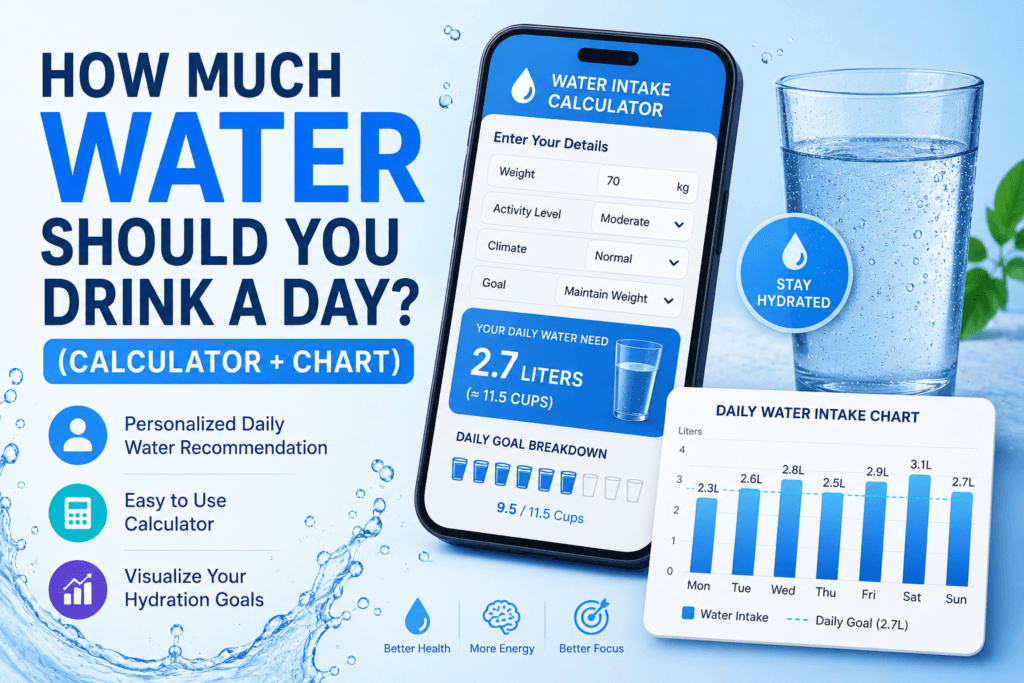
How Much Water Should You Drink a Day? (Calculator + Chart)
A weight-based, activity-adjusted breakdown of daily water needs — backed by clinical hydration research, with a free calculator and an easy-to-read chart.
If you’ve ever typed “how much water should I drink a day” into a search bar at 11 p.m. wondering if your headache is dehydration, you’re not alone. It’s one of the most searched health questions in the United States — and one of the most poorly answered, because most articles repeat the same recycled “8 glasses a day” line without explaining where it comes from or whether it actually applies to you.
It mostly doesn’t. Your real water needs depend on your body weight, how much you sweat, the climate you live in, your diet, and even your caffeine habits. Below, we break down the actual science behind daily hydration, give you a personalized formula you can calculate in under a minute, and show you exactly how your needs shift with exercise and heat.
💧 Get Your Personalized Number
Skip the manual math. Enter your weight, activity level, and climate into our free calculator to get a precise daily water target in ounces, liters, and cups.
Open the Daily Water Intake Calculator →Why the “8 Glasses a Day” Rule Is Outdated
The 8×8 rule — eight 8-ounce glasses, or 64 ounces (about 1.9 liters) a day — has been floating around American health advice since at least the 1940s. It’s easy to remember, which is exactly why it stuck. But it was never based on individualized data. A 120-pound office worker in Minnesota in January and a 220-pound construction worker in Phoenix in July have wildly different fluid needs, yet the 8×8 rule gives them the same number.
Modern hydration guidance, including recommendations referenced by the U.S. National Academies of Sciences, Engineering, and Medicine, instead frames total daily fluid intake as a range tied to body size, sex, and activity, with adjustments for climate and health status. That range, importantly, includes water from food (fruits and vegetables alone can supply 20% or more of daily fluid) and other beverages, not just plain water from a glass.
The General Adequate Intake Range
| Group | Total Fluid (Liters) | Total Fluid (Ounces) |
|---|---|---|
| Adult men | ~3.7 L | ~125 oz |
| Adult women | ~2.7 L | ~91 oz |
| Pregnant women | ~3.0 L | ~101 oz |
| Breastfeeding women | ~3.8 L | ~128 oz |
These are population-level averages, not personal prescriptions. About 80% of that total typically comes from drinking water and other beverages, with the remaining 20% coming from food. That’s the science-backed range — now let’s personalize it.
The Weight-Based Formula You Can Actually Use
The most practical, widely cited starting formula among dietitians and sports medicine clinicians is a simple body-weight ratio:
Daily water (oz) = Body weight (lbs) ÷ 2
This gives you a baseline figure in ounces. From there, you adjust upward based on three multipliers: activity, climate, and individual health factors.
Step 1: Calculate Your Baseline
- 130 lb person: 130 ÷ 2 = 65 oz (about 1.9 L)
- 180 lb person: 180 ÷ 2 = 90 oz (about 2.7 L)
- 240 lb person: 240 ÷ 2 = 120 oz (about 3.5 L)
Step 2: Add for Exercise
For every 30 minutes of moderate-to-vigorous exercise, add 12 ounces. If you sweat heavily, are exercising outdoors in heat, or are an endurance athlete, you may need 16–24 oz per 30 minutes, plus electrolyte replacement.
Step 3: Adjust for Climate and Altitude
Hot, humid climates (think Houston in August or Phoenix in summer) and high altitude environments both increase fluid loss through sweat and faster breathing. Add 8–16 oz on top of your activity-adjusted total on days above roughly 85°F (29°C), or when traveling above 8,000 feet.
Add roughly 12 oz for every 30 minutes of exercise on top of these baseline figures, and another 8–16 oz on hot or humid days.
🧮 Don’t Want to Do the Math?
Our calculator runs all three steps — baseline, activity, and climate — automatically and gives you a daily target plus a simple chart you can save.
Calculate My Daily Water Intake →Signs You’re Not Drinking Enough Water
Thirst is actually a lagging indicator — by the time you feel thirsty, you’re often already 1–2% dehydrated. Watch for these earlier signs instead:
- Urine color: Pale straw-yellow is well-hydrated; dark yellow or amber signals you need more fluids.
- Headaches and fatigue: Even mild fluid loss can reduce blood volume slightly, leading to tiredness and tension-type headaches.
- Dry mouth and lips: One of the most immediate physical signals.
- Reduced urination frequency: Going fewer than 4 times a day can be a sign of inadequate intake.
- Difficulty concentrating: Several studies on mild dehydration have linked it to short-term reductions in attention and working memory.
- Muscle cramps: Especially during or after exercise, often tied to combined water and electrolyte loss.
Can You Drink Too Much Water?
Yes — though it’s far less common than under-hydration. Drinking extremely large volumes of water in a short window, well beyond what the kidneys can excrete (roughly 0.8–1 liter per hour for most adults), can dilute blood sodium levels and cause a condition called hyponatremia. This has occurred in endurance athletes, military trainees, and in rare cases during water-drinking competitions. For the average person sipping water throughout the day, this risk is minimal, but it’s worth avoiding the temptation to “chug” several liters at once to catch up after a dehydrated day. Spreading intake evenly is both safer and more effective for hydration than front-loading it.
Does Coffee, Tea, or Soda Count?
This is one of the most common hydration myths. Caffeine has a mild diuretic effect, but research has consistently shown that moderate caffeinated beverages — a few cups of coffee or tea per day — still provide a net positive contribution to fluid balance. They are not strongly dehydrating in typical intake amounts. That said, water remains the best primary source because it has zero calories, no added sugar, and no risk of disrupting sleep the way caffeine late in the day can.
What Counts Toward Your Daily Total
| Source | Hydration Contribution |
|---|---|
| Plain water | 100% — the gold standard |
| Herbal tea, decaf coffee | High — counts almost fully |
| Coffee, black/green tea | Moderate-high — mild diuretic offset is small |
| Milk, 100% juice | High — but watch added sugar/calories |
| Fruits & vegetables | ~20% of total daily fluid for most people |
| Alcohol | Negative — net dehydrating, especially in excess |
Special Situations That Change Your Number
Pregnancy and Breastfeeding
Fluid needs rise during pregnancy to support increased blood volume and amniotic fluid, and rise further during breastfeeding to support milk production. Most guidance points toward an additional 8–24 oz above a non-pregnant baseline, but this should be personalized with an OB-GYN or midwife.
Hot Climates and Travel
If you live in or are traveling to consistently hot states like Texas, Arizona, Florida, or Nevada during summer months, plan for meaningfully higher intake — often 16–32 oz above your baseline on the hottest days, plus electrolytes if you’re sweating heavily outdoors.
Illness (Fever, Vomiting, Diarrhea)
Fluid losses spike sharply during illness. Oral rehydration with water plus electrolytes is typically recommended, and prolonged vomiting or diarrhea, especially in children or older adults, warrants medical attention if fluids can’t be kept down.
Older Adults
Thirst sensation naturally declines with age, which means older adults can become dehydrated without feeling thirsty at all. Scheduled drinking — for example, a glass of water with every meal and medication — is often more reliable than relying on thirst cues alone.
A Simple Daily Hydration Routine
- Morning: Drink 8–16 oz of water shortly after waking, before coffee, to rehydrate after sleep.
- With meals: Have a glass of water with breakfast, lunch, and dinner — an easy way to cover roughly 24–32 oz without thinking about it.
- Before/during exercise: Drink 8 oz about 20–30 minutes before activity, then 4–8 oz every 15–20 minutes during.
- Afternoon check-in: Glance at urine color; if it’s dark, drink an extra glass.
- Evening: Taper intake 1–2 hours before bed to reduce nighttime bathroom trips, while still meeting your daily target earlier in the day.
🔁 Build the Routine Around Your Real Number
Plug in your weight and activity level once, and use the result as your daily target across the routine above.
Use the Water Intake Calculator →Frequently Asked Questions
How much water should I drink a day to lose weight?
Water itself contains no calories, but drinking 16 oz before meals has been shown in some studies to modestly reduce calorie intake by increasing fullness. It’s a helpful supporting habit, not a stand-alone weight-loss method. Stick to your weight-based hydration target and treat water as an appetite-management tool alongside diet and activity changes.
Is it better to drink water all day or all at once?
Spreading intake evenly throughout the day is more effective for hydration and gentler on the kidneys than drinking large volumes at once. Sipping consistently also helps maintain steadier energy and concentration than infrequent large gulps.
Does the type of water (filtered, tap, sparkling) matter for hydration?
For hydration purposes, filtered, tap, and sparkling water all hydrate similarly. The main differences are taste, mineral content, and in some cases, contaminant levels, which are a water-quality issue rather than a hydration issue.
How do I know if my number from the calculator is right for me?
Treat the calculator’s result as a strong starting point based on body weight, activity, and climate. Fine-tune it using real-world feedback — urine color, energy levels, and how you feel during exercise — and check with a doctor if you have kidney disease, heart failure, or another condition that affects fluid balance.
Explore More Free Tools
The water intake calculator is one of several free, no-signup calculators we maintain to help you make faster, better-informed health and everyday decisions. Browse the full collection of free online tools on Toolriz for calculators covering fitness, finance, and more.
Sources & Further Reading
- National Academies of Sciences, Engineering, and Medicine — Dietary Reference Intakes for Water
- U.S. National Institutes of Health — Office of Dietary Supplements, Water and Hydration
- Mayo Clinic — Water: How much should you drink every day?
- Academy of Nutrition and Dietetics — Hydration fact sheets