Shopify · Fulfillment & Margins
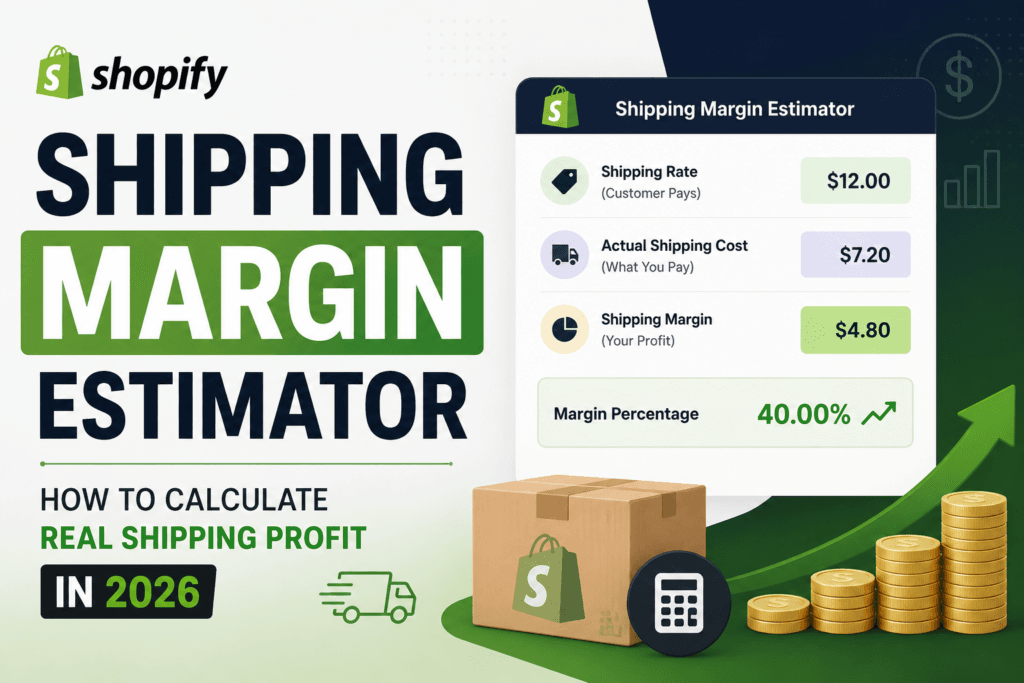
Shopify Shipping Margin Estimator: How to Calculate Real Shipping Profit in 2026
Most Shopify merchants know their shipping cost. Almost none know their shipping margin. Here’s the exact formula, the mistakes that quietly erase it, and a free calculator that does the math for you.
What Shipping Margin Actually Means (and Why It’s Not the Same as Shipping Cost)
Open your Shopify shipping settings and you’ll see a rate you charge customers. Open your carrier invoice and you’ll see a rate you pay to ship the box. Almost every merchant compares those two numbers in their head and calls it a day. That comparison is incomplete, and it’s the reason so many stores believe shipping is roughly break-even when it’s actually bleeding several points of net margin every month.
Shipping margin is the profit (or loss) left over after you subtract everything it actually costs to get an order out the door — carrier label, dimensional weight surcharges, packaging materials, and a reasonable share of packing labor — from whatever you collected from the customer for shipping, including any amount baked into the product price if you advertise “free shipping.”
Shipping cost answers “what did I pay the carrier?” Shipping margin answers the question that actually determines whether your store is profitable: “did shipping help or hurt my bottom line on this order?” A Shopify Shipping Margin Estimator is built specifically to answer that second question in seconds, using your real rate card instead of rough guesses.
Why Shipping Margin Is Quietly Draining Shopify Store Profits in 2026
Shipping has stopped being a fixed, predictable line item. Base carrier rates from UPS and FedEx rose again in 2026, with headline general rate increases sitting near the high single digits — but once fuel, residential, and dimensional-weight surcharges are layered on, the effective increase most small and mid-size shippers actually feel runs meaningfully higher than the number in the press release. Surcharges alone now make up roughly a third of the average package’s total cost, which is exactly the part of the bill most flat-rate Shopify shipping settings never account for.
Put together, this creates a squeeze most merchants never model explicitly. Charge too little for shipping and every order quietly subsidizes the customer. Charge too much, or present an unexpected total at checkout, and you lose the sale before it happens — cart abandonment driven by surprise shipping costs remains the single largest checkout killer in ecommerce. The only way out of that squeeze is knowing your actual number, order by order, rather than a single flat rate you set once and never revisited.
The Shipping Margin Formula, Step by Step
You need three inputs. Every one of them is something you can pull from your Shopify order data and your carrier account within a few minutes.
- Shipping revenue — what the customer paid for shipping at checkout, or the shipping allocation if you bake it into a “free shipping” product price.
- True shipping cost — the carrier label cost, including any dimensional weight or zone surcharge that applied to that specific package.
- Packaging & handling cost — box or mailer, tape, dunnage, and a per-order labor estimate for pick, pack, and label printing.
As a percentage, the formula is:
Run this per SKU, per weight bracket, or per shipping zone and patterns appear almost immediately — usually that one or two product categories are quietly subsidizing the rest of the catalog’s shipping.
A Worked Example: Two Orders, Two Very Different Outcomes
Here’s why averages hide the real story. Two Shopify orders, both charged the same flat $6.99 shipping rate at checkout, can land on opposite sides of profitable once actual carrier cost and dimensional weight are factored in.
| Order | Shipping charged | Actual carrier cost | Packaging | Shipping margin |
|---|---|---|---|---|
| Order A — small accessory, 8 oz | $6.99 | $4.45 | $0.55 | +$1.99 (28.5%) |
| Order B — bulky item, DIM-priced | $6.99 | $11.20 | $1.10 | −$5.31 (−76%) |
A single flat rate makes Order A look great and quietly buries the loss on Order B inside your blended average. Multiply Order B’s pattern across a few hundred monthly orders in that weight class and it becomes one of the largest hidden drags on store profit — invisible until it’s calculated order by order instead of averaged across the whole store.
7 Mistakes That Quietly Erase Shipping Margin
- 01Flat rates that ignore zones. A package shipped three zones away can cost meaningfully more than the same package shipped locally, even at identical weight.
- 02Ignoring dimensional weight. Carriers bill the larger of actual weight or a volume-based “dimensional weight” — a lightweight but bulky box can cost far more than its scale weight suggests.
- 03Underpriced packaging. Box, mailer, tape, and void fill add up. Leaving packaging out of the calculation overstates margin on every single order.
- 04Free shipping thresholds set by guesswork. A threshold set without checking it against average order value and product margin can convert well at checkout and still lose money at fulfillment.
- 05Treating shipping revenue as pure profit. Collected shipping fees are revenue, not margin, until the true carrier and packaging cost is subtracted.
- 06Not rate-shopping across carriers. Comparing rates across carriers for every shipment is one of the most consistent ways merchants recover cost, often in the high single digits as a percentage.
- 07Never revisiting rates after a carrier rate increase. Carriers adjust pricing at least annually; checkout rates set two years ago are often quietly out of date.
How to Improve Shipping Margin Without Losing Sales at Checkout
1. Price shipping by weight and zone, not one flat number
Shopify’s native shipping profiles support weight-based and zone-based rates. Segmenting rates this way stops your lightest, cheapest-to-ship products from silently subsidizing your heaviest ones.
2. Audit packaging before you audit carriers
Right-sizing boxes and mailers reduces both material cost and dimensional weight charges at the same time — often the single highest-leverage fix available, because it lowers two cost lines with one change.
3. Rate-shop every shipment
Comparing live rates across USPS, UPS, FedEx, and regional carriers for each shipment — rather than defaulting to one carrier — is one of the more consistently reported ways merchants recover margin without changing anything the customer sees.
4. Recalculate margin after every carrier rate increase
When a carrier announces a general rate increase, the checkout price you charge customers doesn’t update itself. Re-running your shipping margin calculation after each carrier adjustment keeps your checkout price aligned with reality instead of drifting into a loss.
Run your real numbers in under a minute
The Shopify Shipping Margin Estimator takes your checkout shipping price, carrier cost, and packaging cost and returns your exact margin — per order, per weight bracket, or across your whole store.
Open the Shipping Margin Estimator →5. Segment your catalog by shipping profitability
Not every SKU needs the same shipping strategy. Bulky, low-value items are frequently the ones losing the most margin and may need a separate flat rate, a minimum order requirement, or exclusion from free shipping promotions.
Setting a Free Shipping Threshold That Doesn’t Wreck Your Margin
Free shipping increases conversion, but only when the math behind it has been checked. A common, defensible starting point is setting the threshold at roughly 1.3 to 1.5 times your current average order value, so the larger basket size helps offset the shipping cost you’re absorbing.
Rule of thumb: raising a free shipping threshold tends to lift average order value, but each increase also has a small negative effect on conversion. The two effects roughly cancel out below an average order value of about $75, which is why lower-AOV stores are often better off charging shipping outright or building a smaller shipping cost into product price instead of offering blanket free shipping.
Before changing a threshold, model it against your actual shipping margin data rather than copying a competitor’s number — a threshold that works for a $150 AOV apparel brand can be actively unprofitable for a $35 AOV accessories store.
Frequently Asked Questions
What is shipping margin in ecommerce?
Shipping margin is the difference between what a customer pays for shipping and what it actually costs the merchant to pack and ship that order, expressed in dollars or as a percentage. It differs from shipping cost, which only measures the outgoing expense on its own.
How do you calculate shipping margin on Shopify?
Subtract true shipping cost — carrier label, surcharges, packaging, and handling — from the shipping revenue collected at checkout, then divide by shipping revenue and multiply by 100 for a percentage.
What is a good shipping margin percentage for a Shopify store?
Most healthy stores keep total shipping cost under roughly 12% of revenue, with top performers reaching 6 to 9% through carrier negotiation and packaging optimization. For flat-rate shipping specifically, a margin near break-even to modestly positive is common for small merchants.
Why is my Shopify store losing money on shipping?
The usual culprits are flat rates that don’t reflect real carrier zones and weight, unaccounted dimensional weight charges, underestimated packaging cost, and a free shipping threshold set without checking it against margin.
Should I offer free shipping on my Shopify store?
It tends to work best once average order value clears your threshold comfortably and product margin can absorb the carrier cost — commonly a threshold around 1.3 to 1.5 times current AOV.
About the Author
Sources & Further Reading
- GoBolt, “The Real Ecommerce Shipping Costs in 2026” — average per-order shipping cost analysis
- Ringly.io, “54 Ecommerce Shipping Statistics You Need to Know in 2026” — cart abandonment and shipping-as-percent-of-order data
- Eightx, “Average Ecommerce Shipping Cost as a Percent of Revenue, by Vertical (2026)” — free shipping threshold and AOV modeling
- Agentis, “How Much Should Shipping Cost? 2026 Ecommerce Benchmarks” — shipping cost as percent of revenue benchmarks
- ShipperHQ, “2026 Carrier Rate Increases: What Shippers Need to Know” — carrier surcharge and rate increase data
- ParcelPath, “USPS Shipping Rates 2026” — current USPS rate structure