

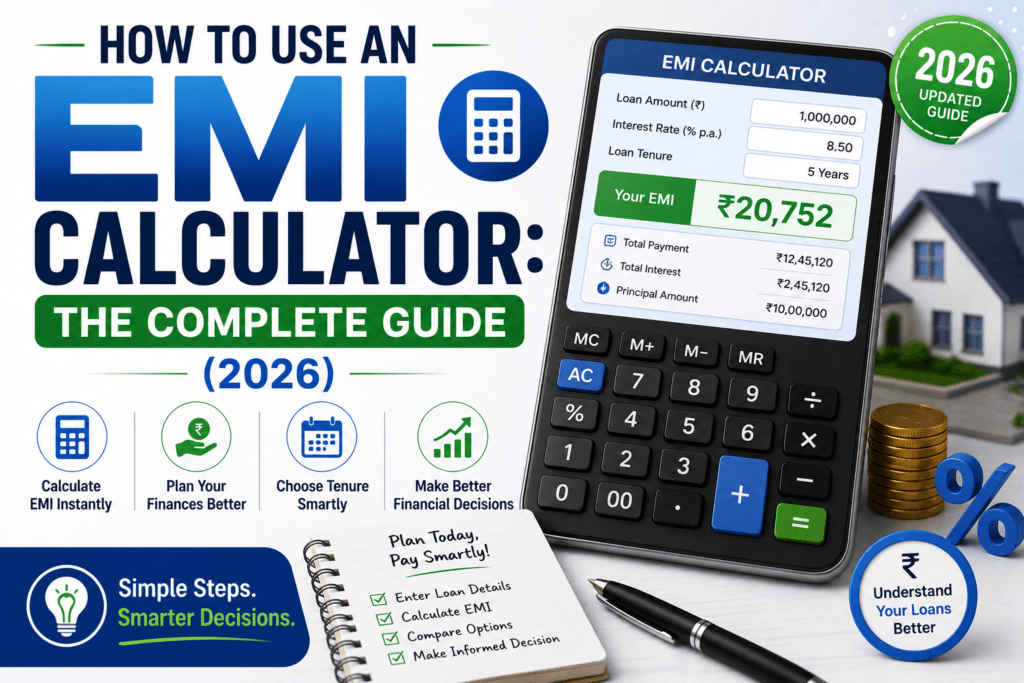
How to Use an EMI Calculator: The Complete Guide (2026)
If you are about to take out a home loan, auto loan, personal loan, or student loan, the single most important number you need before you sign anything is your EMI — Equated Monthly Installment. Get this number wrong, and you could end up committing to a payment that quietly strains your budget for years. Get it right, and you walk into every lender conversation with confidence and leverage.
This guide walks you through exactly how an EMI calculator works, how to use one step by step, the math running behind the scenes, and practical strategies real borrowers use to lower their monthly payments before they ever apply for a loan.
- What Is an EMI Calculator and Why It Matters
- How an EMI Calculator Actually Works
- Step-by-Step: How to Use an EMI Calculator
- The EMI Formula Explained (With a Real Example)
- Using an EMI Calculator for Different Loan Types
- Common Mistakes People Make When Calculating EMI
- 7 Practical Ways to Lower Your Monthly EMI
- Understanding Your Amortization Schedule
- Real-World Example: Comparing Two Loan Offers
- Frequently Asked Questions
1. What Is an EMI Calculator and Why It Matters
An EMI calculator is a financial tool that instantly tells you how much you will pay every month toward a loan, based on three inputs: the loan amount (principal), the annual interest rate, and the repayment tenure (the number of months or years you’ll take to repay it). Instead of manually working through amortization math with a pen, calculator, or spreadsheet formulas, you simply plug in your numbers and get an accurate monthly figure in seconds.
What makes this tool genuinely useful isn’t just the speed — it’s the clarity it gives you before you’re sitting across from a loan officer. Lenders are in the business of approving loans that work for them. You need a tool that works for you. An EMI calculator lets you test different loan amounts, interest rates, and repayment periods until you land on a monthly payment that actually fits your income and lifestyle, rather than discovering the real number only after paperwork is already in motion.
Why this matters right now: With interest rates fluctuating and lenders competing aggressively for borrowers in 2026, even a half-percent difference in your rate — or a six-month difference in tenure — can shift your total repayment by thousands of dollars. A calculator turns that abstract risk into a concrete number you can plan around.
You can try a free, instant EMI calculator here: EMI Calculator by ToolRiz. It requires no sign-up and gives you an immediate monthly payment breakdown along with total interest payable.
2. How an EMI Calculator Actually Works
Behind every EMI calculator is a fixed mathematical formula used by banks and financial institutions worldwide. The calculator doesn’t guess — it applies compound interest logic to spread your total repayment (principal plus interest) evenly across every month of your loan term.
Here’s the core idea in plain language: in the early months of a loan, a larger portion of your payment goes toward interest, and a smaller portion reduces your actual principal. As months pass, that ratio flips — you start paying down more principal and less interest — even though your total monthly payment stays exactly the same throughout the loan. This structure is called amortization, and it’s the same system used for mortgages, auto loans, and most personal loans in the United States.
An EMI calculator automates all of this instantly, which is why it has become the starting point for nearly every serious borrower’s research process — long before they contact a bank.
3. Step-by-Step: How to Use an EMI Calculator
Using an EMI calculator takes less than a minute once you know what each field means. Here is the exact process:
Step 1: Enter Your Loan Amount (Principal)
This is the total amount you plan to borrow — for example, $250,000 for a home, $28,000 for a car, or $10,000 for a personal loan. Be realistic here. Include only the amount you’ll actually finance, not the full purchase price if you’re planning a down payment.
Step 2: Enter the Annual Interest Rate
Your lender will quote this as an annual percentage rate (APR). If you haven’t received a formal quote yet, use the average current rate for your loan type and credit profile as a starting estimate, then adjust once you get real offers.
Step 3: Enter the Loan Tenure
This is how long you intend to take to repay the loan — usually expressed in months or years. A 30-year mortgage, a 5-year auto loan, and a 3-year personal loan are common examples.
Step 4: Review Your Results
Once you input these three numbers, the calculator instantly generates:
- Your fixed monthly EMI payment
- Total interest payable over the full loan term
- Total amount payable (principal + interest combined)
- In many tools, a full month-by-month amortization breakdown
Step 5: Adjust the Numbers and Compare Scenarios
This is the step most people skip — and it’s the most valuable one. Go back and change the tenure from 5 years to 4, or the loan amount by $5,000, and watch how the monthly payment and total interest shift. Running three or four “what-if” scenarios before applying for a loan is how informed borrowers avoid overpaying.
Pro tip: Run your numbers using a slightly higher interest rate than what you expect to receive. This gives you a safety buffer, so if your final approved rate comes in higher than anticipated, your budget won’t be caught off guard.
Ready to try it yourself? Use the free EMI Calculator to run your own numbers in real time — no registration required.
4. The EMI Formula Explained (With a Real Example)
If you want to understand exactly what’s happening under the hood, here is the standard formula used by every EMI calculator:
EMI = [P × R × (1+R)^N] / [(1+R)^N − 1]
Where:
P = Principal loan amount
R = Monthly interest rate (annual rate ÷ 12 ÷ 100)
N = Total number of monthly installments (loan tenure in months)
Worked Example
Suppose you borrow $20,000 at an annual interest rate of 9%, repaid over 4 years (48 months).
- P = $20,000
- R = 9% ÷ 12 ÷ 100 = 0.0075
- N = 48
Plugging these into the formula produces a monthly EMI of approximately $497.70. Over the full 48-month term, you would pay roughly $23,890 in total — meaning about $3,890 of that is interest.
Doing this by hand every time you want to test a new scenario is tedious and error-prone. This is exactly why an EMI calculator exists — it applies this formula instantly and lets you focus on decision-making instead of arithmetic.
5. Using an EMI Calculator for Different Loan Types
While the underlying formula stays the same, how you should approach each loan type differs slightly:
Home Loan EMI Calculator
Mortgages typically run 15 to 30 years. Because the tenure is so long, even a small rate difference dramatically affects total interest paid. Always compare a 15-year versus a 30-year scenario — the monthly payment will be higher on the shorter term, but total interest paid can be reduced by tens of thousands of dollars.
Auto Loan EMI Calculator
Car loans usually range from 3 to 7 years. Longer terms lower your monthly payment but often mean you’ll owe more than the car is worth for a period of time (negative equity). Testing a 4-year versus 6-year term side by side is essential before signing.
Personal Loan EMI Calculator
Personal loans carry higher interest rates since they’re usually unsecured. Because rates are steeper, small changes in tenure have an outsized impact on total cost — always check the total interest figure, not just the monthly number.
Student Loan EMI Calculator
For student loans, factor in any grace period after graduation, and consider running the calculation with a slightly higher rate than advertised, since many student loans carry variable rates that can shift after your first year of repayment.
6. Common Mistakes People Make When Calculating EMI
Mistake #1: Focusing only on the monthly payment. A lower EMI achieved by stretching the tenure often means paying significantly more in total interest over the life of the loan. Always check both numbers together.
Mistake #2: Ignoring processing fees and extra charges. Origination fees, insurance add-ons, and prepayment penalties aren’t reflected in the base EMI formula. Factor these in separately when comparing loan offers.
Mistake #3: Using an outdated interest rate. Rates change frequently. Always re-run your calculation with the exact rate quoted in your official loan offer before making a final decision.
Mistake #4: Not testing multiple tenure options. Many borrowers accept the first tenure a lender suggests without comparing it against shorter or longer alternatives that could save real money.
7. 7 Practical Ways to Lower Your Monthly EMI
- Increase your down payment. Every dollar you put down upfront reduces the principal your EMI is calculated on.
- Improve your credit score before applying. A stronger score typically unlocks a lower interest rate, which directly reduces your EMI.
- Choose a longer tenure carefully. This lowers your monthly payment but increases total interest — use it only if cash flow is your primary constraint.
- Shop multiple lenders. Interest rates can vary meaningfully between institutions for the exact same borrower profile.
- Make a lump-sum prepayment when possible. Extra payments toward principal — even occasional ones — reduce future interest and can shorten your loan term.
- Refinance when rates drop. If market rates fall significantly after you take your loan, refinancing can lower your EMI on the remaining balance.
- Avoid unnecessary add-on products. Optional insurance or service bundles rolled into your loan increase the principal you’re paying interest on.
8. Understanding Your Amortization Schedule
Most EMI calculators can generate a full amortization schedule — a month-by-month table showing exactly how much of each payment goes to interest versus principal, and your remaining balance after each installment.
| Month | EMI | Interest Paid | Principal Paid | Balance Remaining |
|---|---|---|---|---|
| 1 | $497.70 | $150.00 | $347.70 | $19,652.30 |
| 12 | $497.70 | $117.85 | $379.85 | $15,404.20 |
| 24 | $497.70 | $78.42 | $419.28 | $10,231.60 |
| 48 | $497.70 | $3.71 | $493.99 | $0.00 |
Reviewing this table helps you understand exactly when you’ll cross the halfway point of actual ownership versus interest payments — valuable information if you’re considering a prepayment strategy or planning to sell an asset before the loan matures.
9. Real-World Example: Comparing Two Loan Offers
Consider a borrower comparing two personal loan offers for $15,000:
| Offer | Rate | Tenure | Monthly EMI | Total Interest |
|---|---|---|---|---|
| Lender A | 10.5% | 3 years | $487.29 | $2,542 |
| Lender B | 8.9% | 4 years | $371.42 | $2,828 |
At first glance, Lender B looks more affordable because of its lower rate and smaller monthly payment. But run through an EMI calculator, the numbers reveal that Lender A — despite a higher monthly payment — actually costs less in total interest because of the shorter tenure. This is precisely the kind of insight that’s easy to miss without testing both scenarios side by side, and it’s the strongest argument for running your numbers before signing anything.
Run Your Own Numbers Right Now
Compare loan offers instantly with our free, no-signup EMI Calculator.
Try the EMI Calculator →10. Frequently Asked Questions
What does EMI stand for?
EMI stands for Equated Monthly Installment — a fixed payment amount made by a borrower to a lender on a set date each month, covering both interest and a portion of the principal, until the loan is fully repaid.
Is an EMI calculator accurate?
Yes. An EMI calculator uses the same standardized amortization formula that banks and financial institutions use internally. The result is accurate as long as the interest rate, loan amount, and tenure you enter match your actual loan terms.
Does a longer loan tenure always mean I pay more interest?
In almost all cases, yes. A longer tenure lowers your monthly payment but increases the total interest paid over the life of the loan, because interest accrues over a longer period of time.
Can I use an EMI calculator before applying for a loan?
Absolutely — and it’s recommended. Using an EMI calculator before applying lets you estimate a realistic monthly payment, test different loan amounts and tenures, and walk into lender conversations already knowing what fits your budget.
Does prepaying my loan reduce my EMI?
It depends on the lender’s terms. Some lenders reduce your future EMI amount after a prepayment, while others keep the EMI the same and instead shorten your remaining loan tenure. Check your loan agreement or ask your lender directly.
What information do I need before using an EMI calculator?
You only need three things: the loan amount you plan to borrow, the annual interest rate, and your intended repayment tenure in months or years. No personal or financial account details are required.
Final Thoughts
An EMI calculator is one of the simplest yet most powerful tools available to anyone considering a loan in 2026. It turns confusing loan offers into clear, comparable numbers, helps you avoid the trap of focusing only on monthly affordability while ignoring total cost, and gives you real negotiating power when you sit down with a lender. Before you sign for a mortgage, auto loan, personal loan, or student loan, take five minutes to run your numbers — future you will be glad you did.
Looking for more free financial and everyday utility tools? Explore the full collection here: Free Online Tools at ToolRiz.