

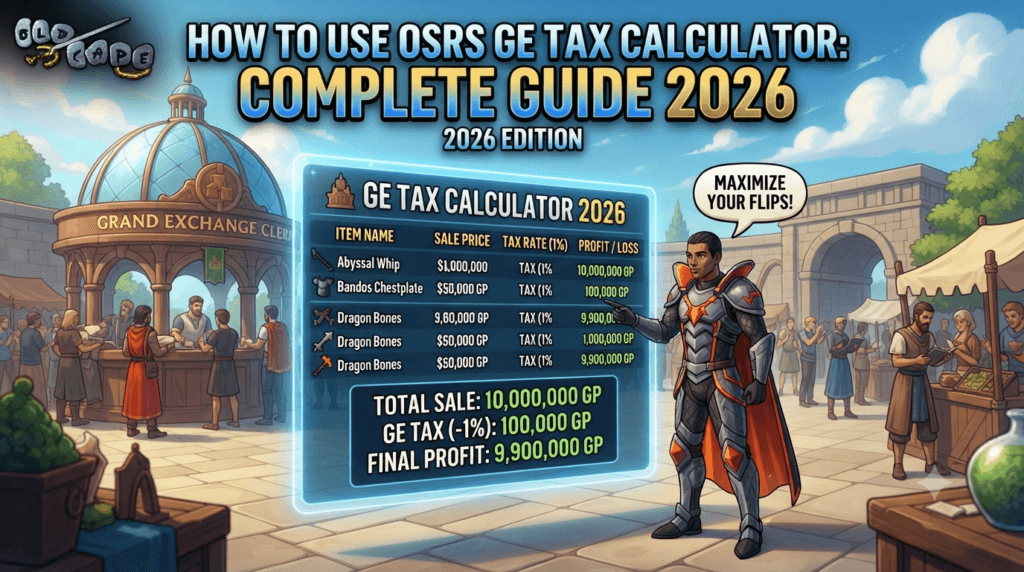
How to Use OSRS GE Tax Calculator: Complete Guide 2026
Stop losing your flipping margins to hidden taxes. Learn the exact math behind the Old School RuneScape Grand Exchange tax, the 5M cap, and how to calculate net profit on every trade in 2026.
To use an OSRS GE Tax Calculator, input the item’s exact Grand Exchange sell price and the quantity you are selling. The tool instantly applies the 1% tax rate, factors in the 5,000,000 GP maximum cap per item, and outputs your exact net profit. In 2026, this tool is essential for high-volume merchants (flippers) and PvMers selling high-value loot like Twisted Bows, ensuring margins aren’t wiped out by Jagex’s gold sink mechanics. Use the Toolriz Calculator here.
- The 2026 OSRS Economy & Gold Sinks
- What is an OSRS GE Tax Calculator?
- The Math: 1% Rates and the 5M Cap
- Step-by-Step: How to Use the Tool
- Tax Exemptions: Bonds & Low-Tier Items
- How Tax Changed Flipping in 2026
- Real-World Example: Twisted Bow vs. Dragon Bones
- Top 5 GE Trading Mistakes
- Frequently Asked Questions
The 2026 OSRS Economy & Gold Sinks
Old School RuneScape (OSRS) has one of the most complex, player-driven economies in MMORPG history. Unlike modern games where gold is spawned infinitely through daily quests, OSRS relies heavily on player-to-player trading. However, without mechanics to remove gold from the game, inflation would run rampant, and a partyhat would cost 10 Billion GP. To combat this, Jagex introduced the Grand Exchange Tax in December 2021, which remains a cornerstone of the 2026 economy.
The GE tax functions as a “gold sink.” Every time an item is sold on the Grand Exchange, a small percentage of that gold is permanently deleted from the game. This mechanism successfully removed trillions of GP from circulation, stabilizing the value of armor, weapons, and resources. However, it created a massive headache for players: calculating exact profit margins.
If you are a high-volume flipper (a “mercher”), a 1% tax can completely erase your profit margin if you aren’t careful. If you are a PvMer selling a massive drop table haul, you need to know exactly how much gold will hit your coin pouch after the tax is deducted. Doing this math manually—especially with the complex 5,000,000 GP cap—is tedious and prone to errors.
This is why an OSRS GE Tax Calculator is a mandatory tool for any serious player in 2026. It removes the mental math and provides instant, exact payouts for any trade.
A 1% tax sounds small, but on a 1 Billion GP item, that is 10M GP. On high-volume 1,000 GP items flipped 10,000 times a day, the tax silently eats your margins. You must calculate the tax before you place an offer.
What is an OSRS GE Tax Calculator?
An OSRS GE Tax Calculator is a specialized gaming utility designed for the Grand Exchange. Unlike a generic percentage calculator, this tool is programmed with the specific rules and edge cases of Jagex’s tax system, most notably the 5,000,000 GP maximum cap and the 50 GP minimum exemption.
The tool requires two basic inputs to function:
- Sell Price: The exact price per item you are listing on the GE.
- Quantity: How many of the item you are selling.
Once entered, the calculator outputs the total tax paid, the tax per item, and your final net profit. This allows merchants to calculate whether a flip is viable before committing their capital.
The Math: 1% Rates and the 5M Cap
To trust the calculator, you must understand the formula running behind the scenes. The standard Grand Exchange tax formula is:
However, there is a crucial modifier: The 5M Cap. No matter how many items you sell in a single slot, or how expensive a single item is, the maximum tax the game will charge you for that specific transaction is 5,000,000 GP.
Furthermore, the tax is calculated per item. If you sell 10 Twisted Bows in one GE slot, the tax is not capped at 5M total; it is capped at 5M *per bow* (though realistically, 1% of a 1.2B bow is 12M, so it hits the 5M cap immediately).
If an item sells for 50 GP or less, the tax is 0. If it sells for 51 GP to 100 GP, the tax is 1 GP (as the game rounds down fractions, but enforces a 1 GP minimum if the price is above 50). The Toolriz calculator handles all these rounding and cap rules automatically.
Step-by-Step: How to Use the Toolriz Converter
Using the tool takes seconds and can be done on your phone while playing. Follow these steps before you sell your loot.
Check GE Price
Look up the item on the OSRS Grand Exchange or a third-party price tracker like OSRS Wiki. Note the exact price you expect it to sell for.
Input Sell Price
Enter the exact per-item sell price into the calculator. Do not use the buy price; the tax is only applied to the sell transaction.
Input Quantity
Enter how many of the item you are selling. For high-volume items like runes or ores, this is crucial for calculating total tax.
Calculate Tax
Click calculate. The tool instantly displays the 1% tax, applies the 5M cap if necessary, and shows your net payout.
Verify Flip Margins
If you are flipping, subtract your original buy price from the net payout. If the number is positive, the flip is profitable.
List the Item
Once you are satisfied with the net profit, place the sell offer on the Grand Exchange.
Track Over Time
For large flips, use the calculator daily to ensure price drops haven’t turned a profitable margin into a tax-induced loss.
Tax Exemptions: Bonds & Low-Tier Items
Jagex built in a few exemptions to protect specific types of players. If you are trading in these categories, the calculator will show a 0% tax rate.
1. Old School Bonds
To prevent the tax from impacting players who simply want to buy membership or gold legitimately through Jagex, OSRS Bonds are 100% tax-free. You can buy and sell bonds on the GE without losing a single GP to the tax sink.
2. Items Under 50 GP
If an item’s GE value is 50 GP or lower, it is exempt from tax. This protects early-game players who are killing cows for cowhides or gathering feathers. However, if an item sells for 51 GP, the tax is 1 GP (rounded up from 0.51).
As the chart shows, once an item’s value crosses 500,000,000 GP, the tax hits the 5M cap. For ultra-rares like the Twisted Bow or 3rd Age armor, the tax burden is effectively less than 0.5%. For more on high-end PvM economics, check out our gaming strategy blog.
How Tax Changed Flipping in 2026
Before the tax was introduced, a flipper could buy an item for 1,000 GP and sell it for 1,005 GP, making a 5 GP profit per item. On 10,000 items, that was 50,000 GP profit. With a 1% tax, selling an item for 1,005 GP incurs a 10 GP tax. The flipper who bought at 1,000 GP and sold at 1,005 GP now loses 5 GP per item.
The tax forced merchants to widen their margins. Today, a profitable flip requires a spread of at least 1.1% to break even, and ideally 2-3% to make meaningful profit. The Toolriz GE Tax Calculator allows flippers to input their buy and sell prices to instantly see if the spread is wide enough to survive the tax sink.
Real-World Example: Twisted Bow vs. Dragon Bones
Let’s look at two distinct player profiles to see how the calculator interprets their data.
Scenario A: The PvMer (Selling a Twisted Bow)
- Item: Twisted Bow
- Sell Price: 1,200,000,000 GP (1.2 Billion)
- Math without Cap: 1.2B × 0.01 = 12,000,000 GP Tax
- Math with Cap: Tax is capped at 5,000,000 GP.
Calculator Result: The tool recognizes the 5M cap and shows a net payout of 1,195,000,000 GP. The PvMer saves 7M GP compared to a flat 1% tax.
Scenario B: The High-Volume Flipper (Dragon Bones)
- Item: Dragon Bones
- Buy Price: 2,500 GP each
- Sell Price: 2,600 GP each
- Quantity: 10,000
Calculator Result: 1% of 2,600 GP is 26 GP tax per bone. Net payout per bone is 2,574 GP. Profit per bone = 74 GP. Total net profit = 740,000 GP. Without the calculator, the flipper might have tried to sell at 2,520 GP, which would have resulted in a net loss.
Top 5 GE Trading Mistakes
- Forgetting the Tax on Buy Offers: The tax is paid by the seller. If you place a buy offer for 1,000 GP, you pay 1,000 GP. But the person selling to you only receives 990 GP.
- Ignoring the 5M Cap: When selling ultra-high-value items, remember the tax stops at 5M. This makes selling a 1B item mathematically cheaper (by percentage) than selling ten 100M items.
- Flipping 1% Margins: A 1% margin is a break-even point after tax. You must find items with at least a 2-3% price disparity to profit.
- Assuming Bonds are Taxed: Do not factor in tax when flipping OSRS Bonds. They are completely exempt.
- Selling in Small Batches: The tax cap is applied per item in the stack, but doing single-item trades for high-value gear is safe. Just ensure you aren’t accidentally paying minimum taxes on bulk low-tier items.
If you buy an item for 100M and the market crashes to 99M, selling it will incur a 990k tax. You will receive 98.01M, turning a 1M market loss into a nearly 2M actual loss. Always use the calculator to assess exit strategies.
🔑 Key Takeaways
- An OSRS GE Tax Calculator instantly calculates the 1% Grand Exchange tax and applies the 5,000,000 GP maximum cap.
- The tax is only applied to the seller; buyers pay exactly their offer price.
- Items selling for 50 GP or less are tax-exempt, as are Old School Bonds.
- The 5M cap protects high-level PvMers selling items like the Twisted Bow or Scythe of Vitur.
- Flippers must secure margins of at least 1.1% to break even, and 2-3% to profit after tax.
- Always calculate your net payout before listing a sell offer to avoid margin erosion.
Calculate Your GE Taxes Now
Stop guessing your margins. Use our free, instant OSRS GE Tax Calculator to see exactly how much gold you will keep after your next Grand Exchange sale.
Frequently Asked Questions
The OSRS GE tax is calculated at 1% of the item’s sale price. There is a minimum tax of 1 GP per item (if the sale price is over 50 GP) and a maximum tax cap of 5,000,000 GP (5M) per single item transaction. A OSRS GE Tax Calculator automates this math instantly.
The maximum Grand Exchange tax you can be charged on a single item sale is 5,000,000 GP (5M). This means if you sell a Twisted Bow for 1.2 Billion GP, you only pay 5M in tax, not 12M. The cap protects high-value PvMers.
Yes. Items that sell for 50 GP or less are completely exempt from the GE tax to protect early-game players. Additionally, Old School Bonds are entirely tax-free, meaning you can buy and sell them on the GE without paying any tax.
No. The Grand Exchange tax is only applied to the seller. When you place a buy offer and it completes, you pay exactly the price you offered. The 1% tax is deducted from the gold received by the person who sold the item to you.
Jagex added the GE tax in 2021 as a “gold sink” to combat severe inflation in the OSRS economy. By permanently deleting 1% of all sale gold from the game, it removes billions of GP from circulation, stabilizing item prices.
Yes, but it requires wider margins. Before the tax, a 0.5% margin was profitable. Now, you need at least a 1.1% spread to break even, and ideally 2-3% to make a profit. Use a calculator to ensure your flips are viable.