
How to Use Profit Margin Calculator: Complete Guide 2026
A plain-English, step-by-step walkthrough of how to calculate profit margin correctly, the difference between gross and net margin, and what counts as “good” in your industry.
Table of Contents
- What Is Profit Margin, Really?
- Why Profit Margin Matters More Than Revenue
- The Profit Margin Formula Explained
- Gross Profit Margin vs. Net Profit Margin
- How to Use a Profit Margin Calculator: Step by Step
- Worked Examples With Real Numbers
- Profit Margin vs. Markup: The Mistake Almost Everyone Makes
- What Is a Good Profit Margin? Industry Benchmarks
- What to Do If Your Profit Margin Is Too Low
- Common Mistakes When Calculating Profit Margin
- When to Use a Calculator vs. Doing It by Hand
- Frequently Asked Questions
If you sell anything — a physical product, a digital download, a service, or an hour of your time — there’s one number that quietly decides whether your business actually makes money or just moves money around: profit margin. Revenue can look impressive on paper while the business behind it is barely surviving, or even losing money on every sale. Margin is the number that tells you the truth.
This guide walks through exactly how to use a profit margin calculator the right way, breaks down the formulas in plain language, works through real examples with actual dollar amounts, and explains what counts as a healthy margin depending on the kind of business you’re running. By the end, you’ll be able to plug numbers into a profit margin calculator and immediately understand what the result is actually telling you — not just what the percentage says, but what it means for your pricing and your next move.
1. What Is Profit Margin, Really?
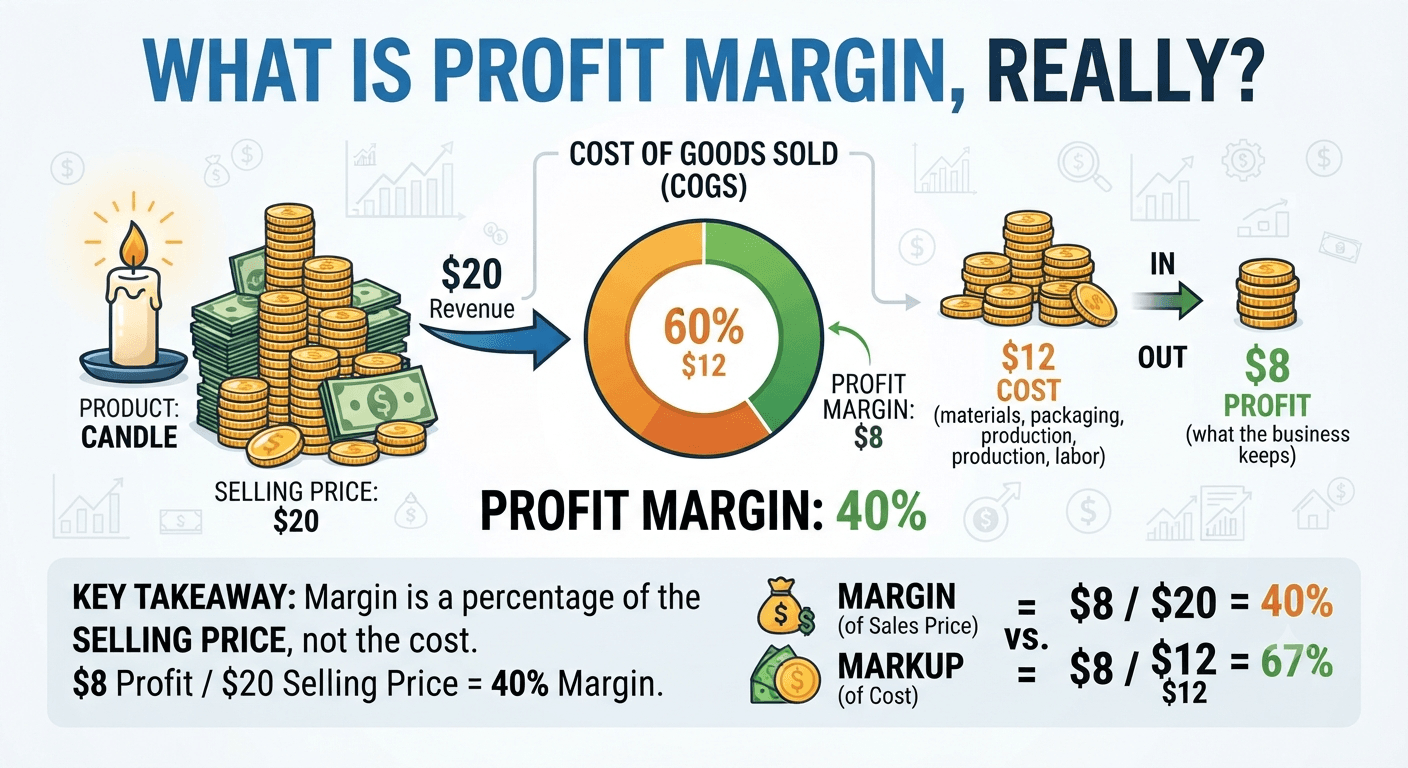
Profit margin is a percentage that shows how much of every dollar in revenue you actually keep as profit after costs are subtracted. If a candle business sells a candle for $20 and it costs $12 to make, the business keeps $8 of that sale — a 40% profit margin. The other 60% went straight back out the door to cover materials, packaging, and production.
Notice that margin is expressed as a percentage of the selling price, not the cost. This distinction trips up more business owners than almost anything else in basic accounting, and we’ll unpack it fully later in this guide, because confusing margin with markup is one of the fastest ways to accidentally underprice a product.
2. Why Profit Margin Matters More Than Revenue
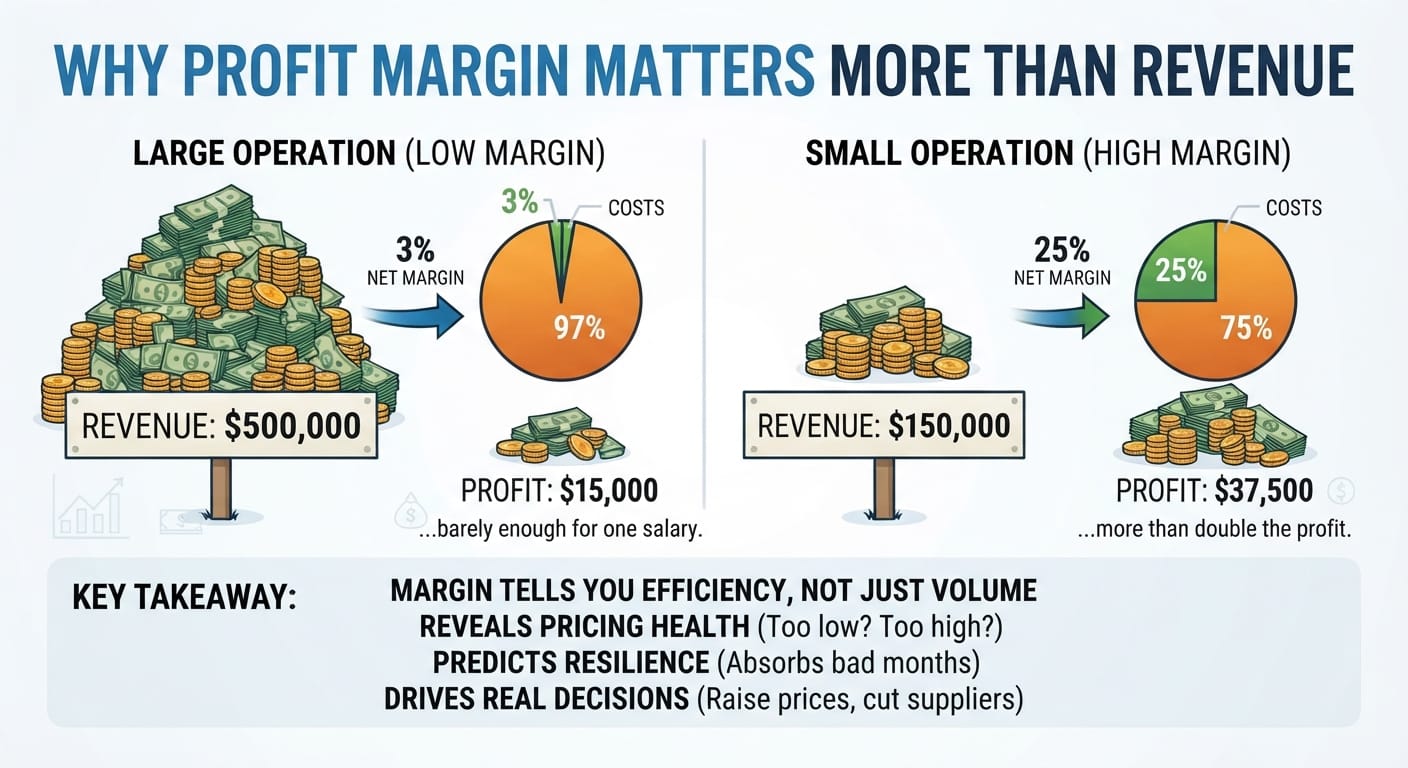
It’s easy to get excited about a big revenue number. A store that brings in $500,000 a year sounds successful. But if that store is only running a 3% net margin, it’s walking away with $15,000 in actual profit — barely enough to cover a single employee’s salary, let alone reinvest in growth.
Compare that to a smaller operation bringing in $150,000 a year at a 25% margin. That business nets $37,500 — more than double the profit of the “bigger” business, despite doing less than a third of the sales volume. This is exactly why investors, lenders, and experienced business owners look at margin before they look at revenue. Margin tells you how efficient the business actually is, not just how busy it is.
- Margin reveals pricing health. A thin margin usually means prices are too low, costs are too high, or both.
- Margin predicts resilience. Businesses with healthy margins can absorb a bad month, a cost increase, or a slow season far more easily than businesses running razor-thin.
- Margin drives real decisions. Whether to raise prices, cut a supplier, discontinue a product, or expand a product line all come back to what the margin data shows.
3. The Profit Margin Formula Explained
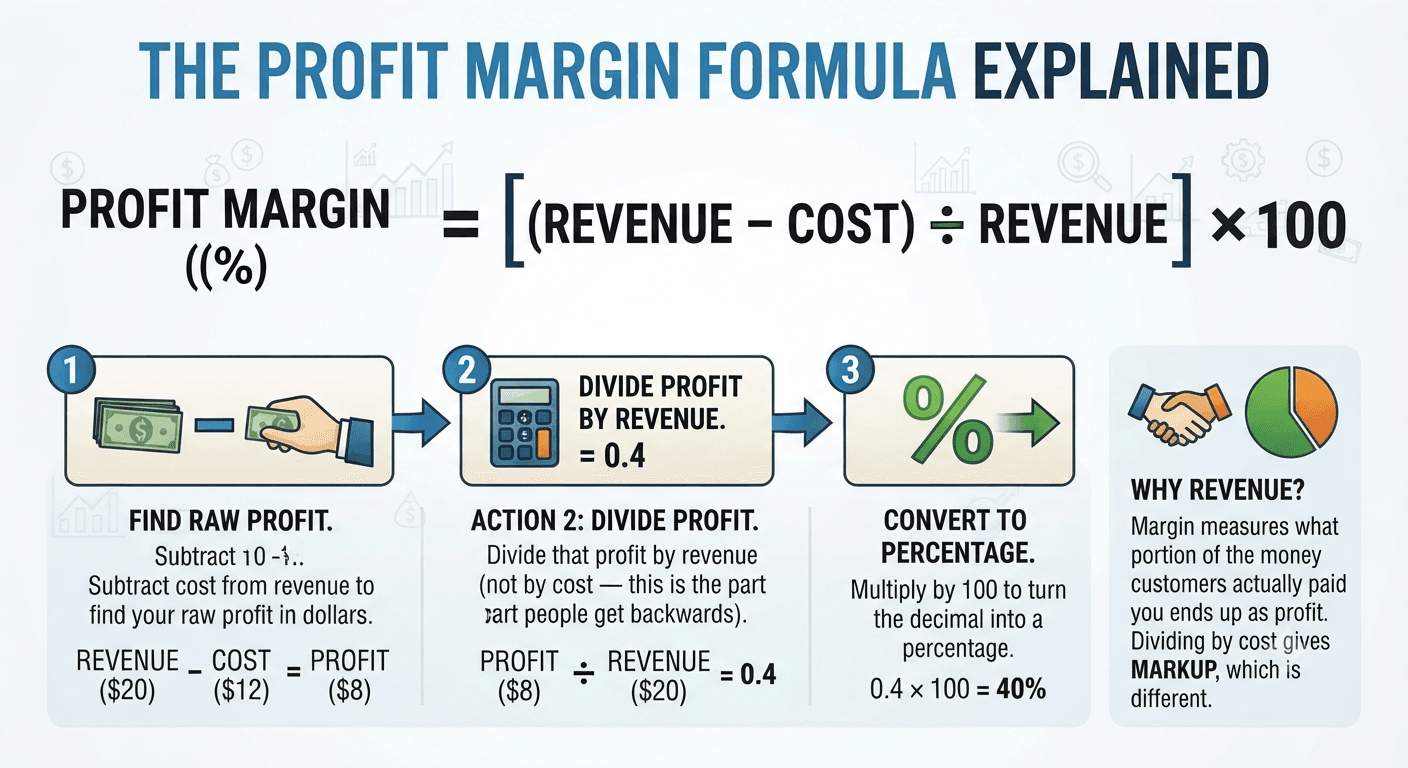
The core formula behind every profit margin calculator, no matter how the interface looks, comes down to this:
Profit Margin (%) = [(Revenue − Cost) ÷ Revenue] × 100
Break it into three simple actions:
- Subtract cost from revenue to find your raw profit in dollars.
- Divide that profit by revenue (not by cost — this is the part people get backwards).
- Multiply by 100 to turn the decimal into a percentage.
4. Gross Profit Margin vs. Net Profit Margin
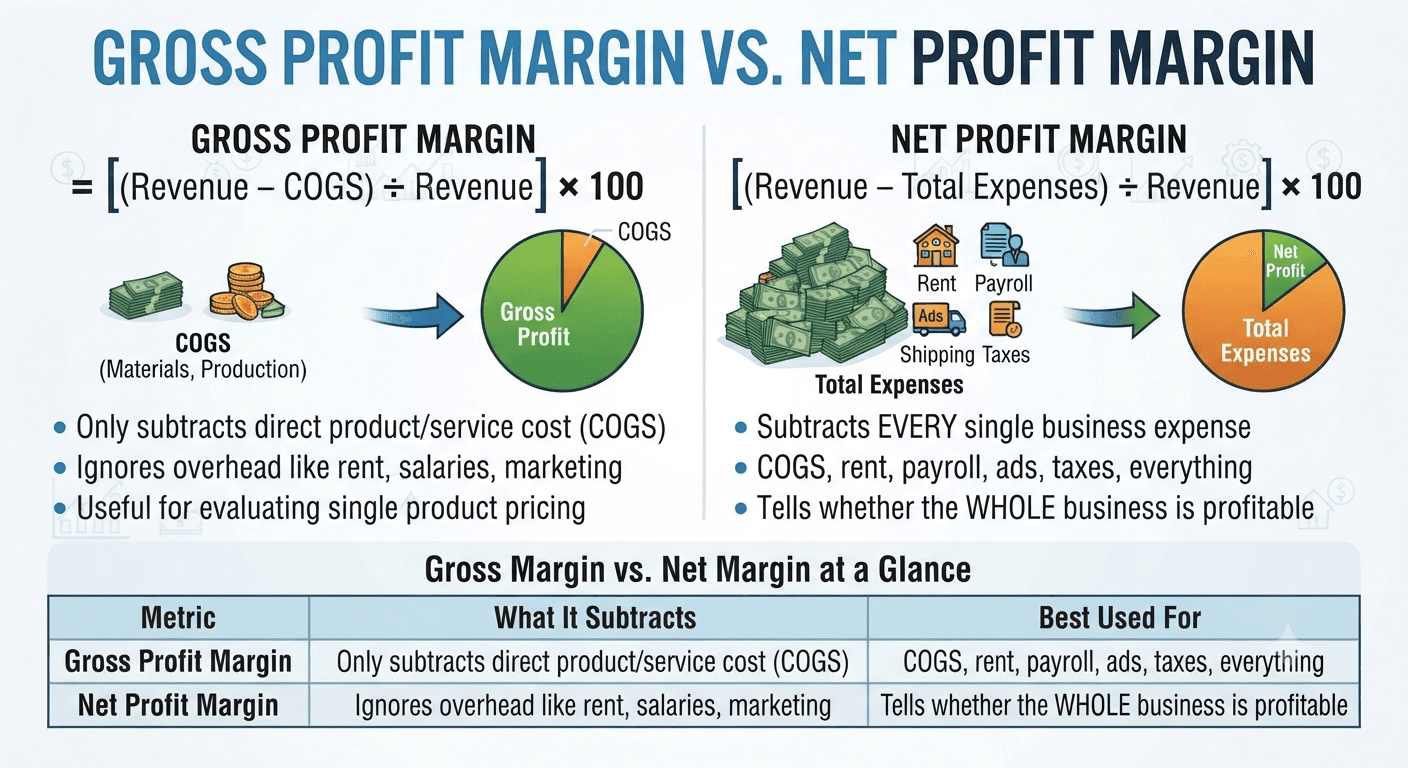
“Profit margin” isn’t actually one single number — it’s a category with two commonly used versions, and mixing them up leads to a lot of confusion when comparing your business to industry benchmarks.
Gross Profit Margin
Gross margin only subtracts the direct cost of producing or acquiring what you sold — often called cost of goods sold (COGS). It ignores overhead like rent, software subscriptions, marketing spend, and salaries.
Gross Profit Margin = [(Revenue − COGS) ÷ Revenue] × 100
Net Profit Margin
Net margin is the more honest, complete number. It subtracts every single business expense — COGS, rent, payroll, ad spend, software, shipping, credit card fees, taxes, everything — before comparing the leftover profit to revenue.
Net Profit Margin = [(Revenue − Total Expenses) ÷ Revenue] × 100
Gross margin is useful for evaluating a single product’s pricing. Net margin is what tells you whether the business as a whole is actually profitable. A product can carry a beautiful 60% gross margin and the business can still lose money overall if operating expenses eat up everything above that line.
| Metric | What It Subtracts | Best Used For |
|---|---|---|
| Gross Profit Margin | Only direct product/service cost (COGS) | Pricing individual products, comparing product lines |
| Net Profit Margin | All business expenses, including overhead and taxes | Understanding true business profitability |
5. How to Use a Profit Margin Calculator: Step by Step
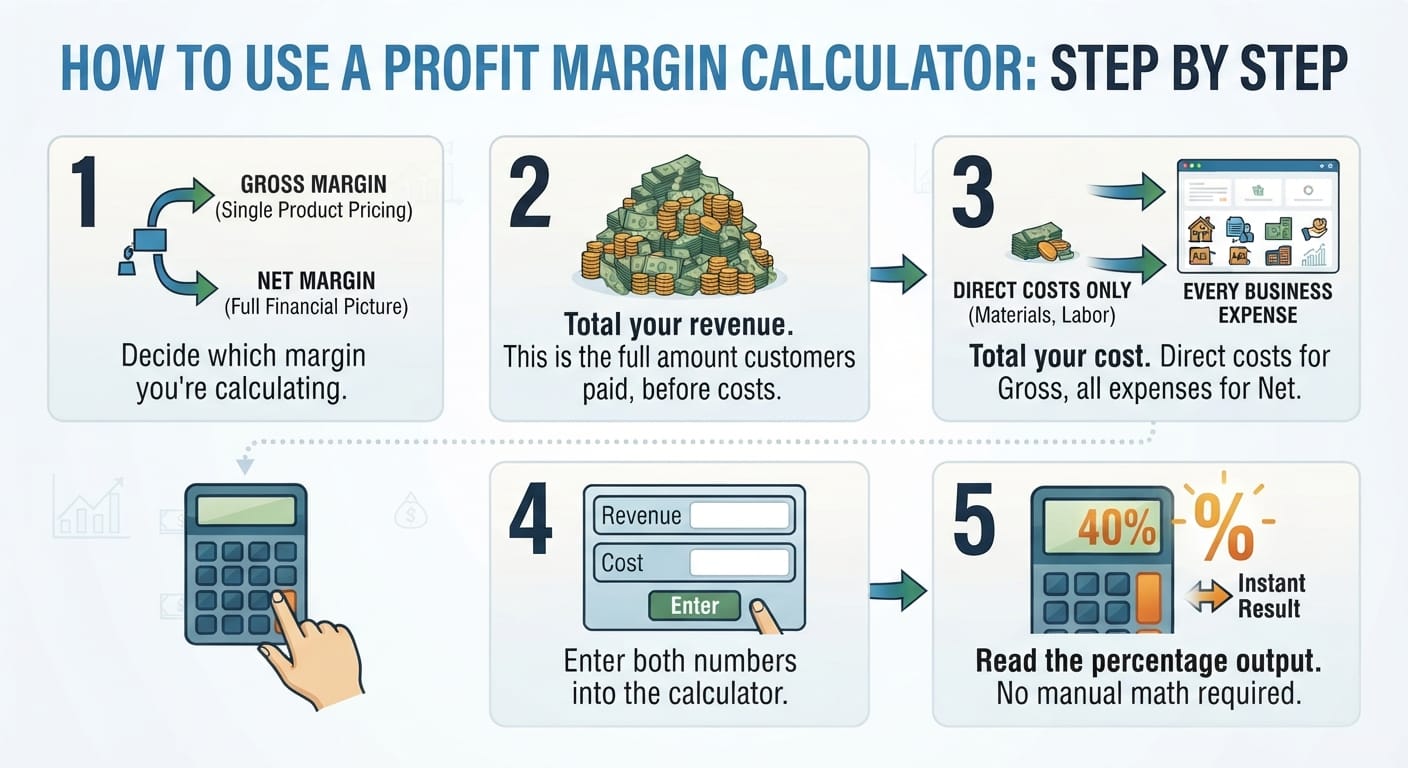
A profit margin calculator does the arithmetic instantly, but it’s only as accurate as the numbers you feed it. Here’s how to use one correctly, whether you’re checking a single sale or your whole business for the month or year.
- Decide which margin you’re calculating. Gross margin for a single product’s pricing, or net margin for the full financial picture.
- Total your revenue. This is the full amount a customer paid, before any costs are subtracted — not the amount you “keep.”
- Total your cost. For gross margin, add up direct costs only (materials, wholesale cost, direct labor tied to production). For net margin, add every expense the business incurs.
- Enter both numbers into the calculator. Most tools ask for revenue and cost as two separate fields.
- Read the percentage output. The calculator subtracts cost from revenue, divides by revenue, and displays the margin instantly — no manual math required.
Skip the Manual Math — Calculate Your Margin Instantly
Enter your revenue and cost and get an accurate profit margin percentage in seconds with our free calculator.
Try the Free Profit Margin Calculator →6. Worked Examples With Real Numbers
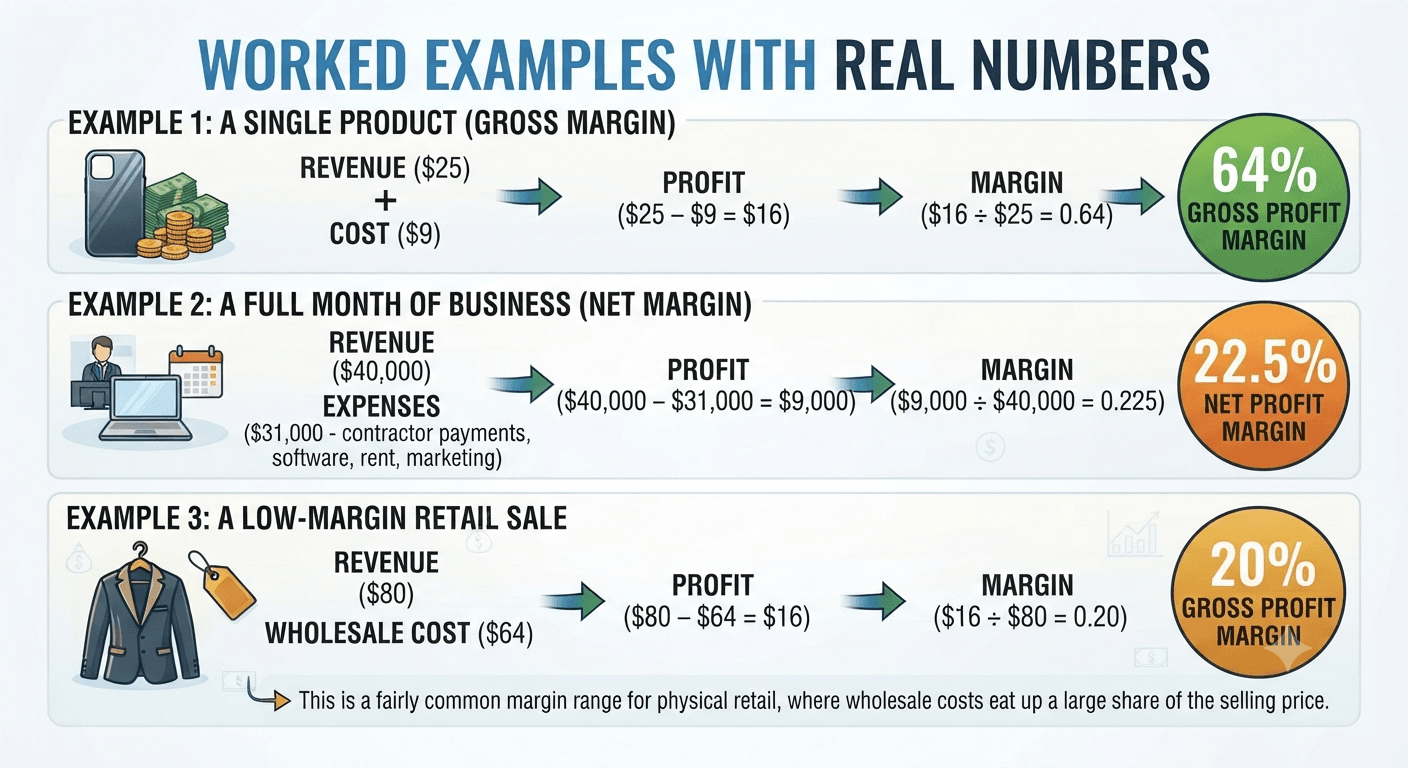
Example 1: A Single Product (Gross Margin)
An online store sells a phone case for $25. The case, including materials and packaging, costs $9 to produce.
- Profit: $25 − $9 = $16
- Margin: $16 ÷ $25 = 0.64
- Result: 64% gross profit margin
Example 2: A Full Month of Business (Net Margin)
A small consulting business brings in $40,000 in revenue for the month. Total expenses — contractor payments, software, office rent, and marketing — add up to $31,000.
- Profit: $40,000 − $31,000 = $9,000
- Margin: $9,000 ÷ $40,000 = 0.225
- Result: 22.5% net profit margin
Example 3: A Low-Margin Retail Sale
A boutique sells a jacket for $80. The wholesale cost was $64.
- Profit: $80 − $64 = $16
- Margin: $16 ÷ $80 = 0.20
- Result: 20% gross profit margin
This is a fairly common margin range for physical retail, where wholesale costs eat up a large share of the selling price.
7. Profit Margin vs. Markup: The Mistake Almost Everyone Makes
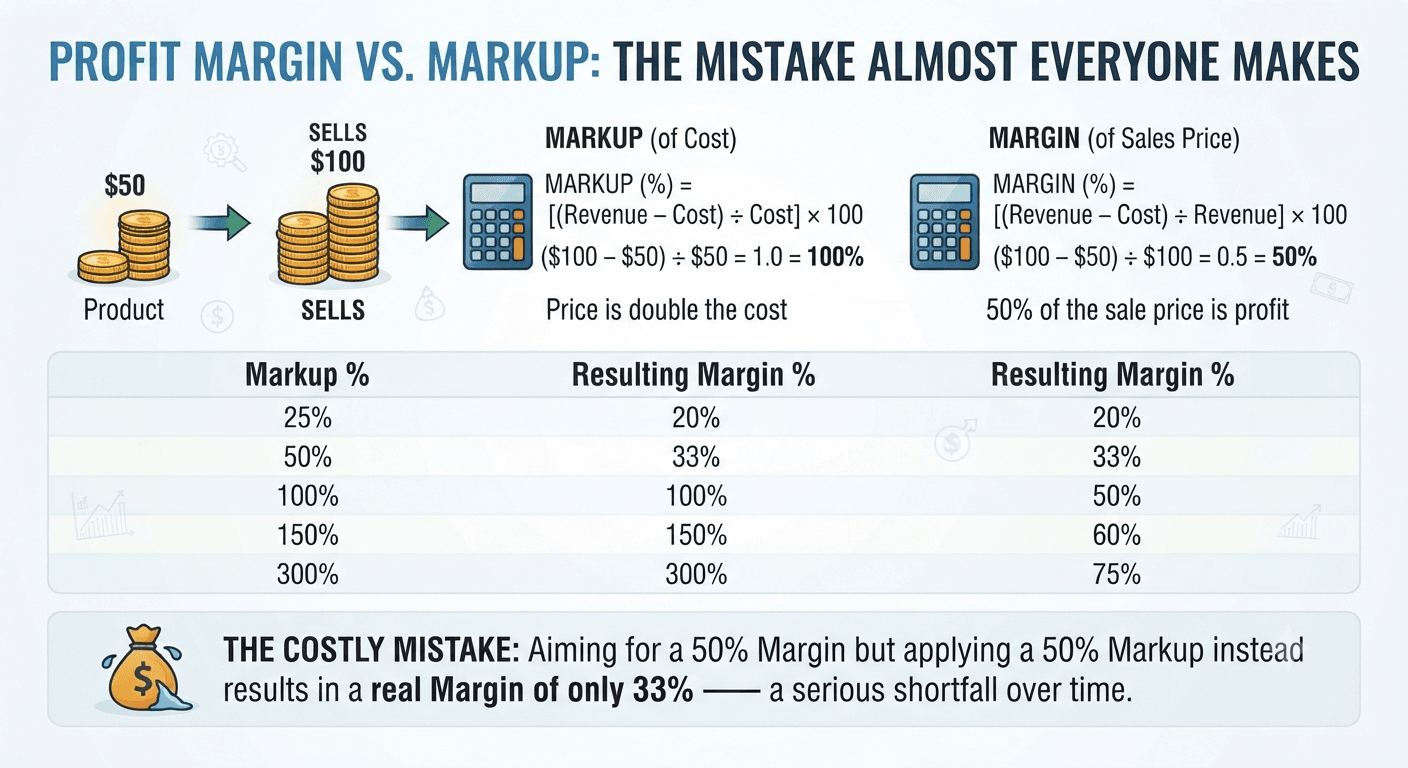
This is, without question, the single most common pricing mistake small business owners make — and it can quietly cost thousands of dollars in lost profit over time.
Markup is calculated as a percentage of your cost. Margin is calculated as a percentage of your selling price. They use the same two numbers but divide by a different one, and the results are never equal.
Markup (%) = [(Revenue − Cost) ÷ Cost] × 100
Take a product that costs $50 and sells for $100. A 100% markup was applied — the price is exactly double the cost. But run that same $50 profit through the margin formula: $50 profit ÷ $100 revenue = 50% margin, not 100%. The numbers look identical at a glance, but they answer two completely different questions.
| Markup % | Resulting Margin % |
|---|---|
| 25% | 20% |
| 50% | 33% |
| 100% | 50% |
| 150% | 60% |
| 300% | 75% |
8. What Is a Good Profit Margin? Industry Benchmarks
There’s no single “good” profit margin that applies to every business — it depends heavily on the industry, the overhead involved, and how much competition drives prices down. Here’s a realistic look at typical net profit margin ranges across common small business categories in the US market.
| Industry Type | Typical Net Margin Range |
|---|---|
| Grocery / low-margin retail | 1% – 3% |
| General e-commerce / online retail | 5% – 10% |
| Restaurants and food service | 3% – 9% |
| Professional services (consulting, agencies) | 15% – 30% |
| Software / digital products | 40% – 80%+ |
| Handmade / creative goods | 20% – 40% |
The pattern here isn’t random. Businesses with high physical costs per unit — groceries, restaurants, wholesale-heavy retail — tend to run thin margins because so much of every dollar goes straight to materials and inventory. Businesses selling knowledge, code, or creative work carry far lower per-unit costs, which is why their margins can run so much higher.
9. What to Do If Your Profit Margin Is Too Low
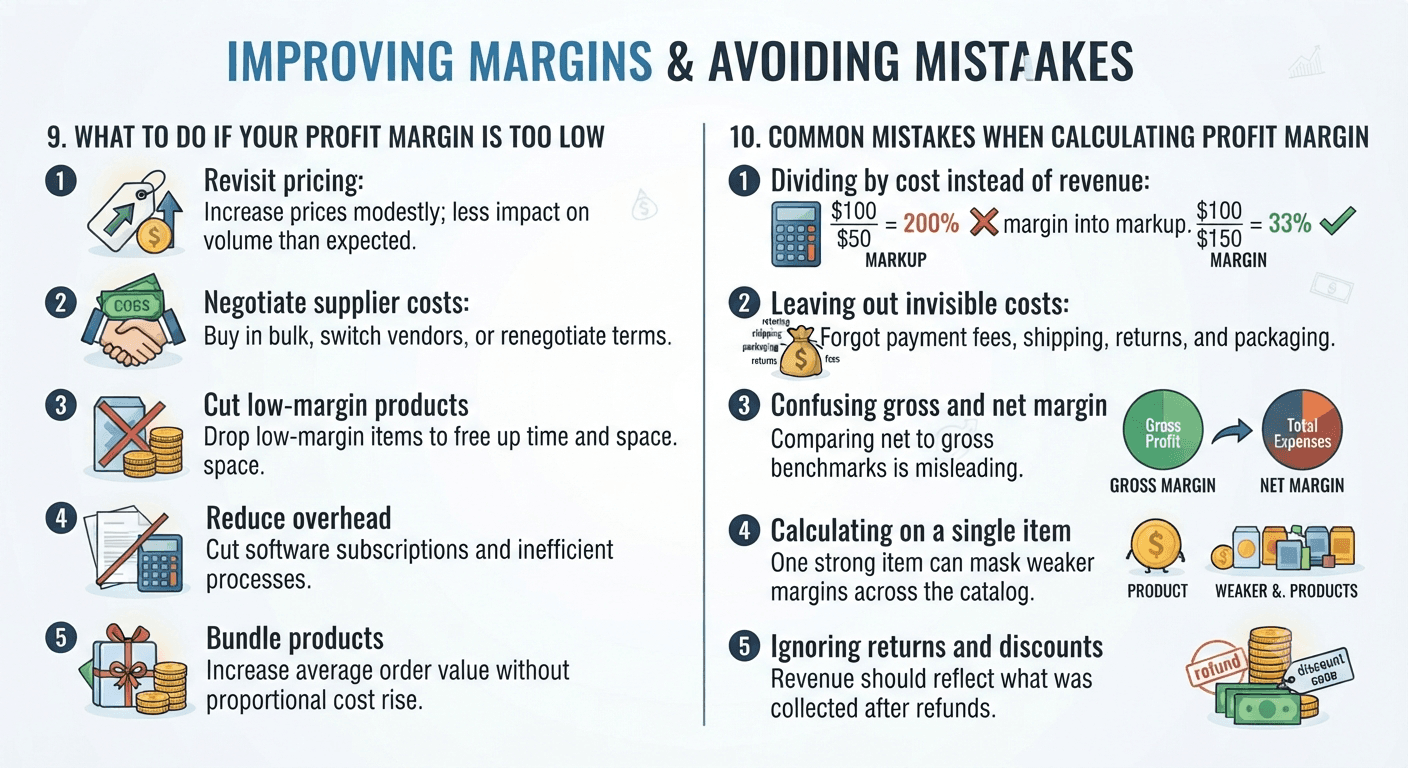
Running the numbers and finding a thinner margin than expected isn’t a dead end — it’s useful information. Here’s where most businesses find room to improve:
- Revisit pricing. Many business owners set prices once and never revisit them, even as costs rise. A modest price increase often has less impact on sales volume than expected.
- Negotiate supplier costs. Buying in larger quantities, switching vendors, or renegotiating terms can meaningfully lower COGS.
- Cut low-margin products. Not every product needs to stay in the lineup. Dropping consistently low-margin items frees up time and inventory space for higher-margin ones.
- Reduce overhead where possible. Software subscriptions, unused tools, and inefficient processes quietly drain net margin even when gross margin looks fine.
- Bundle products or services. Bundling can raise the average order value without a proportional rise in cost, lifting overall margin.
10. Common Mistakes When Calculating Profit Margin
- Dividing by cost instead of revenue. This silently turns your margin calculation into a markup calculation.
- Leaving out “invisible” costs. Payment processing fees, shipping, returns, and packaging often get left out of cost totals, inflating the margin on paper.
- Confusing gross and net margin when comparing to benchmarks. Comparing your net margin to a published gross margin benchmark (or vice versa) will always look misleading.
- Calculating margin on a single best-selling item. One strong product can mask weaker margins across the rest of a catalog. Always check margin at both the product level and the business level.
- Ignoring returns and discounts. Revenue should reflect what was actually collected after refunds and discount codes, not the original listed price.
11. When to Use a Calculator vs. Doing It by Hand
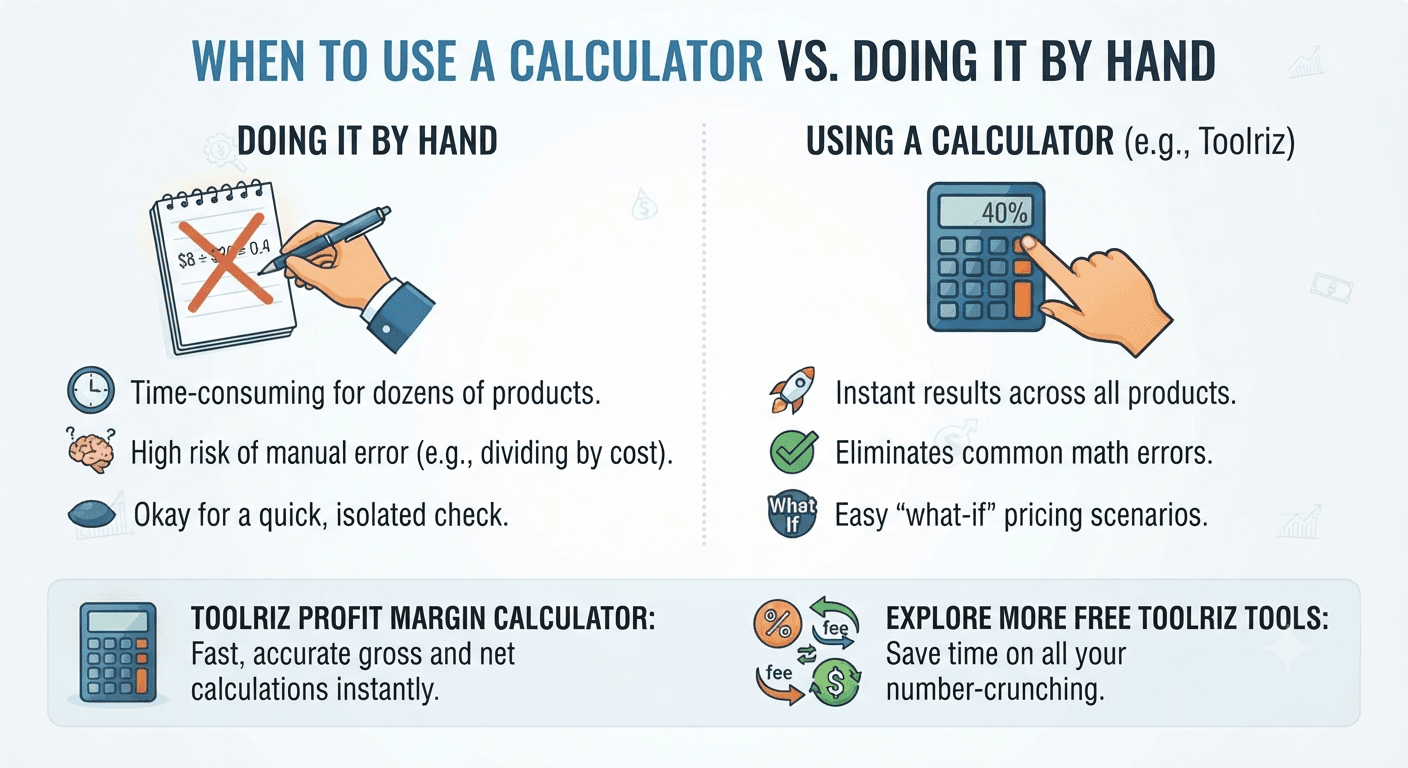
The math behind profit margin is simple enough to do with a pen and paper, but a calculator earns its keep the moment you’re checking margins across dozens of products, running “what if I raise the price by $2” scenarios, or double-checking numbers quickly before a pricing decision. It also removes the single most common manual error — accidentally dividing by cost instead of revenue.
For a quick, accurate result any time you need one, the Toolriz Profit Margin Calculator handles both gross and net margin calculations instantly. If you’re managing several business calculations at once — pricing, fees, conversions — it’s also worth browsing the full collection of free online tools on Toolriz, all built to save time on exactly this kind of number-crunching.
Explore More Free Business Calculators
Profit margin is just one piece of running the numbers. Check out the full library of free calculators for pricing, fees, and more.
Browse All Free Tools →12. Frequently Asked Questions
What is the formula for profit margin?
Profit margin equals (Revenue minus Cost) divided by Revenue, multiplied by 100 to express it as a percentage. This gives gross margin when using direct cost, or net margin when using total business expenses.
What is a good profit margin for a small business?
It depends on the industry. Retail businesses often run net margins of 5–10%, service businesses often reach 15–30%, and digital or software products can exceed 50%, since their per-unit costs are so low.
What is the difference between profit margin and markup?
Margin is calculated as a percentage of the selling price. Markup is calculated as a percentage of the cost. The same dollar profit produces a lower margin percentage than markup percentage every time.
How do you use a profit margin calculator?
Enter your total revenue and total cost. The calculator subtracts cost from revenue to find profit, then divides that profit by revenue to show your margin as a percentage.
Is gross profit margin the same as net profit margin?
No. Gross margin only subtracts the direct cost of the product (cost of goods sold). Net margin subtracts every business expense, giving a more complete view of actual profitability.
Reference context: Profit margin formulas and industry benchmark ranges referenced in this article reflect standard accounting definitions used in US small business and e-commerce financial reporting.