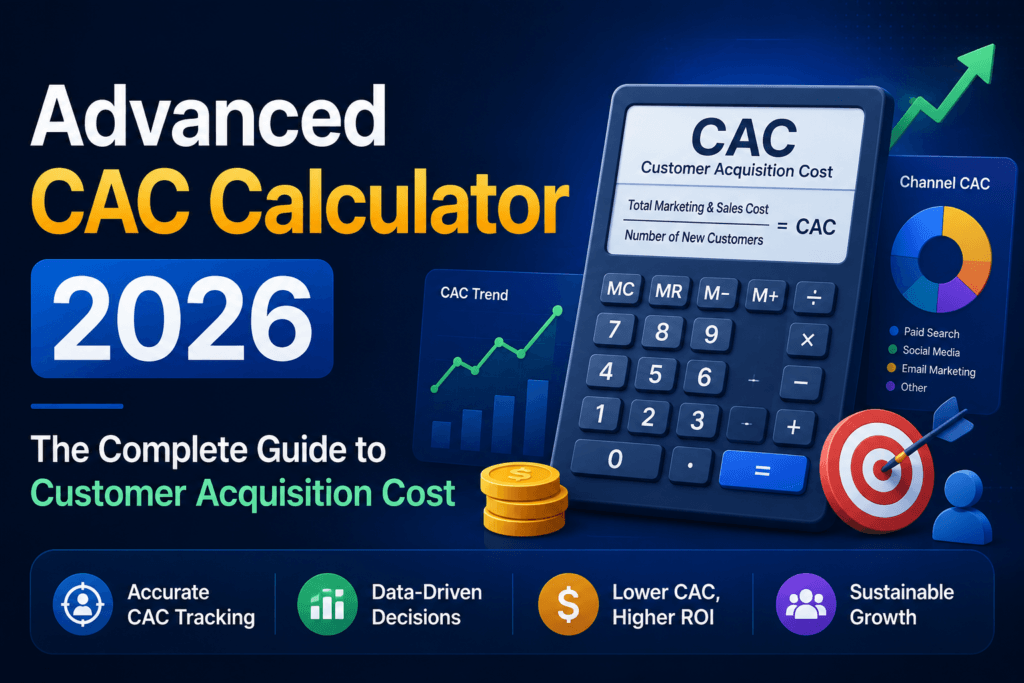
Advanced CAC Calculator 2026:
The Complete Guide to Customer Acquisition Cost
Everything you need to accurately calculate, benchmark, segment by channel, and systematically reduce your Customer Acquisition Cost — with a free calculator built for modern growth teams.
Customer Acquisition Cost is the single most important unit-economics metric in any growth-stage or scaling business. Get it wrong — and you can be growing fast while actually destroying shareholder value. Get it right — and you have a precise lever to optimize every marketing dollar, justify budget requests, and know exactly which channels deserve more investment and which ones should be cut.
This guide covers every dimension of CAC: what it is, how to calculate it correctly (including the advanced version most companies skip), how it compares by industry and channel, the LTV:CAC relationship, and the concrete tactics that consistently bring CAC down without sacrificing growth quality.
What Is Customer Acquisition Cost (CAC)?
Customer Acquisition Cost (CAC) is the total amount of money a company spends to acquire one new paying customer. It captures all sales and marketing expenditures — paid ads, salaries, tools, events, agency fees, commissions — and divides that total by the number of new customers brought in during the same period.
CAC is not just a marketing metric. It is a business health metric. It answers a deceptively simple but critically important question: What does it actually cost us to win one customer?
When CAC is lower than what that customer is worth over their lifetime (LTV), you have a scalable business. When it is equal to or higher than LTV, you are paying to acquire customers at a loss — a situation that no amount of revenue growth can fix.
CAC vs. Cost Per Lead (CPL) vs. Cost Per Acquisition (CPA)
These three metrics are frequently confused. Here is how they differ:
| Metric | What It Measures | When to Use It |
|---|---|---|
| CPL | Cost to generate one lead (not yet a customer) | Top-of-funnel campaign efficiency |
| CPA | Cost to get one desired action (download, trial signup, etc.) | Mid-funnel conversion optimization |
| CAC | Cost to convert one paying customer | Business unit economics & scaling decisions |
CAC is the final, most accurate reflection of acquisition efficiency. A low CPL means nothing if your sales team cannot convert leads into paying customers. CAC captures the entire funnel.
The Basic CAC Formula — And Why It Falls Short
Most articles will give you this formula and stop there:
This gives you a usable number. But it has three serious limitations that will lead you to make wrong decisions:
- It blends all channels together. Your Google Ads CAC might be $120 while your content marketing CAC is $680. Averaging them hides the truth.
- It ignores time lags. Customers acquired this quarter may be the result of marketing spend from the previous quarter. Matching spend and acquisitions to the same period distorts the real number.
- It omits overhead costs. Software subscriptions, management salaries, and agency retainers are real acquisition costs that basic formulas often exclude.
The Advanced CAC Formula (What Growth Teams Actually Use)
Here is the complete advanced CAC calculation used by sophisticated growth, finance, and revenue operations teams in 2026:
(Total Ad Spend + Sales Salaries + Marketing Salaries + Tools & Software + Agency Fees + Events & Sponsorships + Content Production Costs) ÷ New Paying Customers Acquired
Breaking Down Each Cost Component
Paid Media Spend
All ad spend: Google Ads, Meta Ads, LinkedIn Ads, programmatic display, sponsored content, YouTube, TikTok, affiliate payouts, and retargeting campaigns. This is usually the easiest number to pull and the most accurate.
Sales Team Costs
Base salary, commissions, bonuses, and benefits for all sales reps, SDRs, BDRs, and sales managers whose primary function is new customer acquisition. Do not include account management or customer success salaries — those are retention costs, not acquisition costs.
Marketing Team Costs
Salaries and contractor fees for demand gen, performance marketing, content, SEO, social media, and brand marketers. If a team member splits time between acquisition and retention (e.g., an email marketer who sends nurture campaigns and also sends renewal campaigns), prorate their cost by estimated time allocation.
Technology & Software
Your CRM (Salesforce, HubSpot), marketing automation, sales engagement platforms (Outreach, Salesloft), SEO tools, analytics platforms, ad tech, attribution software, and any AI tools used for prospecting or content generation.
Agency & Freelancer Retainers
PPC management agencies, PR firms, content agencies, SEO consultants, conversion rate optimization contractors. Every external vendor engaged to generate or convert new demand belongs here.
Events, Trade Shows & Sponsorships
Booth fees, conference registrations, branded event sponsorships, field marketing programs, and webinar production costs — all expenses designed to put the brand in front of prospective new customers.
Content & Creative Production
Video production, graphic design, copywriting, photography, and any content assets built primarily to attract or convert new buyers. Ongoing blog production, lead magnets, case studies, and landing page creative all qualify.
Channel-Level CAC: Where the Real Insights Live
Blended CAC is useful for board decks. Channel CAC is useful for decisions. When you break down your CAC by acquisition channel, you almost always discover that two or three channels are carrying the entire business while others are quietly burning budget.
Example: Channel CAC Breakdown
| Channel | Monthly Spend | New Customers | Channel CAC | vs. Blended CAC ($420) |
|---|---|---|---|---|
| Google Ads (Search) | $28,000 | 140 | $200 | 52% below |
| Organic SEO | $12,000 | 50 | $240 | 43% below |
| LinkedIn Ads | $18,000 | 30 | $600 | 43% above |
| Outbound SDR | $35,000 | 40 | $875 | 108% above |
| Referral Program | $7,000 | 40 | $175 | 58% below |
This table reveals a clear story: Referral and Google Search are the most efficient channels. SEO is solid. LinkedIn and Outbound are expensive — but before cutting them, you must check one more variable: do customers from expensive channels have higher LTV, better retention, or faster expansion revenue?
The LTV:CAC Ratio — The Most Important Number in SaaS & E-Commerce
CAC in isolation is meaningless. $500 CAC is amazing if a customer generates $5,000 in lifetime value. It is catastrophic if they generate $400. The LTV:CAC ratio is what gives CAC meaning.
How to Interpret LTV:CAC
| LTV:CAC Ratio | Interpretation | Recommended Action |
|---|---|---|
| Below 1:1 | Losing money on every customer | Critical — Stop Scaling |
| 1:1 – 2:1 | Barely covering acquisition costs | Unsustainable |
| 2:1 – 3:1 | Marginally viable, thin operating leverage | Needs improvement |
| 3:1 | Healthy — standard SaaS benchmark | Maintain & optimize |
| 4:1 – 6:1 | Strong unit economics, good for scaling | Scale with confidence |
| Above 6:1 | Potentially under-investing in growth | Consider increasing spend |
CAC Payback Period: How Long Until You Break Even?
Even a healthy LTV:CAC ratio does not guarantee positive cash flow. If it takes you 36 months to recover your CAC, you need significant capital to fund growth — which increases risk and dilution. The CAC Payback Period tells you how many months it takes to earn back what you spent acquiring a customer.
Payback Period Benchmarks by Business Type (2026)
| Business Type | Good Payback Period | Acceptable | Needs Attention |
|---|---|---|---|
| SMB SaaS | < 12 months | 12–18 months | > 24 months |
| Mid-Market SaaS | < 18 months | 18–24 months | > 36 months |
| Enterprise SaaS | < 24 months | 24–36 months | > 48 months |
| E-Commerce | < 6 months | 6–12 months | > 18 months |
| Marketplace | < 12 months | 12–24 months | > 36 months |
CAC Benchmarks by Industry (2026 Data)
One of the biggest mistakes teams make is evaluating their CAC in a vacuum. A $200 CAC is exceptional for a consumer app and unsustainably low for an enterprise software business. Context is everything. Here are the most current industry benchmarks for 2026:
How to Use the Advanced CAC Calculator (Step-by-Step)
Our Advanced CAC Calculator at Toolriz is built to handle everything covered in this guide — from basic CAC to full LTV:CAC analysis. Here is how to get the most accurate results:
Set Your Time Period
Choose a consistent period — monthly, quarterly, or annually. For most businesses, quarterly gives the best balance between recency and sample size. Avoid weekly calculations unless you have high transaction volume, as the numbers will be too volatile.
Enter All Cost Components
Use the seven cost categories described above. Pull exact figures from your accounting system. For salary costs, use fully loaded cost (salary + benefits + payroll taxes), not just base pay. This typically adds 20–30% to the raw salary figure.
Enter New Customers Acquired
Count only net-new paying customers — not trials, freemium users, or re-activations of churned accounts. If your product has a free-to-paid conversion model, count only the moment a customer makes their first payment.
Add Channel-Level Breakdown
Input spend and customer count per channel. The calculator will surface channel-level CAC instantly, so you can see which acquisition sources are performing and which are underperforming relative to your blended average.
Enter LTV Inputs
Input your average monthly revenue per customer, gross margin percentage, and monthly churn rate. The calculator will compute LTV, the LTV:CAC ratio, and the CAC payback period automatically.
Interpret the Results
Use the output to identify your most efficient channel, evaluate whether your LTV:CAC ratio supports scaling, determine whether your payback period is within healthy range, and set a target CAC for the next quarter.
🧮 Advanced CAC Calculator — Free, No Signup
Calculate blended CAC, channel-level CAC, LTV:CAC ratio, and payback period in under 2 minutes.
7 CAC Calculation Mistakes That Distort Your Data
Even experienced operators make these errors. Each one produces a CAC that is either deceptively low (leading to overconfident scaling) or inflated (leading to unnecessary budget cuts).
Mistake 1: Matching Spend and Acquisitions to the Same Calendar Period Without Adjusting for Sales Cycle Length
If your average sales cycle is 90 days, then Q1 spend produces Q2 customers. Using Q1 spend and Q1 new customers in the same CAC calculation overstates CAC for Q1 (when deals are being worked) and understates it for Q2 (when those deals close). The fix: shift your acquisition count forward by the length of your average sales cycle.
Mistake 2: Excluding Overhead and Management Costs
The VP of Marketing’s salary is a real CAC cost. So is the cost of your CRM, your analytics stack, and the time your CEO spends doing sales calls. Teams that only count ad spend and direct labor consistently underreport their true CAC by 30–50%.
Mistake 3: Including Churn-and-Return Customers
Customers who previously churned and then re-subscribed should generally not be counted as new customer acquisitions. The effort to win them back is categorically different from acquiring truly new customers. Segment win-backs separately.
Mistake 4: Using Vanity Attribution Instead of Multi-Touch Attribution
If your attribution model credits 100% of the conversion to the last click, you are systematically undervaluing top-of-funnel channels (SEO, content, brand) and overvaluing bottom-of-funnel channels (branded search, retargeting). Use a multi-touch attribution model — at minimum linear, ideally data-driven — before making channel budget decisions.
Mistake 5: Calculating CAC Across All Products or Customer Segments Together
Blending CAC for enterprise customers with CAC for SMB customers produces a number that accurately describes neither. Always segment CAC by customer tier, product line, and geography when those segments differ meaningfully in deal size or conversion path.
Mistake 6: Treating Free Trial Conversions as Zero-CAC
Free trial users are not free to acquire. The cost of generating the trial signup — whether through paid ads, content, or outbound — is a real CAC cost. The fact that payment is deferred does not eliminate the acquisition investment. Count the cost at the moment of signup and attribute the conversion at the moment of payment.
Mistake 7: Calculating CAC Only Once Per Year
Annual CAC calculations are far too infrequent to be actionable. Market conditions, platform costs, and funnel efficiency all shift month-to-month. Build a CAC dashboard that updates monthly, track 12-month rolling averages to smooth seasonal noise, and investigate any quarter where CAC moves more than 15% in either direction.
12 Proven Strategies to Reduce CAC in 2026
Reducing CAC is not about cutting spend — it is about getting more customers out of the same spend, or converting existing traffic more efficiently. Here are the twelve strategies that consistently work across industries and business models:
1. Build a Compounding Content Engine (Organic CAC Reduction)
Content that ranks in Google drives traffic month after month with no additional per-click cost. A single well-optimized article targeting a high-intent query can deliver customers for years. The CAC for organic conversions decreases over time as the content matures, while paid CAC typically increases as you exhaust your most efficient audiences. Invest in content early and consistently.
2. Invest in a Referral Program
Referred customers consistently show the lowest CAC across every industry studied. They arrive pre-qualified, trust the product, and convert at higher rates. A well-designed referral program (where both the referrer and the referred get tangible value) can generate customers at 40–70% below your blended CAC. This is one of the highest-ROI investments available to growth teams.
3. Fix Your Landing Page Conversion Rate
If your CAC is $500 and your landing page converts at 2%, improving conversion to 4% cuts your CAC to $250 without changing a single dollar of ad spend. Conversion Rate Optimization (CRO) is among the fastest ways to reduce CAC. Run systematic A/B tests on headlines, social proof, CTAs, and form length at minimum.
4. Tighten Your Audience Targeting
Broad audiences generate volume but dilute quality. Narrow your targeting to the personas most likely to convert and retain. Use first-party data (CRM lists of your best customers) to build lookalike audiences on Meta and LinkedIn. Exclude existing customers and recent visitors who have already converted to stop wasting budget on people who will not buy.
5. Shorten the Sales Cycle
A 90-day sales cycle is approximately twice as expensive as a 45-day cycle in terms of SDR time and sales management overhead. Identify the specific stages where deals stall, add self-serve elements (ROI calculators, automated demos, in-product trials), and remove friction from the decision process. Every week you shave off the average sales cycle reduces your CAC.
6. Build Product-Led Growth (PLG) Loops
When the product itself drives acquisition — through viral sharing, collaboration features, or freemium models — CAC approaches zero for a meaningful percentage of new customers. PLG works particularly well for tools with network effects (project management, design software, collaboration tools). Even a partial PLG motion that handles 20% of new customers significantly reduces blended CAC.
7. Invest in Brand (Counter-Intuitive but Data-Backed)
Branded search converts at dramatically lower cost than non-branded search. Customers who search for your brand by name have already been pre-sold — they convert faster, negotiate less, and retain better. Brand investment (content, PR, community, thought leadership) is a long-game CAC reduction strategy that most companies underinvest in until they face paid channel saturation.
8. Implement Lead Scoring to Protect Sales Team Capacity
When sales reps spend time on leads that will never close, you are effectively raising CAC by reducing the number of productive conversations per rep per month. Implement lead scoring that routes only sales-qualified leads to human reps. Lower-score leads should enter automated nurture sequences until they demonstrate buying intent signals.
9. Double Down on Your Lowest-CAC Channel
This sounds obvious, but most companies fail to do it. Your analysis of channel-level CAC will reveal one or two channels that are dramatically outperforming others. Before experimenting with new channels, fully saturate your most efficient ones. Marginal returns will eventually kick in, but most companies hit the ceiling of their best channel far later than they think.
10. Automate Your Nurture Sequences
Leads that are not yet ready to buy represent a real acquisition investment. If they fall out of your funnel because you have no systematic follow-up, you have paid to acquire them and received nothing in return. Build automated email sequences that maintain contact with cold leads, deliver relevant content, and trigger re-engagement when behavioral signals indicate renewed interest.
11. Reduce Churn to Improve the Economics of CAC
This is not strictly a CAC reduction strategy, but it has a profound effect on how manageable your CAC is. When churn is high, you must constantly replace churning customers just to maintain revenue — which means acquisition spend stays high forever. Reducing monthly churn from 5% to 3% is mathematically equivalent to getting a 40% CAC reduction from a unit economics standpoint.
12. Negotiate Better Platform Rates and Use Smart Bidding
On Google Ads, shifting from manual CPC to Target CPA or Target ROAS bidding allows the platform’s machine learning to find conversions within your cost parameters. On Meta, using Advantage+ campaigns with broad targeting often outperforms manually configured audience sets. These changes will not single-handedly transform your CAC, but together they reliably improve paid channel efficiency by 15–30%.
CAC Expectations by Company Stage
Your CAC is not just benchmarked against your industry. It is also evaluated in the context of your company’s growth stage. What is acceptable at Seed is alarming at Series B.
| Stage | Primary CAC Focus | Acceptable LTV:CAC | Key Metric Priority |
|---|---|---|---|
| Pre-Seed / Seed | Find channels that work at all | 1:1 – 2:1 (learning phase) | Conversion rate proof |
| Series A | Identify 1–2 repeatable channels | 2:1 – 3:1 | Channel CAC by source |
| Series B | Scale proven channels, reduce CAC | 3:1+ | Payback period < 18 months |
| Series C+ | Diversify channels, brand investment | 3:1 – 5:1 | Blended CAC trending down YoY |
| Growth / Pre-IPO | Efficiency & predictability | 4:1 – 6:1 | Magic Number & Rule of 40 |
Expert Perspective: What Top Growth Leaders Look at Beyond CAC
⚡ Expert Insight — Growth Analytics Perspective
The most sophisticated growth operators in 2026 look at CAC as part of a system, not as a standalone KPI. They track CAC alongside Net Revenue Retention (NRR), Magic Number, and ARR per FTE. A company with a $600 CAC, 120% NRR, and 1.5 Magic Number is healthier than one with a $250 CAC, 85% NRR, and 0.7 Magic Number. CAC tells you the cost of filling the bucket. NRR tells you whether the bucket has holes. You need both numbers to make sound decisions about growth investment.
The Magic Number: A Critical Companion to CAC
Building a CAC Tracking Dashboard
A single CAC calculation is a snapshot. A recurring CAC dashboard is a strategic asset. Here is the structure of an effective CAC tracking system:
Dashboard Components (Monthly Update Cadence)
- Blended CAC — Current period vs. prior 3 periods, with trend line
- Channel CAC — Per-channel breakdown with month-over-month delta
- LTV:CAC Ratio — By segment (SMB, Mid-Market, Enterprise)
- CAC Payback Period — Overall and by cohort
- New Customers by Channel — Volume and percentage share
- Cost Components — Budget line items as percentage of total CAC, tracked for drift
- CAC by ICP Segment — Separate calculations for each Ideal Customer Profile
Segmented CAC: B2B vs. B2C vs. Marketplace
CAC behaves fundamentally differently across business models. Understanding these structural differences prevents you from applying the wrong benchmarks to your situation.
✅ B2B CAC Characteristics
- Naturally high ($300–$2,400+) due to complex sales
- Long payback periods (12–36 months) acceptable
- Offset by high LTV and low churn
- Channel: outbound, events, content, LinkedIn
- Referrals from customers extremely high-value
⚡ B2C CAC Constraints
- Must be low ($20–$200) due to low ARPU
- Payback must be under 6–12 months
- High churn compresses LTV significantly
- Channel: paid social, influencer, SEO, viral
- Network effects critical for sustainable CAC
Marketplace CAC: A Two-Sided Challenge
Marketplaces must calculate CAC separately for buyers and sellers. Acquiring a seller who brings no buyers has zero value. Acquiring a buyer on a marketplace with no inventory creates immediate churn. The most sophisticated marketplace teams track the blended CAC of a buyer-seller pair and evaluate the cross-side network effect value each acquisition creates.
Frequently Asked Questions About CAC
Conclusion: CAC as a Competitive Advantage
The companies that win in 2026 are not the ones who spend the most on customer acquisition — they are the ones who understand their unit economics deeply enough to spend smarter. Customer Acquisition Cost, calculated correctly and tracked rigorously, is the foundation of that understanding.
Start with the correct formula, including all seven cost components. Break your blended CAC into channel-level insights. Compare it against your LTV and payback period. Benchmark it against your industry. Then apply the reduction strategies that fit your stage and business model.
And use the right tools. Our Advanced CAC Calculator makes every calculation in this guide fast and accurate — so you spend your time acting on the insights, not building the spreadsheet. For a complete library of business calculators and conversion tools, explore everything available at Toolriz.com.
🚀 Ready to Calculate Your True CAC?
Use our free Advanced CAC Calculator — built for growth teams who need accurate, channel-segmented, LTV-adjusted results in minutes, not hours.