

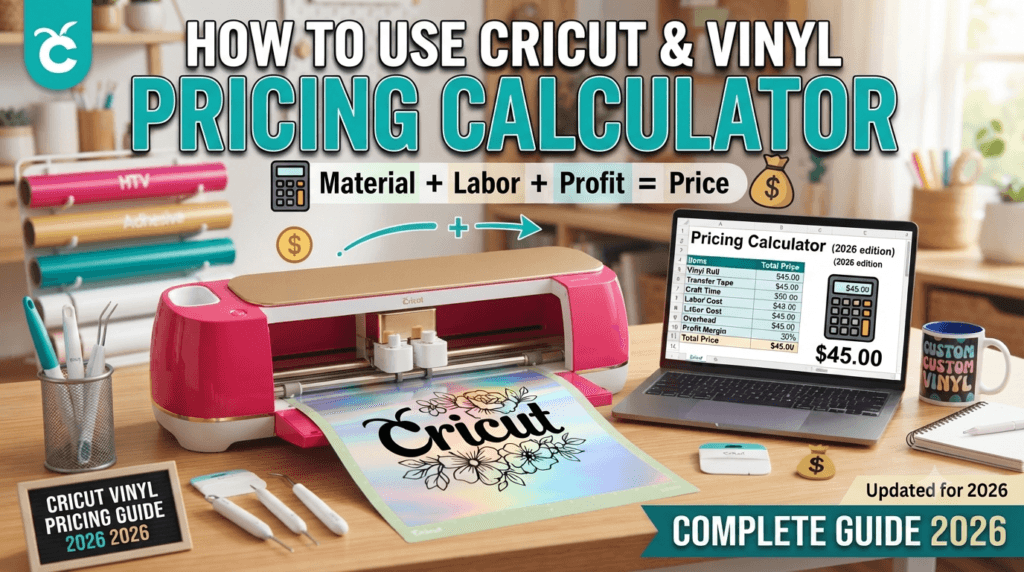
How to Use Cricut & Vinyl Pricing Calculator: Complete Guide 2026
Stop guessing your prices and losing money on hidden costs. Learn how to accurately price your custom decals, HTV apparel, and tumblers to build a profitable craft business in 2026.
To use a Cricut & Vinyl Pricing Calculator, input the cost and square inches of your materials (vinyl, HTV, transfer tape), the cost of the blank item (shirt, tumbler), the time it takes to design, cut, weed, and apply the design, and your desired hourly wage. The calculator adds overhead expenses (machine wear, software fees) and applies a profit margin to output the exact retail price you should charge. Using a calculator ensures you aren’t underpricing your handmade items and losing money to hidden fees. Use the Toolriz Calculator here.
- The Crafter’s Pricing Dilemma in 2026
- What is a Cricut & Vinyl Pricing Calculator?
- The Crafting Profit Formula Explained
- Step-by-Step: How to Use the Tool
- How to Calculate Vinyl & HTV Costs
- Valuing Your Labor: Weeding Time is Money
- The Hidden Overhead You Are Ignoring
- Pricing by Niche: Decals vs. Shirts vs. Tumblers
- How to Interpret Your Calculator Results
- Top 5 Pricing Mistakes Crafters Make
- Frequently Asked Questions
The Crafter’s Pricing Dilemma in 2026
The handmade economy is booming. With platforms like Etsy, Shopify, and local craft fairs providing unprecedented access to buyers, more people than ever are turning their Cricut and Silhouette machines into side hustles or full-time businesses. But there is a silent killer destroying craft businesses every day: underpricing.
Walk into any craft fair or browse Etsy for custom vinyl tumblers or HTV baby onesies, and you will see prices all over the map. A custom tumbler might be listed for $15 on one page and $35 on another. Why? Because most crafters price based on what their competitors charge or by using a “gut feeling” about what seems fair. They fail to calculate the exact cost of materials, the true value of their labor, and the hidden overhead of running a craft business.
When you underprice, you aren’t just making less money—you are actively losing money. Every time you sell a $20 shirt that cost you $12 in materials and 45 minutes of labor, you are paying the customer to take your product. In 2026, with inflation affecting the cost of blanks, vinyl, and shipping, accurate pricing is no longer optional; it is the difference between a hobby and a business.
This is where the Toolriz Cricut & Vinyl Pricing Calculator comes in. It removes the emotion from pricing and replaces it with hard, mathematical data. In this guide, we will show you exactly how to use this tool to ensure every item you sell generates a true profit.
Crafters often price to “compete” without realizing competitors might be using cheaper blanks, not paying themselves an hourly wage, or mass-producing items. Your pricing must reflect your costs and your time, not someone else’s.
What is a Cricut & Vinyl Pricing Calculator?
A Cricut & Vinyl Pricing Calculator is a specialized business tool designed specifically for the economics of handmade crafts. Unlike a generic retail margin calculator, this tool understands the unique variables of a cutting machine business—namely, the cost of vinyl per square inch, weeding time, and the overhead of heat presses and design software.
The tool requires several key inputs to function:
- Material Costs: The cost of the vinyl/HTV used, transfer tape, and the blank item.
- Labor Data: The time spent designing, cutting, weeding, and applying the design, plus your desired hourly wage.
- Overhead Expenses: Allocated costs for machine maintenance, electricity, software subscriptions, and platform fees.
- Profit Margin: The percentage of profit you want to make on top of your costs.
By synthesizing these variables, the calculator outputs a baseline cost and a suggested retail price. It takes the guesswork out of the equation, ensuring that your passion project doesn’t become a financial drain.
The Crafting Profit Formula Explained
To effectively use the calculator, you need to understand the formula running behind the scenes. The standard pricing formula for handmade items in 2026 is:
Let’s break this down:
- Materials: This is the hard cost of every physical thing that goes into the final product. If you use 1 square foot of HTV, a blank Gildan shirt, and a piece of transfer tape, the cost of all three added together is your material cost.
- Labor: Time is money. If you want to earn $20 an hour, and a shirt takes 30 minutes to design, weed, and press, your labor cost is $10. Do not skip this; if you don’t pay yourself, you are volunteering, not running a business.
- Overhead: This covers the “invisible” costs. A portion of your Cricut Access subscription, the electricity to run your heat press, weeding tool replacements, and Etsy listing fees. We usually calculate this as a small percentage of material costs (e.g., 10%) or a flat fee per item.
- Profit Multiplier: This is where you actually make money. Once you have your total cost (Materials + Labor + Overhead), you multiply it by a factor (usually 1.2 to 1.5 for a 20% to 50% profit margin) to get your retail price.
Step-by-Step: How to Use the Toolriz Calculator
Using the Toolriz Cricut & Vinyl Pricing Calculator is straightforward, but gathering your data beforehand ensures the most accurate pricing. Follow these detailed steps.
Gather Material Receipts
Note the price you paid for your roll of vinyl or HTV and the blank items. If you buy blanks in bulk, calculate the per-unit cost, not the bulk price.
Measure Design Size
Open Cricut Design Space and check the dimensions of your design. Calculate the total square inches of material used, including the “bleed” or waste around the design.
Time Yourself
Use a stopwatch during your next production run. Track exactly how long it takes to cut, weed, and apply the design. Enter this time (in minutes) into the labor section of the calculator.
Input Overhead
Estimate your monthly overhead (software, machine wear, utilities). Divide this by the number of items you produce a month to get a per-item overhead fee, and input that.
Set Profit Margin
Decide on your profit margin. For wholesale, use a lower margin (10-15%). For retail, aim for 25-40%. Input this percentage into the tool.
Calculate Price
Click calculate. The tool will instantly output your baseline cost and your suggested retail price. This is the minimum you should charge.
Compare & Adjust
Compare the suggested retail price to current market rates. If it’s too high, find ways to lower material costs (buy wholesale blanks) or increase efficiency (batch weeding). Do not just lower your price.
How to Calculate Vinyl & HTV Costs
The most common mistake crafters make is guessing the cost of the vinyl they use. A roll of Oracal 651 or Siser EasyWeed might cost $12, but how much does a 3-inch decal actually cost? You must break the cost down to the cost per square inch.
The Square Inch Math
Let’s say you buy a standard 12-inch by 5-foot (60-inch) roll of Siser EasyWeed HTV for $12.00.
- Calculate total square inches: 12 inches × 60 inches = 720 square inches.
- Divide the cost by total square inches: $12.00 ÷ 720 = $0.0166 per square inch.
- If your design is 8 inches by 10 inches (80 square inches), the material cost is 80 × $0.0166 = $1.33.
However, you must also account for waste. When you cut a design, you weed away the negative space, but that vinyl is still gone from the roll. Therefore, you calculate the cost based on the bounding box of the cut, not just the visible lines of the design. The Toolriz calculator has fields specifically for this square-inch calculation.
Transfer tape is a material cost! If you use clear transfer tape on a decal, calculate its cost per square inch exactly as you did for the vinyl. It adds an average of $0.20 to $0.50 to every decal, which eats into your profits if not charged to the customer.
Valuing Your Labor: Weeding Time is Money
If you spend 20 minutes meticulously weeding a complex mandala decal, you must be paid for that time. Many crafters value their labor at $0 because they “enjoy it,” but this mindset bankrupts businesses. In 2026, a fair crafting wage is between $15 and $25 per hour, depending on your skill level and the complexity of the work.
When using the calculator, input your time in minutes. If you pay yourself $20/hour, that is $0.33 per minute. A decal that takes 15 minutes to weed and apply incurs a labor cost of $5.00. If you price the decal at $6.00, you only made $1.00 in profit before material costs!
Batching to Lower Labor Costs
If you make 10 of the same decal in a row, your weeding time per item drops significantly due to muscle memory and efficiency. Use the calculator to price “batch production” by timing a batch of 10 and dividing the total time by 10. This allows you to offer a slightly lower price for items you produce in bulk while maintaining your hourly wage.
The Hidden Overhead You Are Ignoring
Overhead is the silent profit killer. These are the costs of running your business that aren’t directly tied to one specific shirt or decal. If you don’t factor overhead into your pricing, you will eventually have to pay for a new Cricut machine or heat press out of your own pocket.
What Counts as Overhead?
- Machine Depreciation: Your Cricut Maker or Explore Air 3 has a limited lifespan (usually 2-3 years of heavy use). You should be saving a few dollars from every sale to buy the next one.
- Consumables: Cutting mats, replacement blades (Premium Fine Point blades dull fast!), weeding hooks, and scraper tools.
- Software: Cricut Access subscription, Adobe Illustrator, or Silhouette Studio Business Edition.
- Utilities: The electricity to run your heat press (which draws a lot of power) and your computer.
- Platform Fees: Etsy charges $0.20 per listing, 6.5% transaction fee, and 3% + $0.25 payment processing fee. If you sell a $20 item, Etsy takes roughly $3.20.
A good rule of thumb is to add a 10% to 15% overhead fee to your total material and labor costs. The calculator allows you to input this as a flat dollar amount or a percentage.
Pricing by Niche: Decals vs. Shirts vs. Tumblers
Different Cricut projects have entirely different cost structures. Let’s look at how the calculator handles three common niches.
| Project Type | Typical Material Cost | Labor Time | Suggested Retail (2026) |
|---|---|---|---|
| 3″ Vinyl Decal (Car) | $0.50 (Vinyl + Tape) | 5 mins ($1.25) | $4.00 – $6.00 |
| Custom HTV T-Shirt | $5.00 (Shirt + HTV) | 15 mins ($3.75) | $18.00 – $25.00 |
| 20oz Personalized Tumbler | $6.50 (Tumbler + Vinyl) | 20 mins ($5.00) | $22.00 – $30.00 |
As you can see, the retail price scales dramatically based on the blank cost and the labor involved. Tumblers require precise application and often sealing, justifying a much higher price point than a simple car decal.
How to Interpret Your Calculator Results
Once you run your numbers, you will be faced with a result. Here is how to handle the three most common scenarios.
Scenario A: The Price Seems Fair
If the calculator says your custom shirt should be $22, and you see similar shirts on Etsy selling for $25, you are in a great position. You can confidently price at $22 to be competitive while still hitting your profit goals.
Scenario B: The Price is Too High
If the calculator says your tumbler should be $35, but everyone else is selling them for $20, do not just lower your price to $20—you will lose money. Instead, look for ways to lower your costs. Can you buy tumblers in bulk from a supplier like EnjoyNiks instead of buying single blanks at Michael’s? Can you use a cheaper vinyl brand for simple designs? Lower your baseline costs, don’t slash your wage.
Scenario C: The Price is Too Low
If the calculator says you should charge $8 for a shirt, but the market is charging $20, charge $20. The calculator provides a minimum baseline. If the market supports a higher price, take the extra profit! Use it to invest in better equipment or run Facebook ads. For more strategies on scaling your craft business, check out our related craft business blog articles.
Top 5 Pricing Mistakes Crafters Make
- Pricing Based on Competitors: Your competitor might be buying materials with a 50% off coupon or not paying themselves a wage. Price based on your math.
- Ignoring Weeding Time: Weeding a 1-color simple text shirt takes 2 minutes. Weeding a multi-layer, intricate mandala takes 30 minutes. You must price these differently.
- Forgetting Platform Fees: If you sell on Etsy, you must build the 10%+ fees into your price, or you will owe money at tax time.
- Not Charging for Design Time: If you have to create a custom SVG for a customer, that time must be billed. Custom design work should command a premium.
- Using “Hobby Lobby” Prices: Retail prices at craft stores reflect mass manufacturing in overseas factories. You are making a handmade, custom item. Do not compete with mass production on price; compete on customization and quality.
🔑 Key Takeaways
- A Cricut & Vinyl Pricing Calculator removes the emotion from pricing and replaces it with mathematical accuracy.
- Always calculate your vinyl and HTV costs down to the square inch, including waste.
- Pay yourself an hourly wage ($15-$25/hour). If you don’t pay yourself, you are running a hobby, not a business.
- Factor in overhead like machine depreciation, blades, mats, and software subscriptions.
- Etsy and platform fees must be calculated into your final retail price to ensure true profitability.
- If the calculator’s suggested price is higher than the market, lower your material costs—don’t slash your profit margin.
Price Your Next Craft Project Accurately
Stop guessing and start profiting. Use our free Cricut & Vinyl Pricing Calculator to ensure every custom shirt, decal, and tumbler you sell makes you money.
Frequently Asked Questions
To price Cricut items, you must calculate the exact cost of materials used (vinyl, HTV, blanks), add an hourly rate for your labor, factor in overhead costs (machine wear, electricity, software subscriptions), and then apply a profit margin (typically 20-30%). A Cricut pricing calculator automates this formula for you.
The formula for pricing vinyl decals is: (Cost of Vinyl per square inch x Square Inches used) + (Cost of Transfer Tape x Square Inches) + (Labor Hours x Hourly Wage) + Overhead + Profit Margin. You must also account for weeding time, which is often the longest part of the decal-making process.
In 2026, a custom HTV (Heat Transfer Vinyl) shirt should generally be priced between $20 and $30. This accounts for the blank shirt ($4-$6), HTV material ($1.50-$3), weeding and pressing labor ($5-$8), and overhead/profit. Complex, multi-layer designs should be priced at the higher end or above.
Yes, when calculating overhead and profit margins, it is crucial to account for platform fees. Etsy charges a 6.5% transaction fee and 3% plus $0.25 for payment processing. You should build these fees into your final retail price to ensure you do not lose money on the sale.
Yes, a Cricut business can be highly profitable in 2026 if priced correctly. Many crafters fail because they underprice their items to compete on price alone. By tracking exact material costs and valuing labor properly using a pricing calculator, you can build a sustainable and profitable craft business.
In the labor section of the calculator, input the total minutes it takes you to weed the design and apply it to the blank. Multiply this by your per-minute wage rate (e.g., $20/hour = $0.33/minute). Complex designs with intricate cuts will naturally have higher labor costs, justifying a higher retail price.