

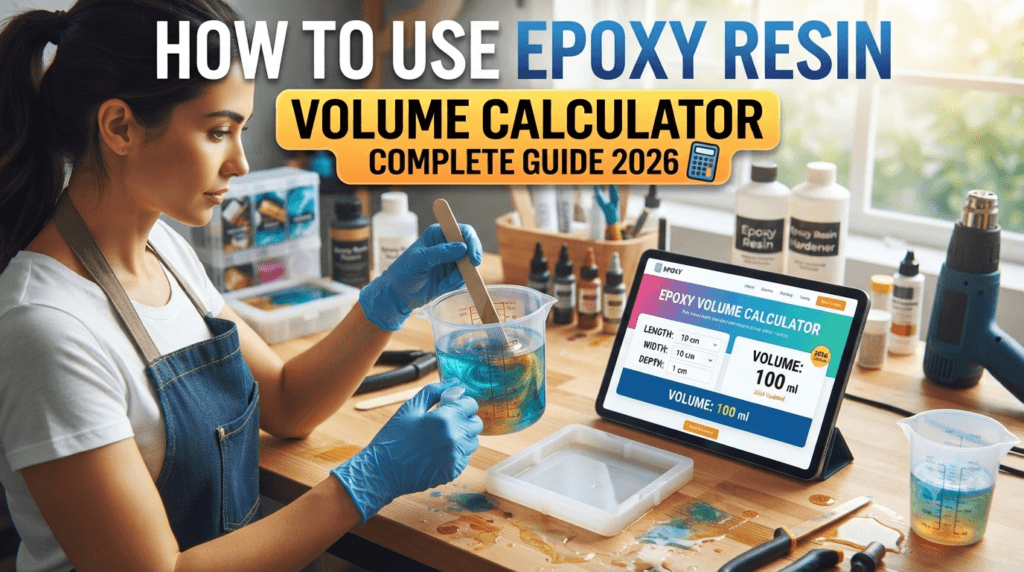
How to Use Epoxy Resin Volume Calculator: Complete Guide 2026
Stop pouring money down the drain. Learn how to calculate the exact volume of epoxy resin and hardener needed for river tables, coatings, and art pieces with zero guesswork.
To use an Epoxy Resin Volume Calculator, measure the length, width, and depth of your project area in inches. Input these dimensions into the calculator, select your epoxy’s mix ratio (1:1 or 2:1 by volume), and click calculate. The tool determines the total cubic inches of the space, converts it to US fluid ounces or gallons, and splits the total into the exact amounts of Part A (Resin) and Part B (Hardener) you need to mix. This prevents wasted material and dangerous exothermic reactions. Use the Toolriz Calculator here.
- The High Cost of Guessing in 2026
- What is an Epoxy Resin Volume Calculator?
- The Math: Cubic Inches to Fluid Ounces
- Step-by-Step: How to Use the Tool
- Decoding Mix Ratios: 1:1 vs. 2:1 vs. 4:1
- Coating Epoxy vs. Deep Pour Epoxy
- Avoiding the Exothermic Reaction
- Calculating for Different Project Types
- How to Calculate Irregular Shapes
- Top 5 Epoxy Measuring Mistakes
- Frequently Asked Questions
The High Cost of Guessing in 2026
Epoxy resin has revolutionized woodworking, art, and home renovation. From stunning river tables that mimic flowing water to high-gloss bar tops and encapsulated keepsakes, epoxy is the magic ingredient. But this magic comes at a steep price. In 2026, premium deep-pour epoxy can cost upwards of $100 to $200 per gallon. When you are working on a large project, a simple miscalculation in volume can cost you hundreds of dollars.
The most common question beginners and even experienced makers ask is: “How much epoxy do I need?” Unfortunately, the answer is rarely intuitive. Because epoxy is sold by volume (fluid ounces or gallons) but projects are measured in linear dimensions (inches), there is a mathematical translation required. Guessing this math leads to two disastrous outcomes.
First, you mix too little. You pour your river table channel, and halfway through, you run out. Now you have to emergency-mix another batch, risking a visible cold joint line where the two pours meet, or worse, a delamination failure. Second, you mix too much. You have a half-gallon of expensive, mixed epoxy left over that begins to cure and exotherm (heat up) in the cup, potentially melting the plastic or causing a fire hazard, all while wasting $50.
This is why mastering the Toolriz Epoxy Resin Volume Calculator is the single most important step before opening a single bucket of resin. It transforms a guessing game into an exact science.
Epoxy is unforgiving. Once Part A and Part B meet, the chemical reaction begins. You cannot “add a little more later” if you run out. Precise volume calculation is not just about saving money; it is about ensuring the structural integrity of your final piece.
What is an Epoxy Resin Volume Calculator?
An Epoxy Resin Volume Calculator is a specialized digital tool designed for fabricators, woodworkers, and artists. It calculates the exact volume of liquid required to fill a specific three-dimensional space. Unlike a standard liquid volume calculator, an epoxy calculator goes two steps further: it accounts for the specific mix ratio of your resin system, and it understands the critical 1.805 conversion factor used in US measurements.
The tool requires three basic inputs to function:
- Length: The longest dimension of the pour area.
- Width: The dimension perpendicular to the length.
- Depth: How thick the pour will be.
Once these are entered, the calculator outputs the total volume required (in ounces or gallons) and breaks that total down into the exact measurements for Part A (Resin) and Part B (Hardener) based on whether your system requires a 1:1, 2:1, or 4:1 mix ratio.
The Math: Cubic Inches to Fluid Ounces
To trust the calculator, it helps to understand the math happening behind the scenes. In the USA, epoxy is sold in fluid ounces and gallons. However, we measure our projects in inches. We must convert cubic inches into fluid ounces.
Where does 1.805 come from? One US gallon contains 231 cubic inches. One gallon also contains 128 fluid ounces. If we divide 231 by 128, we get 1.805. Therefore, it takes 1.805 cubic inches of space to hold exactly 1 fluid ounce of liquid epoxy.
Example: You have a silicone mold that is 10 inches long, 5 inches wide, and 1 inch deep.
10 × 5 × 1 = 50 cubic inches.
50 ÷ 1.805 = 27.7 fluid ounces of total mixed epoxy needed.
Doing this math by hand for a 6-foot river table is tedious and prone to errors. The Toolriz calculator handles this instantly, even for fractional dimensions.
Step-by-Step: How to Use the Toolriz Calculator
Using the tool is simple, but accuracy in your measurements is key. Follow these steps for a flawless pour.
Measure the Pour Area
Use a tape measure to find the exact length and width of your mold or surface in inches. For round molds, measure the diameter.
Determine the Pour Depth
Decide how thick you are pouring. For a coating, this might be 1/8 inch (0.125). For a river table, it might be 1.5 inches. Enter this as a decimal.
Input Data into Toolriz
Enter your Length, Width, and Depth into the corresponding fields on the calculator page. Ensure your units are set to inches.
Select Mix Ratio
Check the technical data sheet (TDS) for your specific epoxy kit. Select 1:1, 2:1, or 4:1 by volume in the calculator dropdown.
Calculate Total Volume
Click calculate. The tool outputs the total fluid ounces (and gallons) of mixed epoxy required to fill your space.
Review Part A & B Split
Look at the breakdown. If you need 30 oz total with a 2:1 ratio, the tool will tell you to pour 20 oz of Part A and 10 oz of Part B.
Add a 5% Safety Buffer
Manually add 5% to the final numbers to account for resin left clinging to the mixing cups and sticks. It is better to have a tiny bit extra than not enough.
Decoding Mix Ratios: 1:1 vs. 2:1 vs. 4:1
One of the most confusing aspects of epoxy for beginners is the mix ratio. Why are there different ratios, and what do they mean? The calculator handles the math, but you must select the correct ratio for your specific product.
1:1 Ratio (By Volume)
This is the most common ratio for coating epoxies (tabletops, bar tops, art resin). It means you need exactly equal parts of Resin (Part A) and Hardener (Part B). If the calculator says you need 20 oz total, you mix 10 oz of A and 10 oz of B. These systems are user-friendly but are usually limited to pours of 1/4 inch or less.
2:1 Ratio (By Volume)
Many deep pour epoxies use a 2:1 ratio. This means you need twice as much Resin (Part A) as Hardener (Part B). If the calculator says you need 30 oz total, you mix 20 oz of A and 10 oz of B. Deep pour epoxies use less hardener to slow down the chemical reaction, allowing thicker pours without overheating.
4:1 Ratio (By Volume)
Some industrial or ultra-deep marine epoxies use a 4:1 ratio. This requires extreme precision. If you are off by a fraction, the epoxy will never fully cure. The calculator is essential here; for 50 oz total, it will precisely dictate 40 oz of A and 10 oz of B.
The Toolriz Epoxy Calculator calculates ratios by volume. Do not use a kitchen scale to measure by weight unless the manufacturer explicitly states the weight ratio (Part A and Part B have different densities). 1 cup of Part A does not weigh the same as 1 cup of Part B. Always use graduated mixing cups for volume ratios.
Coating Epoxy vs. Deep Pour Epoxy
Using the calculator correctly requires knowing which type of epoxy you are using. They are formulated completely differently.
| Feature | Coating Epoxy (Tabletop) | Deep Pour Epoxy |
|---|---|---|
| Max Pour Depth | 1/8 inch to 1/4 inch | 1/2 inch to 2+ inches |
| Viscosity | Thick (self-leveling) | Thin (like water) |
| Cure Time | Fast (12-24 hours) | Slow (3 to 7 days) |
| Bubble Release | Requires torching | Bubbles rise naturally |
| Calculator Use | Calculate total volume for the surface area. | Calculate volume for the full mold cavity. |
If you try to use coating epoxy for a 1-inch thick river table pour because it is cheaper, the calculator will give you the right volume, but the epoxy will exotherm, turn yellow, crack, and potentially boil. Always match the epoxy type to the depth calculated.
Avoiding the Exothermic Reaction
An exothermic reaction is the chemical heat generated when Part A and Part B mix. In small amounts (like a 4 oz art cup), it is harmless. But when you mix too much coating epoxy, or pour it too deep, the heat cannot escape. The center of the pour gets hotter and hotter.
This is where the calculator saves you. By telling you exactly how much to mix for your specific depth, it prevents you from mixing a massive batch of fast-curing epoxy that will “kick” in your cup. If your calculator result shows you need 60 oz for your project, and you are using a fast 1:1 epoxy, the calculator implicitly warns you that mixing 60 oz of fast epoxy at once might exotherm. You might need to split that into two 30 oz pours. For more safety tips on handling exothermic materials, check out our fabrication safety articles in the Toolriz DIY blog.
Calculating for Different Project Types
The way you use the calculator changes slightly based on the project. Here is how to handle the big three.
1. The River Table
A river table features a live edge wood slab with a gap (the “river”) filled with epoxy. Do not calculate the entire table dimensions. You must measure only the empty river channel. Because live edges are wavy, measure the width at three points (top, middle, bottom), add them up, and divide by 3 to get the average width. Input this average width, the length of the slab, and the slab thickness as the depth. This gives you the exact volume of the river.
2. Bar Top / Tabletop Coating
For a flood coat (the final thick glossy layer), the standard depth is 1/8 inch (0.125). Input the length and width of the table, and set depth to 0.125. The calculator tells you how much to mix. Note: You usually need two or three 1/8 inch flood coats, so multiply the calculator’s result by 2 or 3 for your total material purchase.
3. Silicone Molds (Art & Jewelry)
For small silicone molds, measure the interior dimensions of one mold in inches. Calculate the volume for one, then multiply by the number of molds you are filling. Because these are small volumes, the calculator will output in fluid ounces, which you can easily convert to tablespoons or milliliters.
Before doing a deep pour in a porous wood mold, you must apply a “seal coat” of epoxy to lock in the wood pores and prevent air bubbles from escaping into the deep pour. A seal coat is usually brushed on thin. Estimate an extra 10% of total volume just for sealing the wood before your main pour.
How to Calculate Irregular Shapes
What if you are pouring epoxy into a sphere mold, or a complex geometric prism? The calculator defaults to rectangular volumes (L × W × D). For irregular shapes, you must use the water displacement method.
- Fill your mold with water to the exact fill line you desire.
- Pour that water into a measuring cup.
- Note the fluid ounces of water. (e.g., 16 oz).
- Input those fluid ounces directly into the Toolriz calculator as your required total volume.
- Select your mix ratio, and the tool will split the 16 oz into the correct Part A and Part B amounts.
This is the most foolproof way to calculate volume for 3D casting without doing complex calculus for sphere volumes.
Top 5 Epoxy Measuring Mistakes
- Measuring by Weight instead of Volume: Unless the TDS explicitly gives a weight ratio, always use graduated cups. The Toolriz calculator is volume-based.
- Ignoring the 5% Buffer: Resin sticks to the sides of the cup. If you need exactly 32 oz, mix 34 oz to ensure you actually have 32 oz of usable liquid.
- Using “Inches” and “Feet” interchangeably: If your table is 4 feet long, do not enter “4” into the length box. You must enter “48” (inches). The math relies entirely on cubic inches.
- Guessing the Depth: “About a quarter inch” is not good enough. 0.20 inches vs 0.25 inches is a 20% difference in material cost. Measure with calipers or a ruler.
- Forgetting the Seal Coat: If you calculate 1 gallon for your river table, but forget that the wood will soak up a seal coat, you will be short on pour day. Always calculate the seal coat separately.
🔑 Key Takeaways
- An Epoxy Resin Volume Calculator translates project dimensions (inches) into liquid volume (ounces/gallons) using the 1.805 conversion factor.
- Always measure your project in inches (Length × Width × Depth) for accurate cubic inch calculation.
- Know your mix ratio (1:1, 2:1, 4:1) before using the tool, as it splits the total volume into Part A and Part B accordingly.
- Never mix more fast-curing (coating) epoxy than the calculator recommends for your depth, to avoid dangerous exothermic reactions.
- For irregular shapes, use the water displacement method to find your fluid ounce volume, then input that directly into the calculator.
- Always add a 5% safety buffer to your final calculation to account for material left in mixing containers.
Calculate Your Next Epoxy Pour
Don’t risk a failed pour or wasted money. Use our free, precise Epoxy Resin Volume Calculator to get exact Part A and Part B measurements instantly.
Frequently Asked Questions
To calculate how much epoxy resin you need, measure the length, width, and desired depth of your mold or surface in inches. Multiply these dimensions to get the volume in cubic inches, then divide by 1.805 to convert to US fluid ounces. An Epoxy Resin Volume Calculator automates this math instantly and factors in your specific mix ratio.
For a river table, you must calculate the volume of the empty “river” channel. Measure the length of the channel, its average width, and the depth of the slab. Because deep pours require specific deep-pour epoxy, using a calculator ensures you buy enough kits at once, as color matching between separate batches can be difficult.
The 1.805 rule is the conversion factor used to turn cubic inches of volume into US fluid ounces of epoxy. Because 1 US gallon of epoxy equals 231 cubic inches, dividing your total cubic inches by 1.805 gives you the exact fluid ounces required for your project.
Yes. Once the total required volume is calculated, the tool divides it according to your specific epoxy system’s mix ratio (either 1:1 by volume for coating epoxies, or 2:1 by volume for many deep pour systems) to tell you exactly how much Part A (Resin) and Part B (Hardener) to pour.
If you pour standard tabletop epoxy deeper than 1/4 inch, it will trigger an exothermic reaction. The epoxy will heat up rapidly, yellow, bubble excessively, or even crack and warp. Deep pour epoxy must be used for pours over 1/2 inch, calculated precisely to avoid material waste.
Most consumer epoxies are designed to be measured by volume (using graduated cups). Part A and Part B have different densities, so measuring by weight on a scale without the manufacturer’s specific weight ratio will result in an incorrect mix. Always use the volume method unless instructed otherwise.