

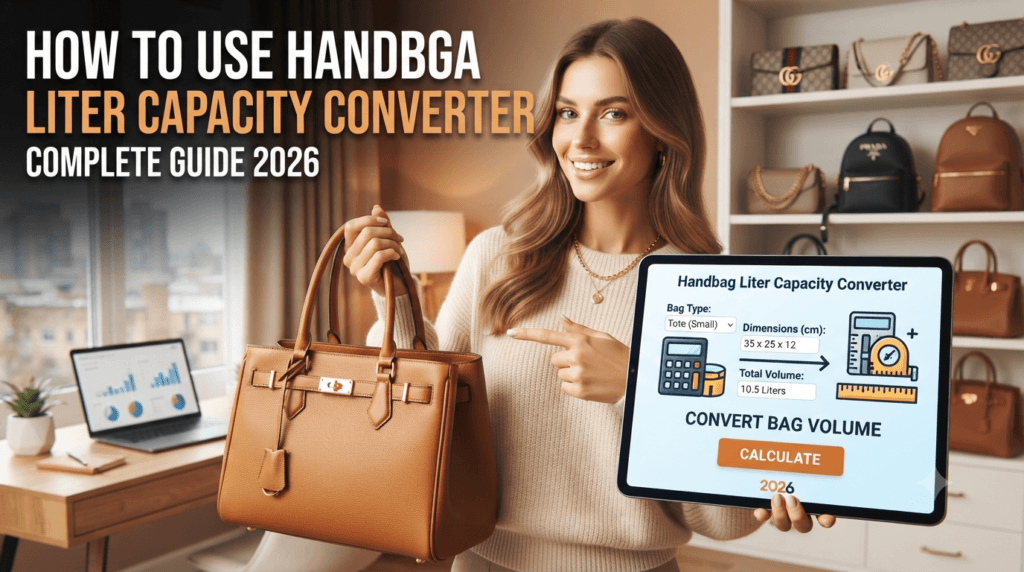
How to Use Handbag Liter Capacity Converter: Complete Guide 2026
Stop guessing if your tote will fit under the airplane seat. Learn how to calculate the exact liter volume of any handbag to beat airline personal item limits in 2026.
To use a Handbag Liter Capacity Converter, measure the interior Length, Width, and Depth of your bag in inches. Input these dimensions into the converter, and it instantly multiplies them to find cubic inches, then divides by 61.02 to output the exact volume in liters. In 2026, this tool is essential for travelers, as most US airlines limit personal items to 33 liters (18″ x 14″ x 8″). Use the Toolriz Converter here.
- The 2026 Travel & Luggage Squeeze
- What is a Handbag Liter Capacity Converter?
- The Math: Cubic Inches to Liters
- Step-by-Step: How to Use the Tool
- The “Shape Factor”: Why Bags Hold Less Than Math Says
- Airline Personal Item Limits for 2026
- Real-World Volume: What Fits in 10L, 20L, or 30L?
- How to Interpret Your Calculator Results
- Using the Converter for Online Shopping
The 2026 Travel & Luggage Squeeze
In 2026, the golden age of carefree air travel is long gone. With airlines like Spirit, Frontier, and even legacy carriers like United and Delta strictly enforcing “Basic Economy” rules, the days of sneaking a slightly oversized tote bag onto a plane are over. Gate agents now carry standardized sizing bins (the dreaded “sizer boxes”), and if your personal item doesn’t fit inside, you are hit with a $65 to $100 gate-check fee.
The rules state your personal item must fit under the seat in front of you, typically sized at 18 x 14 x 8 inches. But fashion and luggage brands rarely sell handbags, totes, or backpacks based on airline dimensions. They sell them based on aesthetic names (“The Weekender,” “The Carry-All Tote”) or, if you are lucky, in metric volumes like liters.
This creates a massive logistical problem for travelers. You find a beautiful leather tote online. The dimensions list 17″ x 13″ x 7″. Is that too big? Will it squeeze into the sizer? And how does that compare to a standard 20-liter travel backpack? Doing this math—multiplying inches, converting to liters, accounting for soft materials—in your head while shopping is nearly impossible.
This is exactly why the Toolriz Handbag Liter Capacity Converter was created. It translates linear dimensions (inches or centimeters) into standard volumetric capacity (liters), allowing you to make apples-to-apples comparisons between bags and airline limits.
Airline limits are a hard box. If your soft tote bag is stuffed to 19 inches, it won’t fit. Calculating your bag’s volume in liters tells you exactly how much “stuff” you can fit inside while remaining under the dimensional limit.
What is a Handbag Liter Capacity Converter?
A Handbag Liter Capacity Converter is a specialized digital tool designed for travel logistics and fashion shopping. Unlike a generic luggage weight scale, this tool is programmed with the geometric formulas required to calculate the volumetric capacity of a three-dimensional object.
The tool requires three basic inputs to function:
- Length: The longest side of the bag’s main compartment.
- Width/Depth: The side-to-side measurement.
- Height: The bottom-to-top measurement.
Once these are entered, the calculator multiplies them to find the cubic volume and converts that number into liters. This allows you to compare a structured boxy handbag to a floppy canvas duffle bag using the same universal metric: volume.
The Math: Cubic Inches to Liters
To trust the calculator, it helps to understand the math running behind the scenes. In the United States, bags are measured in inches. Volume is calculated in cubic inches. But travel capacity is globally recognized in liters.
Where does the 61.02 come from? One liter of volume is exactly equal to 61.0237 cubic inches. Therefore, to convert cubic inches into liters, you must divide the total cubic inches by 61.02.
Example: The standard US airline personal item limit is 18″ x 14″ x 8″.
18 × 14 × 8 = 2,016 cubic inches.
2,016 ÷ 61.02 = 33.03 Liters.
So, the magic number for US air travel in 2026 is 33 liters. If your handbag’s volume is under 33L, it should fit under the seat. Doing this math by hand for every bag you own is tedious. The Toolriz calculator does it instantly.
Step-by-Step: How to Use the Toolriz Converter
Using the tool requires a tape measure and 30 seconds of your time. Follow these steps before your next shopping trip or flight.
Empty the Bag
Remove all items from your handbag. You need to measure the bag’s natural, unstuffed dimensions to get an accurate baseline volume.
Measure Interior Length
Place the tape measure inside the bag at the zipper seam. Measure from the left wall to the right wall at the widest point. Enter this in inches.
Measure Interior Width/Depth
Measure from the front wall of the bag to the back wall. If the bag has a gusset (a folded panel that expands), stretch it out to its maximum intended width.
Measure Interior Height
Measure from the bottom seam of the bag up to the top zipper seam. Do not include the length of the handles or straps.
Input into Converter
Enter the three numbers into the Toolriz calculator. Click the ‘Convert’ button to instantly get the volume in liters.
Compare to 33L Limit
Look at the resulting liter number. If it is under 33L, the bag is a safe personal item. If it is over 33L, it must be checked or packed less full.
Shop with Confidence
When shopping online, input the listed dimensions into the tool before buying. You will know exactly how big the bag is before it arrives.
The “Shape Factor”: Why Bags Hold Less Than Math Says
The Handbag Liter Capacity Converter calculates theoretical geometric volume. It assumes your bag is a perfect rectangular prism (a box). However, very few handbags are perfect boxes. Totes slope at the top, duffles have curved edges, and backpacks have zippers that constrict the opening.
This introduces the concept of the Shape Factor (or Efficiency Ratio). The actual usable volume of a bag is almost always 15% to 25% lower than the mathematical volume. A soft leather tote might measure 20 liters mathematically, but because the sides cave inward when you carry it, it might only practically hold 16 liters of clothes.
Airline Personal Item Limits for 2026
Not all airlines are created equal. While the 33-liter (18x14x8) rule is the standard for US carriers, ultra-low-cost carriers (ULCCs) and European airlines have different, often stricter, limits. If you are traveling internationally, the calculator becomes even more vital.
| Airline | Dimension Limit (Inches) | Theoretical Limit (Liters) | Strictness |
|---|---|---|---|
| Delta / United / American | 18 x 14 x 8 | 33 Liters | Moderate |
| Spirit / Frontier | 18 x 14 x 8 | 33 Liters | Extremely Strict |
| Allegiant | 16 x 15 x 7 | 27.4 Liters | Extremely Strict |
| JetBlue | 17 x 13 x 8 | 28.9 Liters | Moderate |
| Ryanair (Europe) | 15.7 x 9.8 x 7.8 | 19.8 Liters | Extremely Strict |
| easyJet (Europe) | 17.7 x 13.7 x 7.8 | 31.2 Liters | Strict |
If you are flying Ryanair, your handbag must be under 20 liters to guarantee it will be allowed on the plane for free. If you try to bring a 25L tote, you will be forced to pay the gate check fee. The Toolriz converter allows you to check your bag against these international limits instantly. For more tips on navigating budget travel, check out our travel logistics blog.
Real-World Volume: What Fits in 10L, 20L, or 30L?
Math is abstract. To make the calculator useful, you need to know what a 10-liter, 20-liter, or 30-liter bag actually holds in real life.
10 Liters (The Daypack / Large Purse)
A 10L bag is roughly equivalent to a standard reusable grocery tote or a small sling bag. It can hold a 13-inch laptop, a water bottle, a light sweater, and your daily essentials (wallet, keys, phone). This is the perfect size for a city sightseeing bag.
20 Liters (The Everyday Tote / Small Personal Item)
A 20L bag is equivalent to a standard school backpack or a large tote bag. It can hold a 15-inch laptop, a tablet, a change of clothes, toiletries, and a packed lunch. This makes an excellent personal item for a short weekend trip, as it easily fits under the seat.
30 Liters (The Maximum Personal Item / Weekender)
A 30L bag is the absolute maximum you want for a personal item. It is roughly the size of a standard duffle bag or a large travel backpack. You can pack 2 days’ worth of clothes, a pair of shoes, toiletries, and electronics. It will fit under the seat, but it will consume all your legroom.
How to Interpret Your Calculator Results
Once you run your bag’s dimensions through the Toolriz calculator, you will be faced with a number. Here is how to act on the data.
Scenario A: The Bag is Under 28 Liters
Your bag calculated to 25L. This is the sweet spot for a personal item. It is under the 33L US limit, and even if the bag bulges slightly when stuffed, it will likely still fit into the gate sizer. You are safe to pack it full.
Scenario B: The Bag is Between 30 and 33 Liters
Your bag calculated to 32L. This is the danger zone. Mathematically, it fits the 18x14x8 limit. However, if the bag is made of soft material and you overpack it, it will bulge past 18 inches and fail the sizer box test. You must pack carefully, using packing cubes to keep the bag rigid and flat.
Scenario C: The Bag is Over 35 Liters
Your tote calculated to 40L. This bag is officially too large to be a personal item on any major airline. Do not attempt to bring it as a personal item; you will get gate-checked. If you want to use it, you must pay for a carry-on fee, or only pack it half-full and compress it down to fit the sizer.
Airline sizer boxes are unforgiving. If your bag is 18.1 inches long, it will not fit, regardless of its liter volume. Soft bags can be “mushed” to fit, but if your bag has a rigid frame or hard bottom, you must strictly adhere to the dimensional limits.
Using the Converter for Online Shopping
The Toolriz converter isn’t just for travel; it is a powerful shopping tool. When you shop for bags online, brands usually list dimensions in inches, but it is incredibly hard to visualize what “16 x 12 x 6 inches” looks like in real life. Is that a big bag or a small bag?
By running those listed dimensions through the calculator, you get a liter volume. If you know your favorite everyday purse is 12 liters, and the online bag calculates to 18 liters, you immediately know the online bag is 50% larger than what you are used to. This prevents the disappointment of receiving a bag that is drastically smaller (or overwhelmingly larger) than you expected.
If you are using a 30L tote as a personal item, buy 2 medium packing cubes. By pre-packing your clothes into rigid cubes, you force the soft sides of the tote to remain flat and rectangular, maximizing your usable volume while ensuring the bag fits perfectly into the airline sizer box.
🔑 Key Takeaways
- A Handbag Liter Capacity Converter translates linear dimensions (inches) into standard volumetric capacity (liters).
- The formula is (Length × Width × Depth) ÷ 61.02 = Liters.
- The standard US airline personal item limit is 33 liters (18 x 14 x 8 inches).
- The “Shape Factor” means soft, unstructured bags practically hold 15-25% less than their mathematical volume.
- Ultra-low-cost carriers like Ryanair and Allegiant have strict limits below 25 liters; always check your bag before flying.
- Use the converter when shopping online to visualize how big a bag actually is compared to your favorite purse.
Calculate Your Bag’s Volume Now
Don’t risk a gate-check fee. Use our free, instant Handbag Liter Capacity Converter to see if your tote fits airline personal item limits.
Frequently Asked Questions
To calculate the liter capacity of a handbag, measure the interior Length, Width, and Depth in inches. Multiply these three numbers to get cubic inches, then divide by 61.02 to convert to liters. A Handbag Liter Capacity Converter automates this math instantly.
Most US airlines limit personal items to 18 x 14 x 8 inches. This equals 2,016 cubic inches, which is approximately 33 liters. However, because bags are not perfectly rectangular, the actual usable capacity is usually around 25 to 28 liters.
Yes, a 20-liter handbag is considered a large everyday tote. It is large enough to hold a 15-inch laptop, a water bottle, a makeup bag, and daily essentials. For travel, a 20L bag makes an excellent personal item.
Fashion brands often prioritize aesthetics and style over technical logistics, listing only linear dimensions. However, travel and outdoor brands usually list liters because it is a more accurate representation of how much the bag can actually hold.
The calculator provides the mathematical volume based on your inputted dimensions. For soft materials like leather or nylon, you can slightly over-measure the bag when stuffed to get a realistic ‘expanded’ liter capacity.
No, a 40L duffle bag is too large to be considered a personal item on any major airline. It will likely need to be checked or paid for as a carry-on. Personal items must generally be under 33 liters.