

How to Use Handmade Bag Pricing Calculator: Complete Guide 2026
Stop paying your customers to take your bags. Learn the exact math behind handmade bag pricing to value your labor, cover hidden overhead, and build a profitable craft business in 2026.
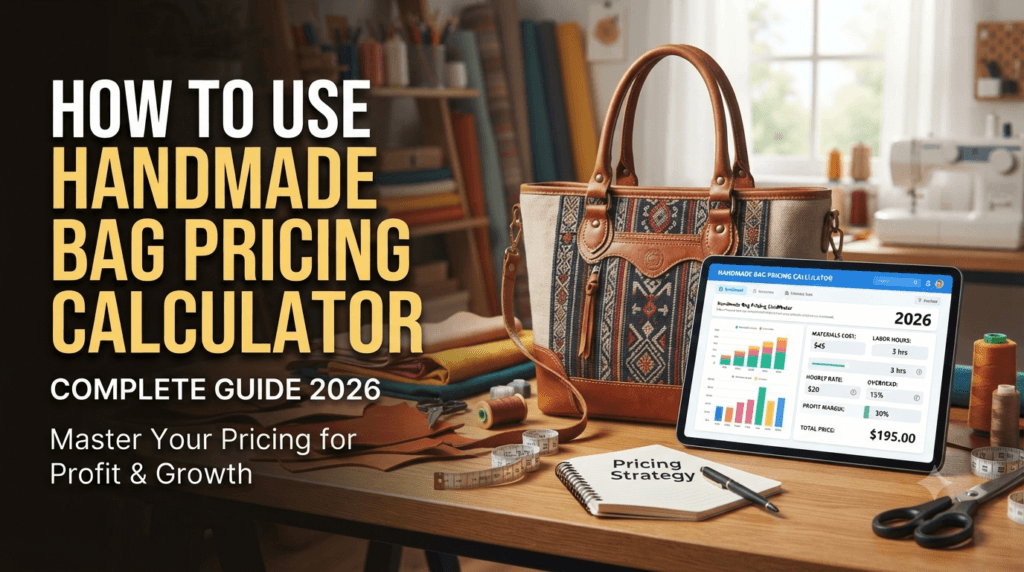
To use a Handmade Bag Pricing Calculator, input your total material costs (leather/fabric, hardware, thread), the time spent crafting in minutes, your desired hourly wage, and an overhead percentage. The calculator adds these to find your base cost, then applies a retail multiplier (usually 2.0x to 2.5x) to output a profitable retail price. In 2026, this tool is essential to ensure you aren’t underpricing your custom bags and losing money to hidden fees. Use the Toolriz Calculator here.
- The 2026 Handmade Bag Economy
- What is a Handmade Bag Pricing Calculator?
- The Craft Profit Formula Explained
- Step-by-Step: How to Use the Tool
- Decoding Material Costs: Hides, Hardware, and Scrap
- Valuing Your Labor: Time is Money
- The Hidden Overhead You Are Ignoring
- Wholesale vs. Retail Multipliers
- Real-World Example: Pricing a Leather Tote
- Top 5 Pricing Mistakes Bag Makers Make
- Frequently Asked Questions
The 2026 Handmade Bag Economy
The maker economy is thriving in 2026. Platforms like Etsy, Shopify, and Instagram have made it easier than ever to sell handmade goods. However, the market is also saturated. To stand out, bag makers—whether crafting full-grain leather totes, canvas messenger bags, or quilted crossbody bags—must balance artistic integrity with hard business math.
The number one reason handmade bag businesses fail is underpricing. Crafters often look at mass-produced bags on Amazon, get intimidated, and price their custom, hand-stitched goods just slightly higher. They fail to realize that a factory in China produces a bag for $3 in labor, while an American maker spends 3 hours crafting it.
If you price a $80 leather bag that cost you $40 in materials and took 3 hours to make, you are effectively earning $13 an hour—and that is before paying for electricity, sewing machine maintenance, or Etsy fees. You are running a charity, not a business.
This is why a Handmade Bag Pricing Calculator is the most critical tool in your workshop. It removes the emotion and guesswork from pricing, replacing it with a mathematical formula that ensures every rivet, stitch, and hour of labor is accounted for.
You cannot compete with mass production on price; you compete on quality and customization. Your pricing must reflect the true cost of sustainable, small-batch craftsmanship. A calculator proves your prices are fair.
What is a Handmade Bag Pricing Calculator?
A Handmade Bag Pricing Calculator is a specialized financial tool designed for leatherworkers, sewists, and craft entrepreneurs. Unlike a generic retail margin calculator, this tool understands the specific variables of bag making—namely, the high cost of raw materials (leather hides, Waxed canvas, solid brass hardware), the intensive labor (cutting, skiving, sewing, edge painting), and the overhead of running a craft studio.
The tool requires four key inputs to function:
- Material Costs: The cost of all physical components used in the bag.
- Labor Time & Wage: The hours spent making the bag and your target hourly rate.
- Overhead Percentage: An allocated cost for tools, studio space, and software.
- Profit Margin/Multiplier: The markup applied to ensure business growth.
Once entered, the calculator outputs your baseline cost and a suggested retail price that guarantees profitability.
The Craft Profit Formula Explained
To trust the calculator, you must understand the formula running behind the scenes. The standard pricing formula for handmade goods in 2026 is:
Let’s break this down:
- Materials: If you use 4 square feet of leather at $12/sq ft, that is $48. Add $6 for hardware and $1 for thread. Total materials = $55.
- Labor: If the bag takes 2.5 hours to make, and you pay yourself $20/hour, your labor cost is $50.
- Overhead: A standard 10% allocation of materials+labor ($105) is $10.50.
- Base Cost: $55 + $50 + $10.50 = $115.50.
- Multiplier (2.0x): $115.50 × 2.0 = $231.00 Retail Price.
If you were selling that bag for $120, you were losing money. The Toolriz calculator does this math instantly, preventing costly errors.
Step-by-Step: How to Use the Toolriz Converter
Using the tool requires tracking your process for one complete bag. Follow these steps for accurate pricing.
Track Material Costs
Keep a spreadsheet of your material purchases. Calculate the cost per unit (e.g., cost per square foot of leather, cost per rivet) to determine exact material cost per bag.
Time the Process
Use a stopwatch. Track cutting time, sewing time, edge painting time, and assembly time. Be honest; include time spent fixing mistakes.
Set Your Hourly Wage
Input a fair living wage for your area. In 2026, $18-$25/hour is standard for skilled craft labor. Do not set this to $0.
Input Overhead
Estimate your monthly business costs (tools, electricity, Etsy fees) and divide by the number of bags you make. Enter this as a percentage or flat fee.
Set Retail Multiplier
For retail sales direct to consumer, a 2.0 to 2.5 multiplier is standard. This gives you a 50% to 60% profit margin.
Calculate Price
Click calculate. The tool outputs your base cost and your suggested retail price. This is the minimum you should charge.
Market Check
If the calculated price is way above market rates, find ways to lower material costs (buying wholesale) or increase sewing efficiency—do not just slash your wage.
Decoding Material Costs: Hides, Hardware, and Scrap
The biggest trap in bag making is miscalculating material costs. A full side of leather might cost $150, but how much does one bag cost? You must calculate the usable yield.
If a leather hide has scars or brands, you cannot use that area. If you buy 20 square feet of hide but only 15 square feet is usable for bags, your effective cost per square foot is higher. You must divide the total hide cost by the *usable* square feet, not the total.
Furthermore, do not forget the small items. A zipper might cost $2.50. A magnetic snap is $0.75. Edge paint is $0.50 per bag. Thread is $0.20. These “micro-costs” add up. If you ignore them, you are literally paying for your customer’s hardware. The Toolriz calculator allows you to input a comprehensive material total to capture all these variables.
Valuing Your Labor: Time is Money
If you spend 4 hours meticulously hand-saddle-stitching a leather clutch, you must be paid for that artistry. Many crafters value their labor at $0 because they “enjoy it.” This mindset bankrupts businesses.
In 2026, a fair crafting wage is between $18 and $25 per hour, depending on your skill level and the complexity of the work. When using the calculator, input your time in minutes. If a bag takes 2 hours and 15 minutes, enter 135 minutes. The calculator converts this to hours and multiplies it by your wage.
Batching to Lower Labor Costs
If you make 5 bags in a row, your cutting and prep time per item drops significantly due to muscle memory. Use the calculator to price “batch production” by timing a batch of 5 and dividing the total time by 5. This allows you to offer a slightly lower price for items you produce in bulk while maintaining your hourly wage.
The Hidden Overhead You Are Ignoring
Overhead is the silent profit killer. These are the costs of running your business that aren’t directly tied to one specific bag. If you don’t factor overhead into your pricing, you will eventually have to pay for a new industrial sewing machine out of your own pocket.
What Counts as Overhead?
- Machine Depreciation: Your Cowboy 441 or Juki LU-563 will eventually wear out. You should be saving a few dollars from every bag to buy the next one.
- Consumables: Cutting mats, rotary blades, skiving knives, needles, and edge bevellers.
- Utilities: The electricity to run your machines and light your studio.
- Platform Fees: Etsy charges $0.20 per listing, 6.5% transaction fee, and 3% + $0.25 payment processing fee. If you sell a $200 bag, Etsy takes roughly $32. That is overhead.
As the chart shows, if you price a $200 bag without using a calculator, you might only walk away with $52 in actual profit—far less than the $200 you thought you made. For more on scaling your craft business, check out our craft business blog.
Wholesale vs. Retail Multipliers
If a boutique wants to stock your bags, they will ask for wholesale pricing. Boutiques typically need to mark up your bag by 2.0x to 2.5x to cover their own rent and staff. If your retail price is only 1.5x your base cost, you cannot offer wholesale without losing money.
The Toolriz pricing calculator helps you set a retail price of 2.5x to 3.0x your base cost. This ensures that if you sell wholesale (at 1.5x to 2.0x base cost), both you and the boutique make a healthy profit.
Real-World Example: Pricing a Leather Tote
Let’s walk through a complete calculation for a standard Full-Grain Leather Tote Bag.
- Materials: 5 sq ft leather ($60), Hardware ($12), Thread ($2). Total = $74.
- Labor: 3 hours at $22/hour. Total = $66.
- Overhead: 10% of $140 = $14.
- Base Cost: $74 + $66 + $14 = $154.
Using the calculator with a 2.2x retail multiplier: $154 × 2.2 = $338.80.
If you were previously selling this tote for $180, you were actually losing $26 on every sale when factoring in fees and overhead. The calculator proves that your true price must be over $300 to sustain your business.
Top 5 Pricing Mistakes Bag Makers Make
- Pricing Based on Competitors: Your competitor might be using cheaper imported leather or not paying themselves a wage. Price based on your math.
- Forgetting the “Waste” Factor: When cutting patterns from a leather hide, you always have scrap. You pay for the scrap, so you must calculate material costs based on the whole hide yield.
- Not Paying for Pattern Design: If you spent 10 hours designing a new tote pattern, that time must be amortized into the first 20 bags you sell. Add a “design fee” to the first batch.
- Using Hobby Pricing on Professional Platforms: If you sell on Etsy, you are competing in a professional marketplace. You must charge professional prices that include Etsy’s 16%+ total fee structure.
- Fear of High Prices: Customers perceive value through price. A $300 handmade leather bag is seen as an investment. A $90 identical bag is seen as cheap. Do not be afraid of the calculator’s math.
🔑 Key Takeaways
- A Handmade Bag Pricing Calculator removes emotion from pricing and replaces it with mathematical accuracy.
- Always calculate your base cost (Materials + Labor + Overhead) before setting a retail price.
- In 2026, skilled craft labor should be priced between $18 and $25 per hour.
- Platform fees (Etsy, PayPal) must be calculated into your overhead to ensure true profitability.
- Set your retail multiplier to at least 2.0x to 2.5x your base cost to allow for future wholesale opportunities.
- If the calculator’s suggested price is higher than you expected, do not lower your price—find ways to lower material costs or increase efficiency.
Price Your Next Bag for Profit
Stop guessing and start earning. Use our free, precise Handmade Bag Pricing Calculator to ensure every custom leather, canvas, or fabric bag you sell makes you money.
Frequently Asked Questions
To price a handmade bag, calculate the exact cost of materials (leather, fabric, hardware), add your labor time multiplied by an hourly wage, factor in overhead costs (tools, electricity, platform fees), and then multiply the total base cost by a profit margin (typically 2.0 to 2.5 for retail). A Handmade Bag Pricing Calculator automates this math.
A healthy profit margin for handmade bags is typically 50% to 60%. This means you multiply your total cost (materials + labor + overhead) by 2.0 to 2.5 to get your retail price. This leaves enough room to offer wholesale pricing to boutiques if needed.
In 2026, skilled craft labor for handmade bags should be priced between $18 and $25 per hour. You must track the exact minutes spent cutting, sewing, edge-painting, and assembling. Do not guess your time; use a timer for accurate labor costs.
Yes, by inputting an overhead percentage, you can account for platform fees. Etsy typically charges 6.5% transaction fee plus 3% and $0.25 for payment processing. You should build this 10%+ overhead into your base cost before applying your retail multiplier.
Yes, it can be highly profitable if priced correctly. Many makers fail because they underprice to compete with mass production. By tracking exact material costs and valuing labor properly using a pricing calculator, you can build a sustainable, profitable craft business.
Divide the total cost of the leather hide by the usable square feet to get your cost per square foot. Multiply this by the square footage required for your bag pattern. Always account for scrap by calculating cost based on the whole hide, not just the usable portion.