

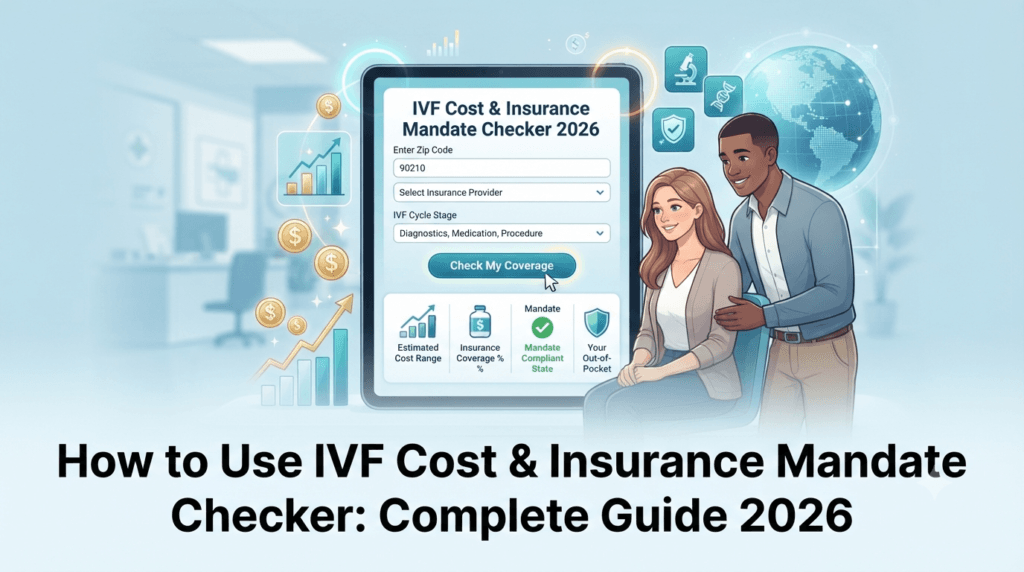
How to Use IVF Cost & Insurance Mandate Checker: Complete Guide 2026
Decoding the financial maze of fertility treatment. Learn exactly how to estimate your out-of-pocket IVF costs, navigate state insurance mandates, and take control of your family-building journey in the USA.
To use an IVF Cost & Insurance Mandate Checker, you need to input your US state of residence/employment, your employer’s plan type (Fully Insured vs. Self-Funded/ERISA), and your clinic’s estimated base fees for an IVF cycle. The tool cross-references your state’s 2026 fertility mandate laws with your plan type to estimate whether your insurance must cover the procedure, providing a realistic out-of-pocket cost estimate ranging from $0 (with comprehensive mandate coverage) to $20,000+ (without coverage). Use the Toolriz Checker here.
- The Financial Reality of IVF in 2026
- What is the IVF Cost & Insurance Mandate Checker?
- Step-by-Step: How to Use the Tool
- Understanding US State IVF Insurance Mandates
- The ERISA Loophole: Why Your Mandate Might Not Apply
- The True Cost Breakdown of an IVF Cycle
- How to Interpret Your Calculator Results
- 7 Strategies to Maximize IVF Insurance Coverage
- Financial Strategies for Uncovered IVF
- IVF Legislation & Tech Trends in 2026
- Frequently Asked Questions
The Financial Reality of IVF in 2026
The journey to parenthood is deeply personal, often emotional, and—when infertility becomes a factor—profoundly expensive. In the United States, the financial burden of In Vitro Fertilization (IVF) is one of the most significant barriers to family building. As we navigate 2026, the landscape of reproductive healthcare financing remains a complex patchwork of state laws, federal regulations, and employer-specific insurance benefits.
For millions of Americans, the clinical aspects of IVF are only half the battle. The other half is a grueling financial puzzle. A single cycle of IVF can cost anywhere from $15,000 to $20,000 when accounting for medications, facility fees, and laboratory work. For many households, this cost requires dipping into savings, taking out loans, or even remortgaging homes. The stress of financial uncertainty can negatively impact the emotional well-being of patients already navigating the hormonal and psychological toll of fertility treatments.
However, the system is not entirely without support. Over the past decade, a growing number of US states have passed IVF insurance mandates—laws requiring health insurance companies to cover fertility treatments. Furthermore, many forward-thinking employers are beginning to offer fertility benefits as part of their talent retention strategies. The challenge for the patient? Navigating this labyrinth. You need to know if your state has a mandate, if your specific employer’s plan is legally bound by that mandate, and how much you will ultimately owe in deductibles and copays.
This is where an IVF Cost & Insurance Mandate Checker becomes an essential tool. It bridges the gap between confusing legal jargon and clear financial planning. In this comprehensive guide, we will walk you through exactly how to use the Toolriz IVF Cost & Insurance Mandate Checker, demystify the legal loopholes that might deny you coverage, and provide actionable strategies to minimize your out-of-pocket expenses in 2026.
Medical billing is notoriously opaque. Fertility billing is even worse. Patients are frequently blindsided by hidden fees for anesthesia, embryo freezing, or genetic testing. By learning to use a mandate checker and cost estimator, you arm yourself with the knowledge needed to advocate for your benefits and avoid financial shock.
What is the IVF Cost & Insurance Mandate Checker?
The IVF Cost & Insurance Mandate Checker is a specialized digital tool designed to help prospective parents estimate their financial responsibility for fertility treatments. Unlike a generic medical cost calculator, this tool specifically focuses on the intersection of state legislation and health insurance plan structures.
In simple terms, the tool does three things:
- Verifies State Mandates: It checks whether the state where your insurance plan is issued has a law requiring IVF coverage.
- Evaluates Plan Applicability: It determines whether your specific type of insurance plan (fully insured vs. self-funded) is legally required to comply with that state mandate.
- Calculates Out-of-Pocket Estimates: Based on typical deductibles, copays, and coinsurance structures, it estimates what you will actually pay out of pocket for a cycle.
The Toolriz checker was built to simplify a process that usually requires hours of hold time with insurance representatives and frantic Googling of state legal codes. It provides an instant, data-driven snapshot of your fertility financial landscape.
Step-by-Step: How to Use the Toolriz Checker
Using the Toolriz IVF Cost & Insurance Mandate Checker is straightforward, but gathering the right information beforehand will ensure your estimate is as accurate as possible. Follow these detailed steps.
Gather Your Insurance Card
Locate your health insurance card. You will need to know the name of your insurance carrier and the customer service number, as well as the state where the policy was issued (usually found on the back of the card or in your employer’s HR portal).
Determine Plan Type (Crucial)
You must find out if your employer offers a Fully Insured plan or a Self-Funded (ERISA) plan. You can usually find this by logging into your HR portal (like Workday or ADP) or calling the number on your card and asking, “Is my plan self-funded or fully insured?”
Get Clinic Pricing
Ask your fertility clinic for their “base IVF cycle cost” (usually $12k-$15k) and an estimate for medications ($3k-$5k). Also, ask about add-ons like ICSI ($1.5k) or PGT-A genetic testing ($3k).
Input Data into the Checker
Go to the Toolriz IVF Checker page. Input your state, select your plan type, and enter the clinic costs you gathered. Be as accurate as possible with the financial figures.
Review the Mandate Status
The tool will immediately tell you if your state has an IVF mandate and if your plan type is bound by it. If you have a self-funded plan in a mandate state, the tool will note that coverage is not legally required but may be offered voluntarily.
Analyze Your Cost Estimate
The calculator will output an estimated out-of-pocket range. If you are covered by a mandate, this might be your deductible amount ($0-$3,000). If uncovered, it will reflect the total cost ($15,000-$25,000).
Print and Verify
Take a screenshot or print the results. Use this estimate as a baseline when you call your insurance company to verify your exact benefits before beginning treatment.
The Toolriz IVF Cost & Insurance Mandate Checker provides an estimate based on state laws and average clinic costs. It is not a guarantee of coverage. You must always verify benefits directly with your insurance carrier by calling the number on your insurance card and asking for your “Infertility Benefits Summary.”
Understanding US State IVF Insurance Mandates
In the United States, health insurance is regulated at both the federal and state levels. While federal laws set baseline protections, individual states have the power to dictate what procedures health insurance companies must cover. These are called mandates.
As of 2026, approximately 20 states have passed laws requiring insurers to cover some level of infertility treatment, though the specifics vary wildly. Some states mandate comprehensive IVF coverage, while others only mandate diagnostics (blood tests and ultrasounds) or less invasive treatments like Intrauterine Insemination (IUI).
States with Comprehensive IVF Mandates
States like Massachusetts, Illinois, New Jersey, Connecticut, Rhode Island, New York, Maryland, Delaware, New Hampshire, Colorado, and California (for large group employers only) have robust mandates. In these states, if you have a qualifying insurance plan, IVF is treated much like any other medical procedure—you pay your deductible and coinsurance, and insurance covers the rest.
The “Try for X Months” Rule
Many state mandates do not grant immediate access to IVF. They often require patients to demonstrate medical infertility. Traditionally, this meant trying to conceive naturally for 12 months (or 6 months if the female partner is over 35). In 2026, several progressive states have updated these definitions to be more inclusive of LGBTQ+ couples and single parents by choice, removing the “try naturally” requirement and replacing it with a clinical definition of infertility.
Lifetime Maximums
Even in mandate states, insurance companies often impose a lifetime maximum benefit. For example, a state law might mandate coverage but cap it at $100,000 per lifetime. Because IVF cycles can cost $20,000 each, this means insurance would only cover roughly 4 to 5 cycles before you are responsible for 100% of the costs. The Toolriz checker factors these common limits into its estimations.
The ERISA Loophole: Why Your Mandate Might Not Apply
This is the single most frustrating aspect of US fertility insurance. You could live in a state with a perfect, comprehensive IVF mandate, and still be denied coverage. Why? Because of a federal law called ERISA (Employee Retirement Income Security Act of 1974).
ERISA governs employee benefit plans. Under ERISA, if an employer self-funds its health insurance plan, the plan is exempt from state-level insurance mandates. State mandates only apply to fully insured plans.
Fully Insured vs. Self-Funded Plans
- Fully Insured Plans: The employer pays a premium to an insurance company (like Blue Cross, Aetna, or UnitedHealthcare), and the insurance company assumes the financial risk of paying claims. These plans MUST follow state mandates.
- Self-Funded (Self-Insured) Plans: The employer itself pays the medical claims out of its own pocket, often hiring an insurance company merely to process the paperwork (Administrative Services Only). These plans are exempt from state mandates.
Approximately 65% of US workers who receive health insurance through their employer are enrolled in self-funded plans. This is why checking your state’s mandate is only half the battle. The IVF Cost & Insurance Mandate Checker explicitly asks for your plan type to account for the ERISA loophole.
If you discover your employer is self-funded and therefore exempt from the state IVF mandate, do not lose hope. Many large corporations offer fertility benefits voluntarily to stay competitive. Check with your HR department about specific fertility benefits, or look into supplemental fertility benefits programs like Carrot Fertility or Progyny, which employers can add to self-funded plans.
The True Cost Breakdown of an IVF Cycle
To accurately use a cost checker, you need to understand what goes into the price of IVF. The $15,000 to $20,000 figure is not a single bill; it is an amalgamation of several distinct services. Here is the ultra-detailed breakdown of IVF costs in the USA for 2026.
| Service / Procedure | Average Cost Range (USD) | What It Includes |
|---|---|---|
| Baseline & Monitoring | $1,500 – $3,000 | Initial consult, baseline bloodwork, and frequent transvaginal ultrasounds during the stimulation phase. |
| Fertility Medications | $3,000 – $6,000 | Gonadotropins (Gonal-f, Follistim), Lupron or Cetrotide to prevent premature ovulation, and the trigger shot (Ovidrel). |
| Egg Retrieval (Aspiration) | $5,000 – $7,000 | The surgical procedure (under sedation) to remove eggs from the ovaries. Includes facility and anesthesia fees. |
| Embryology Lab Fees | $2,000 – $4,000 | Sperm washing, fertilization of the eggs, and culturing embryos in the lab for 3-5 days. |
| ICSI (Intracytoplasmic Sperm Injection) | $1,000 – $2,000 | Injecting a single sperm directly into each egg. Often required for male-factor infertility or previous failed fertilization. |
| PGT-A (Genetic Testing) | $2,500 – $4,000 | Preimplantation Genetic Testing for aneuploidy. Biopsying embryos to check for chromosomal abnormalities. Usually billed per embryo plus a base lab fee. |
| Embryo Transfer | $2,000 – $4,000 | The procedure to place the embryo into the uterus. (Can be Fresh or Frozen transfer). |
| Cryopreservation & Storage | $600 – $1,500 (first year) | Freezing extra embryos and the first year of storage. Subsequent years cost $500-$1,000 annually. |
When you input data into the Toolriz checker, it is vital to include these add-ons if your clinic recommends them. A basic cycle without medications or genetic testing might be quoted at $10,000, but your final bill will almost certainly be higher once these components are factored in.
How to Interpret Your Calculator Results
Once you run your numbers through the Toolriz IVF Cost & Insurance Mandate Checker, you will receive a detailed output. Here is how to understand what the numbers mean for your specific situation.
Scenario A: You have a Fully Insured Plan in a Mandate State
Result: The tool will indicate that your state mandates coverage and your plan type qualifies. Your estimated out-of-pocket cost will likely be between $0 and $3,500.
What it means: You hit the jackpot. Your insurance is legally required to cover IVF. Your out-of-pocket costs will consist of your plan’s standard deductible, specialist copays, and coinsurance. For example, if you have a $2,500 deductible and 10% coinsurance on a $15,000 cycle, you might pay the $2,500 deductible plus 10% of the remaining $12,500 ($1,250), totaling $3,750.
Scenario B: You have a Self-Funded Plan in a Mandate State
Result: The tool will note that while your state has a mandate, the ERISA exemption applies to your self-funded plan. Your estimated cost will be the full clinic price ($15,000 – $25,000), unless your employer voluntarily offers benefits.
What it means: You are at the mercy of your employer’s specific benefit design. You must call your insurance to ask specifically about “infertility benefits.” Do not ask if IVF is “covered” (a vague term); ask if there is a “lifetime maximum dollar limit for IVF cycles.”
Scenario C: You are in a Non-Mandate State (Any Plan Type)
Result: The tool will show no state mandate. Your estimated out-of-pocket cost is the full clinic price ($15,000 – $25,000).
What it means: Unless your employer has specifically purchased a fertility benefits rider, you will be paying out of pocket. This is the scenario where patients most often seek financing options, grants, or clinical trials.
7 Strategies to Maximize IVF Insurance Coverage
Even if your initial results from the mandate checker look bleak, there are often ways to optimize your situation. Here are seven high-impact strategies to maximize your fertility benefits in 2026.
- Ask for a “Gap Exception” or “Network Deficiency”: If your insurance mandates IVF but has no in-network fertility clinics within a reasonable driving distance, you can request a network gap exception. This forces the insurance company to cover an out-of-network clinic at in-network rates.
- Utilize Diagnostic Codes Over Infertility Codes: Sometimes, fertility issues are tied to underlying medical conditions like PCOS, endometriosis, or hypothalamic amenorrhea. If your doctor bills monitoring and bloodwork under diagnostic codes for these conditions rather than general “infertility” codes, your insurance is more likely to cover the monitoring phase, even if they don’t cover the actual IVF procedure.
- Maximize Your HSA/FSA: If you have a High Deductible Health Plan (HDHP) with a Health Savings Account (HSA) or a Flexible Spending Account (FSA), you can use pre-tax dollars to pay for IVF. For 2026, the HSA contribution limit is around $4,150 for individuals and $8,300 for families. Using pre-tax money effectively gives you a 20-30% discount on your out-of-pocket costs.
- Time Your Cycle Across Two Calendar Years: If your deductible is high and you are nearing the end of the year, consider starting your IVF cycle in late December and completing the embryo transfer in January. This allows you to hit your deductible in year one, and hit it again immediately in year two, effectively getting two deductibles’ worth of coverage applied to one continuous treatment.
- Appeal Every Denial: Insurance companies bank on the fact that patients will accept an initial denial. If your IVF is denied, file an internal appeal. If that fails, request an external review by an independent doctor. Studies show that a significant percentage of initially denied fertility claims are overturned upon appeal, especially in states with mandates.
- Check Spousal Coverage: If your employer’s plan is self-funded and doesn’t cover IVF, check your spouse’s plan. If their employer is fully insured and located in a mandate state, you might have secondary coverage that unlocks the mandate benefits.
- Leverage Employer Benefits like Progyny: Even if you are in a non-mandate state, check if your employer uses a fertility benefit manager like Progyny. Progyny contracts with clinics to offer “Smart Cycles,” where one cycle covers retrieval, freezing, and transfer, often bypassing the traditional insurance deductible structure entirely.
Financial Strategies for Uncovered IVF
For the thousands of Americans who discover through the checker that they have zero insurance coverage for IVF, the journey does not end—it simply requires a different financial roadmap. Here are the most viable paths to funding IVF in 2026.
1. Shared Risk / Multi-Cycle Refund Programs
Many large fertility clinics offer “Shared Risk” programs. You pay a flat, upfront fee (often $20,000 to $30,000) that covers up to 3 or 4 IVF cycles and all associated embryo freezing and transfers. The catch? If you do not take home a baby, you get a large portion (usually 70-100%) of your money back. This provides immense peace of mind and caps your financial risk.
2. Fertility Grants and Scholarships
Numerous non-profit organizations offer financial assistance for IVF. Organizations like the BabyQuest Foundation, Cade Foundation, and Pay It Forward Fertility provide grants that cover partial or full cycle costs. The application process is rigorous—often requiring essays and financial documentation—but the payoff is life-changing.
3. Clinical Trials and Research Studies
Academic medical centers and teaching hospitals frequently conduct research on fertility protocols, new medications, or genetic testing. By enrolling in a clinical trial, you may receive IVF treatment at a massively reduced cost or entirely for free. Check ClinicalTrials.gov or ask university-affiliated clinics about active studies.
4. Fertility-Specific Loans
Companies like CapexMD, Fertility Finance, and Sunfish specialize in loans for fertility treatments. They offer competitive interest rates and terms tailored to the timeline of an IVF cycle. While taking on debt for family building is a significant decision, these specialized lenders often understand the nuances of clinic billing better than traditional banks.
5. International IVF (Medical Tourism)
If US prices are completely out of reach, traveling abroad for IVF remains a viable option. Countries like Spain, Czech Republic, and Mexico offer world-class fertility care at a fraction of the US cost. A full cycle in Spain, including medications and travel, can cost $6,000 to $8,000. The Toolriz blog covers medical tourism in greater detail—explore more in our related articles.
IVF Legislation & Tech Trends in 2026
The landscape of fertility financing and technology is shifting rapidly. As we look at 2026 and beyond, several key trends are emerging that will impact how patients use cost checkers and access care.
The Push for a Federal Mandate
While the US currently relies on a state-by-state patchwork, advocacy groups like RESOLVE: The National Infertility Association are pushing heavily for federal legislation. Bills like the Building Families Act have been introduced in Congress to require all group health plans to cover IVF nationwide. While not yet law in 2026, the momentum is building, and passage of such a bill would make state mandate checkers obsolete overnight.
AI in Cost Estimation and Treatment
Artificial Intelligence is revolutionizing both the clinical and financial sides of IVF. On the clinical side, AI algorithms are being used to select the most viable embryos, increasing success rates and reducing the number of cycles needed. On the financial side, platforms like Toolriz are integrating more granular data to provide hyper-local cost estimates based on specific clinic pricing algorithms and real-time insurance benefit changes.
Rise of Employer-Funded Fertility Benefits
Even without legal mandates, employers are realizing that fertility benefits are a powerful recruitment and retention tool. In 2026, we are seeing a massive increase in mid-sized companies offering benefits like Progyny or Carrot Fertility. If your employer doesn’t offer these benefits, advocating for them during open enrollment can yield results—HR departments are increasingly responsive to data showing the ROI of family-building benefits.
🔑 Key Takeaways
- The IVF Cost & Insurance Mandate Checker is your first step in understanding your financial liability for fertility treatment.
- Always determine if your employer’s plan is Fully Insured (subject to state mandates) or Self-Funded/ERISA (exempt from state mandates).
- Even in mandate states, insurance may impose lifetime maximums, “try naturally” requirements, or high deductibles.
- A true IVF cycle cost includes baseline monitoring, medications, retrieval, lab fees, and transfer—often totaling $15,000 to $25,000.
- If uncovered, explore shared risk programs, grants, HSA/FSA maximization, and clinical trials to bridge the financial gap.
- Never accept an initial insurance denial without filing an appeal; many fertility claims are overturned upon review.
Check Your IVF Coverage Now
Don’t let financial uncertainty delay your family-building journey. Use our free, secure IVF Cost & Insurance Mandate Checker to get an instant estimate of your out-of-pocket costs and state mandate status.
Frequently Asked Questions
To find out if your insurance covers IVF, you need to check two things: your specific employer’s plan benefits (fully insured vs. self-funded) and your state’s IVF insurance mandate laws. Using a tool like the Toolriz IVF Cost & Insurance Mandate Checker helps you cross-reference your state with your plan type to estimate coverage. You must also call the number on your insurance card to ask for your “Infertility Benefits Summary.”
As of 2026, states with comprehensive IVF insurance mandates include Massachusetts, Illinois, New Jersey, Connecticut, Rhode Island, New York, Maryland, Delaware, New Hampshire, Colorado, and California (for large group employers). However, mandates only apply to fully insured plans, not self-funded employer plans regulated by ERISA.
The average cost of a single IVF cycle in the US ranges from $15,000 to $20,000, including medications and facility fees. Without insurance coverage, patients should expect to pay this amount out of pocket. With comprehensive coverage (in a mandate state with a fully insured plan), out-of-pocket costs can drop to standard specialist copays or deductibles, ranging from $0 to $3,500.
ERISA (Employee Retirement Income Security Act) is a federal law that governs self-funded employer health plans. Under ERISA, self-funded plans are exempt from state-level insurance mandates. This means if your employer self-funds its insurance, it is not legally required to provide IVF coverage even if you live in a state that mandates it. Fully insured plans, where the insurance company holds the risk, must comply with state mandates.
No. The Toolriz IVF Cost & Insurance Mandate Checker is a client-side estimation tool. It does not require you to input personally identifiable information (PII) like your name, social security number, or specific member ID. The calculations run in your browser, and your data is not stored or tracked on our servers.
Yes. IVF and fertility medications are considered eligible medical expenses under both Health Savings Accounts (HSAs) and Flexible Spending Accounts (FSAs). Using pre-tax dollars from these accounts to pay for out-of-pocket IVF costs effectively reduces the financial burden by your marginal tax rate (often saving you 20% to 30% on the total cost).