
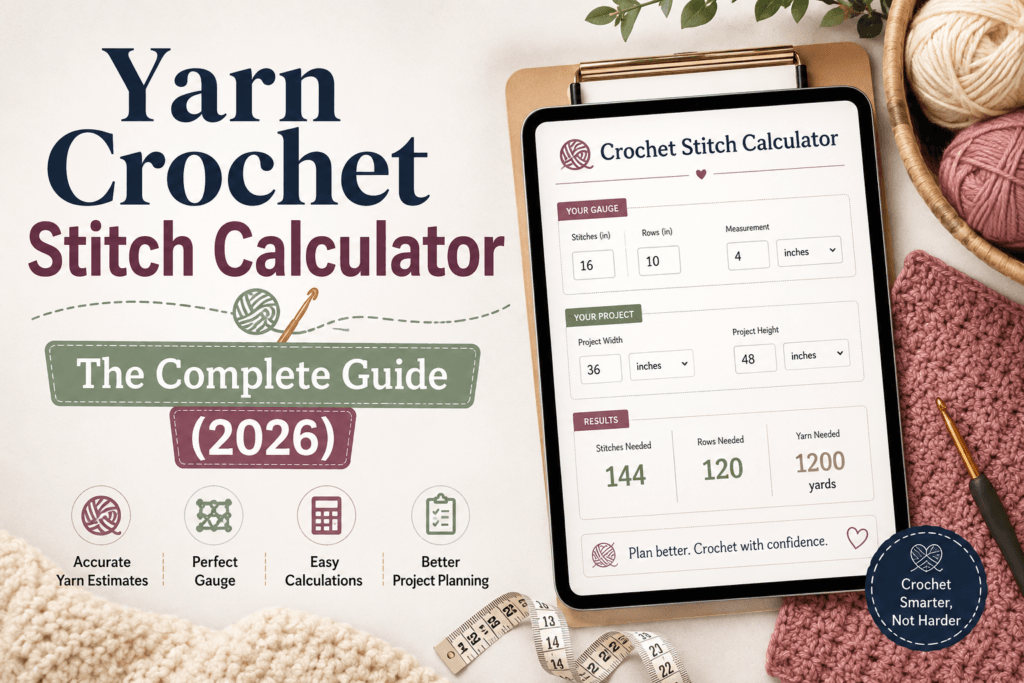
Yarn Crochet Stitch Calculator: The Complete Guide (2026)
Everything you need to stop guessing and start calculating — exact yarn amounts, stitch counts, gauge conversions, and skein math for any crochet project, explained in plain English.
If you have ever bought four skeins of yarn for a blanket and run out at row 40, or bought ten and had six left over, you already know why a crochet stitch calculator exists. Crochet yarn requirements are not guesswork — they are math. This guide breaks that math down step by step, in the same order a working fiber artist or pattern designer would actually use it, so you can plan a project once and buy the right amount of yarn the first time.
- What a crochet stitch calculator actually does
- Gauge: the number every calculation depends on
- The core yarn-yardage formula
- Yarn and stitch charts by project type
- How stitch choice changes yarn usage
- Converting a pattern to a different yarn weight
- Step-by-step: using an online calculator
- Common mistakes that throw off your estimate
- Frequently asked questions
01 / FoundationsWhat a Crochet Stitch Calculator Actually Does
A crochet stitch calculator is a small piece of math wrapped in a form. You give it four pieces of information: your gauge (stitches and rows per inch), the finished width and height you want, and the stitch pattern you plan to use. It gives you back three things: how many stitches to chain to start, how many rows to work, and roughly how many yards or meters of yarn the whole piece will use.
The reason this saves so much trial and error is that crochet, unlike knitting, has enormous variation in how much yarn a single stitch consumes. A single crochet uses noticeably less yarn than a double crochet, which uses less than a treble crochet, and textured stitches like the bobble or popcorn stitch can use 30 to 60 percent more yarn than a plain single crochet worked at the same gauge. A calculator accounts for that instead of relying on a flat “yards per square inch” guess.
Pattern designers calculate yardage using their own tension. If your tension is even slightly different, which is true for almost every crocheter, the yardage printed on a pattern can be off for you by 10 to 25 percent. A calculator that uses your own gauge swatch corrects for that automatically.
02 / The variable that changes everythingGauge: The Number Every Calculation Depends On
Gauge is simply how many stitches and rows fit into one inch (or 10 centimeters) of your fabric, using your hook, your yarn, and your natural tension. It is the single input that every other calculation in this guide is built on, so it is worth doing properly rather than skipping it.
How to measure your gauge swatch correctly
- Crochet a swatch at least 5 inches wide and 5 inches tall using the exact hook and yarn you plan to use for the project.
- Lay it flat without stretching it and let it rest for a few minutes, since crochet fabric relaxes slightly after being worked.
- Measure a 4-inch by 4-inch section in the middle of the swatch, avoiding the curling edges.
- Count the stitches across and the rows down inside that 4-inch square, then divide each number by 4 to get stitches per inch and rows per inch.
Blocking changes gauge, sometimes significantly, especially with fibers like cotton, alpaca, or acrylic blends that relax under heat or moisture. If you plan to block the finished piece, block your swatch the same way before you measure it, or your yardage estimate will run short.
03 / The mathThe Core Yarn-Yardage Formula
Once you have a gauge swatch, the yardage formula is straightforward. This is the same logic a stitch calculator runs behind the scenes.
Swatch area (sq in) = swatch width × swatch height
Step 2 — Weigh the swatch (grams) and note the length of yarn used to make it.
Step 3 — Find yarn used per square inch:
Yards per sq in = yarn length used ÷ swatch area
Step 4 — Apply it to your finished piece:
Total yards needed = yards per sq in × (finished width × finished height)
Step 5 — Convert to skeins:
Skeins needed = total yards ÷ yards per skein (round up)
For example, if your 4-inch by 4-inch swatch used 9 yards of yarn, that is 0.5625 yards per square inch. A 40-inch by 50-inch blanket is 2,000 square inches, so you would need roughly 1,125 yards, or about six skeins of a standard 190-yard worsted weight skein, rounding up and adding a small buffer for the border.
Add 10 to 15 percent to any yardage calculation before buying yarn. Borders, seams, swatches, and the occasional frogged row all eat into your total, and dye lots can vary if you need to buy more later.
04 / Real numbersYarn and Stitch Charts by Project Type
These figures assume a medium-weight (worsted, Category 4) yarn worked in double crochet at a standard gauge of about 12 stitches and 8 rows per 4 inches. Use them as a planning starting point, then confirm with your own gauge swatch.
| Project | Typical Size | Estimated Yardage | Approx. Skeins (190–220 yd) |
|---|---|---|---|
| Baby blanket | 30 in × 40 in | 900–1,200 yd | 5–6 |
| Throw blanket | 50 in × 60 in | 2,200–2,900 yd | 11–15 |
| Queen size blanket | 90 in × 90 in | 4,500–6,500 yd | 15–22* |
| Adult scarf | 8 in × 60 in | 350–550 yd | 2–3 |
| Beanie / hat | Adult, one size | 150–220 yd | 1 |
| Amigurumi (small) | 6–8 in tall | 80–150 yd | 1 (bulky/DK skein) |
| Granny square tote bag | 12 in × 14 in | 500–700 yd | 3–4 |
*Queen size yardage assumes a heavier, chunkier yarn (bulky weight) at 300–400 yards per skein, which is why the skein count doesn’t scale linearly with yardage.
05 / Stitch by stitchHow Stitch Choice Changes Yarn Usage
Two blankets of the exact same finished size can use very different amounts of yarn depending purely on the stitch pattern. This is the detail most beginner yardage estimates miss.
| Stitch | Relative Yarn Usage | Best For |
|---|---|---|
| Single crochet (sc) | Baseline (100%) | Amigurumi, dense fabric, coasters |
| Half double crochet (hdc) | ~115% | Hats, mittens, quick blankets |
| Double crochet (dc) | ~130% | Blankets, garments, scarves |
| Treble crochet (tr) | ~150% | Open, drapey shawls |
| Moss / linen stitch | ~140% | Textured blankets, dishcloths |
| Bobble / popcorn stitch | ~145–160% | Statement blankets, pillow covers |
| Filet mesh (dc + chains) | ~75% | Lightweight shawls, curtains |
If you are substituting a stitch pattern from a written pattern — say, swapping a plain double crochet blanket for a textured moss stitch version — multiply the original yardage estimate by the relative usage percentage above before you buy yarn.
06 / SubstitutionsConverting a Pattern to a Different Yarn Weight
Yarn weight substitution is one of the most common reasons crocheters run short. A pattern written for worsted weight (Category 4) will not use the same yardage if you switch to a bulky (Category 5) or DK (Category 3) yarn, even at the identical finished size, because the gauge changes.
Lace/Fingering (0–1): 7–8+ sts/in · Sport/DK (2–3): 5–6 sts/in · Worsted (4): 4 sts/in · Bulky (5): 3 sts/in · Super Bulky (6): 2 sts/in or fewer.
To convert, calculate the total square inches of the finished piece (this stays constant), then re-run the yardage formula using the new yarn’s gauge and yards-per-skein figure. As a rule of thumb, moving one weight category heavier (for example worsted to bulky) reduces stitch count by roughly 25 to 30 percent but increases yarn thickness enough that total yardage typically drops by 15 to 20 percent, even though the project will use fewer, heavier skeins.
Skip the manual math
Enter your gauge, stitch pattern, and finished measurements, and get an instant stitch count and yardage estimate.
Open the Yarn Crochet Stitch Calculator07 / WalkthroughStep-by-Step: Using an Online Calculator
- Swatch first. Make and measure your gauge swatch as described above — this is the input that makes the output accurate.
- Enter your stitches and rows per inch into the crochet stitch calculator.
- Enter the finished width and height you want for the piece, in inches or centimeters.
- Select your stitch pattern if the tool offers stitch-specific usage rates, so textured stitches are accounted for.
- Review the output: starting chain length, total rows, and estimated yardage.
- Add your buffer. Round the yardage up by 10 to 15 percent before converting to skein count.
- Buy from the same dye lot where possible, especially for large projects like blankets, since dye lots can vary in exact yardage and shade.
08 / Avoid theseCommon Mistakes That Throw Off Your Estimate
- Skipping the gauge swatch. This is the single biggest source of yarn-shortage stories in crochet communities.
- Using the pattern designer’s yardage without adjusting for tension. Tight and loose crocheters can differ by 20 percent or more on identical patterns.
- Forgetting the border or edging. A simple single crochet border around a blanket can add 8 to 12 percent to total yardage.
- Not accounting for color changes. Each color change in tapestry crochet or stripes leaves a tail, and multiple tails across a large project add up to real yardage loss.
- Assuming all “worsted weight” yarns are identical. Fiber content changes density; a cotton worsted and an acrylic worsted with the same weight label can have different yards per skein.
- Rounding down instead of up when converting total yards to number of skeins.
09 / Straight answersFrequently Asked Questions
How do I calculate how much yarn I need for a crochet project?
Multiply the area of your finished piece by the yarn usage rate of your chosen stitch and yarn weight, then divide by the yardage on your yarn label. A stitch calculator does this automatically once you enter your gauge swatch results and finished measurements.
What is crochet gauge and why does it matter for yarn calculations?
Gauge is the number of stitches and rows per inch your specific hook, yarn, and tension produce. Because every yarn estimate is built on gauge, two people following the same pattern can use noticeably different amounts of yarn if their tension differs from the designer’s.
How many skeins of yarn do I need for a queen size crochet blanket?
A queen size blanket, around 90 by 90 inches, generally needs 4,500 to 6,500 yards of worsted weight yarn, which is roughly 15 to 22 standard 200 to 220 yard skeins depending on how dense the stitch pattern is.
Can a stitch calculator convert a pattern to a different yarn weight?
Yes. Enter the original gauge and finished size, then swap in the gauge for your new yarn weight. The calculator recalculates the stitch and row counts so the finished piece stays the same size, which matters when substituting bulky yarn for worsted or DK.
Why did I run out of yarn before finishing my project?
This usually comes down to tension, skipped gauge swatches, or dye lot differences. Tighter tension than the designer’s uses more yarn per stitch, and mixed dye lots can carry slightly less usable yardage than the label states.
Do I need a different calculator for knitting versus crochet?
Yes, in practice. Crochet stitches consume yarn very differently from knit stitches even at a similar gauge, since crochet loops wrap yarn more than once per stitch in many cases, so a calculator built specifically for crochet stitch types will be more accurate than a generic fiber calculator.
Need a different kind of tool?
Browse the full collection of free calculators and converters for crafters, makers, and everyday tasks.
Explore All Free Online Tools