
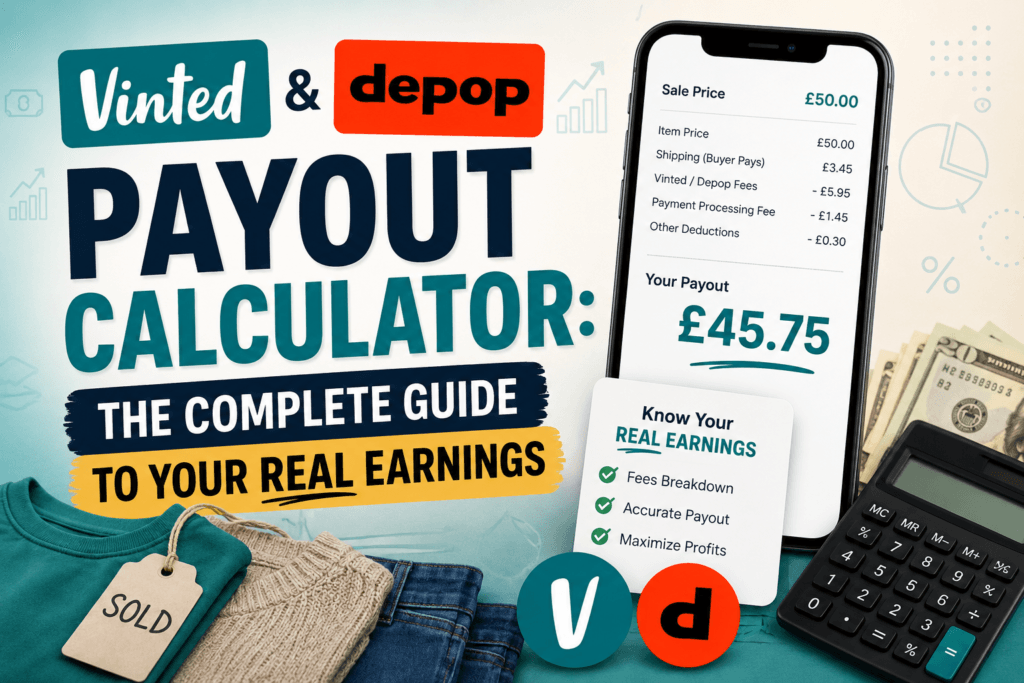
Vinted & Depop Payout Calculator: The Complete Guide to Your Real Earnings
Two sellers list the same $50 hoodie on the same day. One walks away with $50.00. The other walks away with $47.90. Neither one did anything wrong — they just sold on different platforms. Here’s exactly how that math works, and how to calculate it before you list.
Quick Answer
- Vinted (US, 2026): Sellers pay $0 in fees. You keep 100% of your listed price. The buyer separately pays a Buyer Protection fee (about 5% + $0.70) that never touches your payout.
- Depop (US, 2026): Sellers pay $0 selling commission, but Depop still deducts a payment processing fee of 3.3% of the total transaction (item + buyer-paid shipping + tax) plus a flat $0.45 per sale.
- On a $50 item: Vinted pays out $50.00. Depop pays out roughly $47.90 (no shipping) or $47.73 (with $5 shipping). The gap grows the more you sell.
- Use the free Vinted & Depop Payout Calculator to get your exact number for any sale price in seconds, instead of doing this math by hand every time you list an item.
Why Payout Math Catches Sellers Off Guard
Most people who start reselling on Vinted or Depop make the same assumption: whatever price they type into the listing is what lands in their bank account. It’s an easy assumption to make, because neither app puts the full fee breakdown front and center at the moment you hit “list.” It shows up later, quietly, in a payout confirmation screen that most sellers barely glance at.
The problem is that Vinted and Depop don’t calculate your earnings the same way. They don’t even calculate them on the same base amount. One platform takes nothing from the seller and shifts the entire cost to the buyer. The other takes a small processing cut, and calculates it on more than just the item price. If you’re pricing items to hit a specific take-home number, or comparing which platform to list a specific item on, guessing gets expensive fast, especially once you’re moving dozens of items a month instead of one.
This guide breaks down exactly how each platform’s payout math works in 2026, walks through the formulas step by step, and shows you how to check any sale instantly using a free calculator instead of doing it by hand every single time.
What a Vinted/Depop Payout Calculator Actually Does
A payout calculator takes the same inputs a marketplace uses internally — your listing price, any shipping charged to the buyer, and the platform’s current fee structure — and returns the number that actually matters: what lands in your account after everything is deducted. Instead of memorizing formulas or opening a spreadsheet, you type in a price and get your real payout instantly, for either platform, side by side.
This matters most in three situations:
- Pricing an item before you list it. If you need to clear a specific amount after fees (say, to break even on a wholesale lot), you have to price backward from your target payout, not forward from a guess.
- Deciding where to list a specific item. The “better” platform depends on the item’s price point and whether you’d charge for shipping, not a blanket rule.
- Reconciling your actual income. If you’re tracking profit margins across dozens of sales a month, knowing the exact deduction on each one (rather than an estimate) keeps your books accurate.
Skip the manual math
Plug in any sale price and instantly see your Vinted and Depop payouts side by side, including shipping and tax scenarios.
Open the Vinted & Depop Payout Calculator →How Vinted Payouts Work in 2026
Vinted’s entire pitch to sellers is simple: list an item, sell it, keep every dollar. As of 2026, US sellers pay no listing fee, no commission, and no final value fee. Whatever price you set is the price you receive when the item sells, in full.
So how does Vinted make money?
Vinted shifts the cost to the buyer instead of the seller. At checkout, the buyer pays a Buyer Protection fee, typically around 5% of the item price plus a flat $0.70. This fee funds Vinted’s purchase protection (refunds if an item isn’t as described), payment processing, and dispute resolution. It’s added on top of what the buyer pays; it is never subtracted from your payout as a seller.
− (Shipping cost, only if you chose to offer free shipping)
− (Optional promotion cost, only if you paid for Bump or Spotlight)
Two optional costs can reduce what a Vinted seller keeps, and both are choices, not automatic deductions:
- Free shipping offers: If you mark a listing as free shipping, the buyer doesn’t pay for the label, you do, and it comes straight out of your earnings.
- Item Bump or Closet Spotlight: Paid visibility tools (roughly $0.75–$3.00 for a bump, higher for spotlight features) are charged upfront whether or not the item sells. They’re optional marketing spend, not a selling fee.
Because Vinted’s buyer-side fee is percentage-based, buyers on Vinted tend to be more price-sensitive at checkout than you’d expect from the listing price alone. Factor that into how competitively you price, especially against Depop, where the buyer usually sees a cleaner “what you see is what you pay” total.
How Depop Payouts Work in 2026
Depop eliminated its old 10% seller commission for US-based sellers, which used to make it one of the more expensive platforms to sell on. In 2026, US sellers pay $0 in Depop selling fees. What’s left is a single mandatory cost: the payment processing fee, currently 3.3% of the total transaction amount plus a flat $0.45 per sale.
The detail that trips people up: it’s not just the item price
Depop’s processing fee is calculated on the total transaction amount, which means item price, plus any shipping the buyer pays you for, plus applicable sales tax. If you charge $5 for shipping on a $50 item, the fee is calculated on $55, not $50.
Processing Fee = (Total Transaction × 3.3%) + $0.45
Payout = Total Transaction − Processing Fee
If the sale came from a Boosted Listing, subtract an additional 12% of the sale price.
Boosted Listings currently add a 12% fee on top of the standard processing fee for any sale attributed to a boost. Treat boosting as optional ad spend, and factor it into your price if you plan to use it regularly, rather than being surprised when a boosted sale pays out noticeably less than an organic one.
Vinted vs. Depop: Side-by-Side Payout Comparison
Here’s what a $50 sale actually pays out on each platform, with and without buyer-paid shipping, assuming no promotions or boosts were used.
| Scenario | Vinted Payout | Depop Payout | Difference |
|---|---|---|---|
| $50 item, no shipping charged | $50.00 | $47.90 | $2.10 |
| $50 item + $5 shipping | $50.00 | $52.73 | Depop total is higher because the buyer pays shipping separately on top |
| $50 item, seller offers free shipping (seller pays $5 label) | $45.00 | $47.90* | *Depop: buyer pays $0 extra, transaction base stays $50 |
The “difference” isn’t always in Vinted’s favor once shipping enters the picture; the comparison depends entirely on who charges what for shipping and whether you’re comparing gross sale price or net payout. This is exactly why a calculator that lets you toggle shipping and price is more useful than a single flat percentage to memorize.
How to Calculate Your Payout Manually (Formulas)
If you want to sanity-check a number or you’re building your own spreadsheet, here’s the exact order of operations for each platform.
Vinted, step by step
- Start with your listed item price. This is your payout base.
- Subtract shipping only if you selected free shipping (seller-paid).
- Subtract any Item Bump or Closet Spotlight cost you paid upfront (these are separate from the sale itself).
- The remaining number is your payout. No percentage math required.
Depop, step by step
- Add up the total transaction: item price + shipping the buyer paid + any tax collected.
- Multiply that total by 3.3% to get the percentage portion of the fee.
- Add $0.45 to that number for the fixed portion of the fee.
- If the sale came through a Boosted Listing, also subtract 12% of the item’s sale price.
- Subtract the total fee from the total transaction amount. That’s your payout.
Doing this by hand for one sale is easy. Doing it for 40 sales a month, across two platforms, with different shipping charged on each, is where sellers either give up on tracking it accurately or lose an hour a week to spreadsheet math. That’s the exact gap a dedicated calculator closes.
Step-by-Step: Using the Free Vinted & Depop Payout Calculator
The Vinted & Depop Payout Calculator is built to remove every manual step above. Here’s how to use it in under a minute:
- Open the calculator and select the platform, Vinted or Depop, or view both at once for a direct comparison.
- Enter your item’s sale price. This is the number you’re planning to list at, or the number a buyer already agreed to.
- Add shipping details if the buyer is paying for shipping, since this changes Depop’s fee base and doesn’t change Vinted’s.
- Toggle any promotions you’re using, such as a Depop Boosted Listing or a Vinted Bump, so the tool can subtract those costs too.
- Read your payout instantly, along with a breakdown of exactly where each dollar of fees went, so you’re not just seeing a final number, you’re seeing why.
Because it recalculates live as you change the price, it’s also useful for reverse-engineering pricing: if you need to clear exactly $40 after fees on Depop, you can adjust the listed price up or down until the payout figure matches your target, instead of guessing and checking your payout after the sale already happened.
Three Worked Examples, Start to Finish
Example 1 — A $15 t-shirt, no shipping charged
Example 2 — A $50 hoodie + $5 buyer-paid shipping
Example 3 — A $150 designer coat, no shipping charged, Depop Boosted Listing used
Common Payout Mistakes Sellers Make
- Assuming Depop is “free” like Vinted. Depop removed its commission, not its processing fee. There’s still a mandatory cost on every sale.
- Forgetting shipping changes the Depop fee base. Sellers often calculate Depop fees on the item price alone and are surprised the deduction is larger than expected once shipping is added in.
- Not accounting for optional promotion costs as sunk costs. A Vinted Bump or Depop Boost is charged whether or not the item sells; it should be budgeted as marketing spend, not folded into your per-sale fee assumptions.
- Comparing gross sale price instead of net payout across platforms. A “$55 Depop sale” and a “$50 Vinted sale” aren’t directly comparable numbers unless you normalize for what the buyer paid versus what you kept.
- Not repricing after a platform fee change. Both platforms have adjusted fee structures more than once in recent years. Pricing strategies built around an outdated fee model quietly erode margin over time.
How to Maximize What You Actually Keep
Bundle to reduce Depop’s flat fee
Depop’s $0.45 flat fee applies per transaction, not per item. Selling three items in one bundled transaction means paying that flat fee once instead of three times. Encouraging bundle offers (“15% off two or more items”) can meaningfully reduce your effective fee rate on lower-priced inventory.
Price shipping deliberately, not as an afterthought
On Depop, charging for shipping increases your total transaction, which increases the dollar amount of the fee, even though the percentage stays the same. On Vinted, shipping charged to the buyer never touches your payout at all. Decide whether you’re pricing to compete on total buyer cost or on your own net payout, and be consistent across your listings.
Use boosts and bumps selectively
Reserve paid visibility tools for items that already have engagement (likes, saves, questions) but haven’t converted, rather than boosting cold listings. A boost or bump on an item nobody wants just shows more people an item nobody wants; fixing photos, pricing, or descriptions first is usually the higher-leverage move.
Check your numbers before you list, not after you’re paid
The fastest way to protect margin across dozens of listings is to check your expected payout before you commit to a price, using the Vinted & Depop Payout Calculator, rather than reverse-engineering it from a payout notification after the sale has already closed.
Which Platform Should You List On?
| If you care most about… | Better fit | Why |
|---|---|---|
| Keeping 100% of your listed price | Vinted | Zero seller-side fees of any kind |
| A cleaner, single all-in buyer price | Depop | Buyer generally sees fewer add-on fees at checkout than Vinted’s percentage-based Buyer Protection fee |
| Selling frequent bundles | Depop | The $0.45 flat fee applies once per bundled transaction, not per item |
| Low-priced items under $15 | Vinted | Depop’s flat $0.45 fee eats a larger share of small sales |
| Maximum buyer reach in your category | Depends on niche | List on both and compare using the internal links below and your own sales data |
Most experienced resellers don’t pick one platform exclusively; they cross-list the same inventory across Vinted, Depop, and other marketplaces, and let each platform’s audience and fee structure compete for the sale. What matters is knowing, sale by sale, what you’re actually netting on each one, so you can double down on whichever channel is quietly performing better for your specific inventory.
Frequently Asked Questions
Does Vinted take a cut of your sale in the US?
No. As of 2026, Vinted charges US sellers zero commission, zero listing fees, and zero final value fees. You receive 100% of the price you list, unless you choose to offer free shipping, in which case the shipping cost is subtracted from your earnings. Vinted covers its own costs by charging the buyer a separate Buyer Protection fee at checkout, which never reduces your payout.
How much does Depop take from a sale in the US?
US Depop sellers pay no selling commission, but Depop still charges a payment processing fee of 3.3% of the total transaction amount plus a flat $0.45 per sale. That 3.3% is calculated on the item price plus any buyer-paid shipping and tax, not the item price alone.
Is Vinted or Depop cheaper for sellers?
Vinted is cheaper on paper because sellers keep 100% of the item price with no seller-side fee at all. Depop still deducts a small payment processing fee of roughly 3.3% plus $0.45 per sale. On a $50 item with no shipping charged, Vinted pays out $50.00 while Depop pays out around $47.90, a difference of about $2.10 per sale that compounds across your total sales volume.
Does the Depop processing fee apply to shipping too?
Yes. Depop’s 3.3% plus $0.45 processing fee applies to the total transaction amount, which includes the item price, any shipping the buyer pays, and applicable tax, not just the listed item price.
What is a Buyer Protection fee on Vinted?
It’s a checkout charge Vinted adds on top of the item price and shipping, typically around 5% of the item price plus a flat $0.70. It’s paid entirely by the buyer and does not reduce what the seller earns from the sale.
Should I offer free shipping on Vinted or Depop?
Free shipping can improve conversion because buyers see one clean total, but on both platforms it typically means the seller absorbs the shipping cost directly out of their payout. Price the shipping cost into your listing price ahead of time rather than treating it as a giveaway on top of your target margin.
Do fee structures change often on these platforms?
Yes, both Vinted and Depop have adjusted their fee models more than once in recent years, most notably Depop removing its old 10% seller commission for US-based accounts. It’s worth periodically re-checking the current rates, or using an up-to-date calculator, rather than relying on numbers you learned when you first joined a platform.
Can I calculate my payout before I even list an item?
Yes. Enter your planned sale price and shipping charge into the Vinted & Depop Payout Calculator before publishing your listing to see your exact expected payout on either platform, which is especially useful when you need to hit a specific take-home number on resale inventory.
Check your exact payout right now
No sign-up, no spreadsheet. Enter your sale price and shipping details and see your real Vinted and Depop earnings side by side.
Try the Vinted & Depop Payout Calculator →More Free Tools for Resellers
The payout calculator is one of several free tools built for people who buy, sell, and flip for a living or a side hustle. If you’re managing pricing, fees, and profit across multiple marketplaces, it’s worth browsing the full collection of free online tools to see what else can save you time on the numbers side of reselling.